

Electromagnetic Compatibility Testing
EMC testing verifies that electronic and electrical equipment does not generate electromagnetic interference beyond applicable limits and can continue to operate properly in its intended electromagnetic environment. Testing includes EMI emissions testing and EMS immunity testing to help products meet applicable regulatory and market requirements.
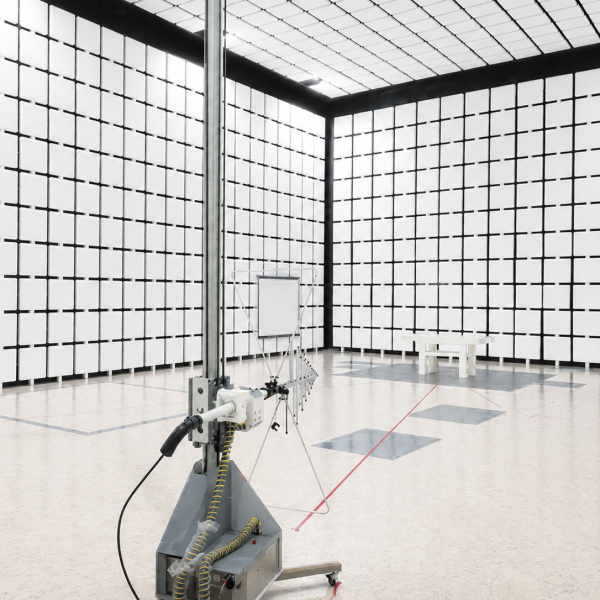
Electronic products may generate electromagnetic interference through the air, power cables, or signal lines during operation. At the same time, products may also be exposed to external disturbances such as electrostatic discharge, radio-frequency fields, power switching, lightning surges, and power-grid abnormalities.
Through EMI and EMS testing, product emissions can be verified against applicable limits while confirming that equipment can maintain its intended functionality and safety under various electromagnetic environments.
Evaluates whether electromagnetic noise generated during product operation exceeds applicable limits and may interfere with other electronic or wireless equipment.
Simulates external electromagnetic disturbances that a product may encounter in real-world environments to verify that the equipment does not crash, malfunction, become damaged, or lose its intended functionality.
Measures electromagnetic energy radiated through the air during product operation to verify compliance with applicable radiated-emission limits.
Measures electromagnetic noise conducted through power or signal lines to evaluate interference with the power network and connected equipment.
Simulates electrostatic discharge generated when a person contacts a product to verify that the equipment does not crash, malfunction, or become damaged.
Simulates exposure to strong radio-frequency electromagnetic fields to verify that the equipment can continue operating properly.
Simulates high-frequency, high-voltage transient pulse bursts generated on power and signal lines by events such as motor startup, relay operation, or switching.
Simulates high-energy surges caused by lightning or large power-switching events to verify the effectiveness of internal overvoltage protection components.
Simulates external RF electromagnetic fields coupling onto power or signal lines and entering the product as conducted disturbances.
Evaluates equipment immunity when operating near strong 50 Hz or 60 Hz magnetic fields generated by power distribution lines, transformers, and related equipment.
Simulates sudden voltage drops, brief power interruptions, and voltage fluctuations caused by public power-grid faults, major load changes, or power outages to verify that the product can maintain intended operation or recover safely.
EMC testing based on the EN 301 489 series and applicable product power, communication, and network ports.
Emissions testing for power and PLC ports in accordance with EN 50561-1 / EN 50561-3.
Evaluation of electric fields, magnetic fields, and magnetic flux density from 0 Hz to 10 MHz in accordance with Annex P of IEC 62477-1.
IEC 61000-4-34.
EN IEC 61000-4-29.
Applicable requirements can be determined based on ITU-T K.21, CE Official Journal harmonized standards, and related conditions or limitations.
Pre-Test
Pre-Compliance Testing
Testing performed during early product development or design modification stages to identify emissions and immunity issues in advance, reducing the risk of later compliance failures and the cost of design changes.
Compliance
Compliance Testing
Formal testing of final product samples in accordance with applicable standards to verify compliance with relevant regulatory and technical requirements.
Support
Certification and Market Access Support
After testing is completed, BTL provides support for subsequent market certification and application processes, including CE, FCC, and NCC.
Computers, servers, tablets, display equipment, and related peripherals.
Smartphones, routers, base stations, communication modules, and other wireless products.
In-vehicle equipment and related electronic components.
EMC testing based on applicable medical device standards.
Industrial computers, control equipment, power electronics, and other industrial products.