

Internet of Things Testing
IoT testing evaluates the wireless connectivity quality of smart home and IoT devices under different use environments. Through throughput, distance-related signal degradation, roaming, wireless coexistence, environmental interference, building-material attenuation, and software control testing, BTL helps quantify product connectivity performance and user experience.
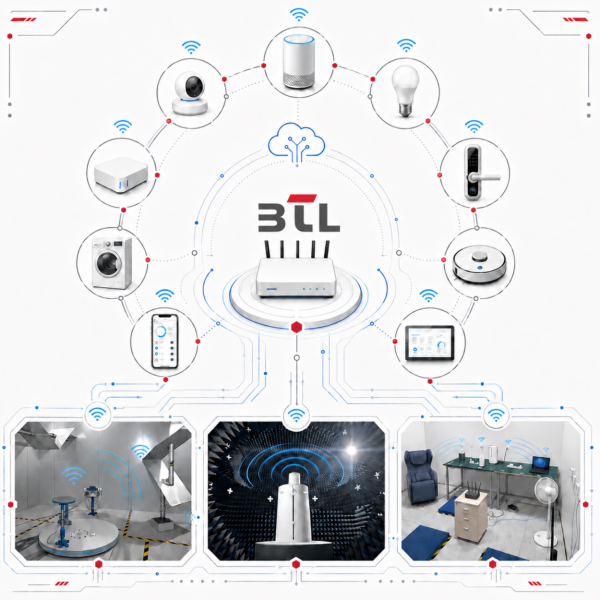
Testing is based on radio-wave propagation loss and environmental models to simulate product connectivity under different distances, spaces, and interference conditions.
Test results are presented using both qualitative and quantitative methods to help evaluate how wireless connectivity quality affects real-world user experience.
Evaluates data transmission performance as distance increases.
Evaluates connection quality when a device switches between different access points.
Evaluates interference between different wireless functions within the same device.
Evaluates the impact of surrounding wireless signals on product connectivity performance.
Evaluates signal attenuation caused by walls, doors, and different building materials.
Evaluates the impact of applications or control interfaces on connectivity performance.
Technical specification for evaluating the wireless connectivity performance of smart home devices.
Evaluation of Wi-Fi connectivity performance for smart home products.
Wireless connectivity and antenna testing facilities.
Testing space for smart home products and environmental simulation.
Access points, routers, and network switches.
Refrigerators, washing machines, range hoods, rice cookers, air conditioners, and air purifiers.
Smart locks, robotic vacuum cleaners, smart plugs, smart speakers, and lighting devices.
Smart toilets, bathtubs, faucets, bathroom mirrors, televisions, cameras, and projection equipment.