

The Delegated Regulation (EU) 2019/320 activates Article 3.3(g) of the Radio Equipment Directive (RED) 2014/53/EU. It requires smartphone vendors to ensure that the smartphone must support the function of accessing emergency services in order to sell devices on the European market, from March 17, 2022.
The speed of emergency services is a key factor in saving lives. How to do it quickly? Let's learn more about the emergency call E112.
The purpose of the emergency call E112 is that when the smartphone user encounters an emergency, the smartphone's advanced mobile positioning (AML) can automatically provide the emergency service with accurate caller's location information through the smartphone's ID, GNSS or WLAN, which will enable emergency personnel to be able to get to the accident scene faster.
Regulatory basis for E112 - Directive 2014/53/EU(RED)
Everyone knows that radio equipment sold to the EU market must meet the requirements of the RED Directive 2014/53/EU, that is, the entire chapter of Article 3, including the following:
Article 3.1(a): Safety, Health
Article 3.1(b): EMC
Article 3.2: RF
Article 3.3(a....i)
However, there is no corresponding specific regulation for the relevant requirements listed in Article 3.3(a....i), so Article 3.3 has not made the requirements before. But the regulation (EU) 2019/320 that will be required to be implemented from March 17, 2022 is the requirement of Article 3.3(g).
E112 Test Sections:
Section 5: GNSS/Galileo compliance
Section 6: AML compliance
Section 7: WLAN location compliance
CE certification requirements:
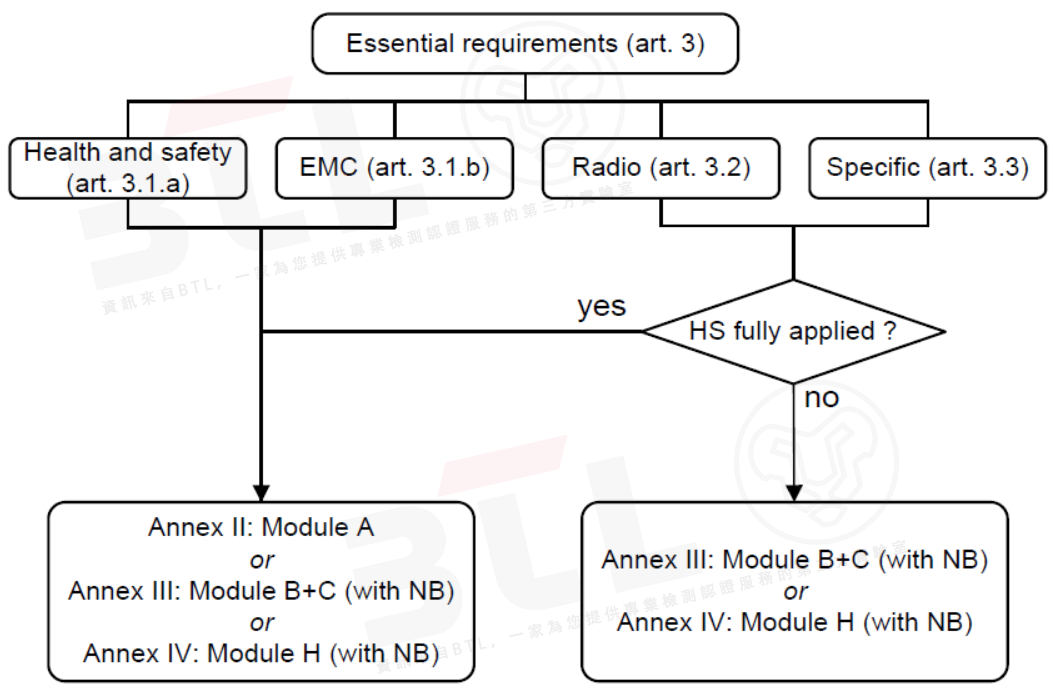
Through the above picture, CE certification can be very clear:
● For Health, Safety and EMC, you can choose Module A (in popular terms: self-declaration SDOC), or you can choose to issue a certificate through NB.
● Same as above when all standards in Article 3.2: RF and Article 3.3(a....i) are fully harmonized.
● NB must be selected for certification when one or more standards in Article 3.2: RF and Article 3.3(a....i) is/are not harmonized.
At this time, I believe everyone will be thinking: what about the E112 standard? Are all fully harmonized?
Due to the lack of a unified EU standard for E112, equipment suppliers and manufacturers cannot ship through Module A (self-declared SDOC). That is to say, there must be a certification body NB to participate in the equipment certification audit.
Smartphone to apply for NB certification:
A. The new original project can be submitted to NB for review together with the RED certificate.
B. For certified product, Article 3.3(g) needs to be added.
1. Products that have not been sold in the EU market yet.
2. Products that have been sold in the EU market but still need to be imported again after March 17, 2022.
Relevant information

CRA Implementation Enters a Critical Phase
In August 2026, preparations for the implementation of the EU Cyber Resilience Act (CRA) entered a critical stage. With the reporting obligations set to take effect on September 11, 2026, drawing near, the European Commission and the European Union Agency for Cybersecurity (ENISA) have been intensively issuing implementation guidance and materials related to the single reporting platform.
Canada's ISED Officially Releases RSS-310 Issue 6: Major Updates to Radio Frequency Equipment Requirements
Innovation, Science and Economic Development Canada (ISED) has formally issued RSS-310, Issue 6, “Licence-Exempt Radio Apparatus: Category II Equipment,” replacing Issue 5, which has been in effect since 2020