

Indonesia SDPPI will strengthen the enforcement of certification labeling requirements and fines
Indonesia's General Information Administration held a meeting on the socialization of administrative penalties on February 27. The aim is to strengthen the enforcement of certification and labelling requirements for importers/distributors of devices. The reason is that SDPPI's market monitoring found that most manufacturers/importers/distributors did not attach labels to the unit/user manual and packaging as required by the new regulations. The relevant administrative punishment mechanism is hereby introduced to strictly control. Subsequently, the SDPPI Monitoring Center will monitor all devices and conduct strict checks on the certificates/labels and compliance of the devices, and if any non-compliance is found, fines will be imposed in accordance with the new penalty mechanism.
The SDPPI monitoring center will be subject to administrative penalties for non-compliance in the following three aspects:
IPFR (Radio Band License)
1. Use of SFR without obtaining a business license and/or Indonesian official approval
2.IPFR holders use telecommunications equipment that has not yet been certified
3. The IPFR holder has not fulfilled the obligations required in the document
4. IPFR holders use the names of radio channels that do not meet their requirements
5.IPFR holders engage in SFR cooperation without approval
6. Cooperation between IPFR holders does not meet the objectives and/or principles set forth in statutory regulations.
ISR (Radio License)
1. The use of SFRE1 without obtaining an operating license and/or official Indonesian approval
2. The ISR holder uses a radio frequency that is not in accordance with its intended purpose and/or does not comply with the technical parameters specified in the ISR
3. The user who does not carry out regular annual registration of its ground station space ISR holder.
APT (Telecommunications equipment) 1. Manufactured, assembled and/or imported telecommunications equipment that is traded or used within the territory of the Republic of Indonesia does not have a telecommunications equipment certificate
2. Manufactured, assembled and/or imported telecommunications equipment that is traded or used within the territory of the Republic of Indonesia does not meet the requirements of the telecommunications equipment Certificate
3.Dealing in telecommunications equipment and/or communication equipment Telecommunications equipment that has not obtained a backup certificate for telecommunications equipment.
4. Dealing in telecommunications equipment and/or telecommunications equipment that has obtained a telecommunications equipment certificate but does not meet technical standards.
5. Use of telecommunications equipment without a certificate for telecommunications equipment and/or communication equipment.
6. Use telecommunications equipment that has obtained a certificate of conformity for telecommunications equipment or communication equipment but does not meet technical standards.
If the holder violates the above relevant provisions, the Indonesian authorities will issue a letter to make administrative penalties, and require the holder to settle the fine within 3 months; If the payer fails to pay the full amount of the fine within 3 months from the date of the issuance of the third administrative penalty overdue bill, the PNBP administrator or the PNBP administrator shall issue the PNBP billing opinion to the agency authorized to manage the national receivables, which shall be processed in accordance with the statutory provisions in the field of national receivables; If the payer fails to meet the obligation to pay the administrative penalty bill, the official has the right to suspend its license to operate in Indonesia according to law.
Based on Indonesia's increasingly stringent requirements for labels, to avoid everyone stepping on the pit, Xiaobian will give you the knowledge of Indonesian labels.
After obtaining the SDPPI certification, the applicant is required to attach the Indonesian SDPPI approval label, QR code and warning sign on the product. Here are the requirements:
1. The SDPPI label must be affixed to the product body. Only when the product body is too small to be affixed to the label, the SDPPI label can be affixed to the packaging, box, or cardboard of the product. The label contains the SDPPI certificate number and PLG ID. The following is an example of an SDPPI label:
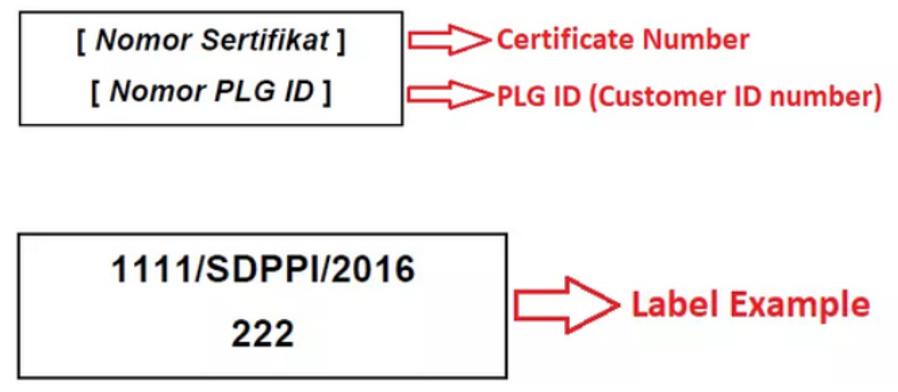
2. Qr code and warning mark need to be affixed to the packaging/box/cardboard of the product, if the device is classified as SRD product (e.g. Bluetooth, low power device, RFID, NFC, etc.), warning mark can be exempted. The following is the format of the warning sign, while for the QR CODE (QR CODE), the picture can be found on the certificate or downloaded from the applicant's SDPPI user account.
3. The pictures of the product meeting the label requirements (including the label, QR code and warning sign) must be uploaded to the SDPPI system within 30 working days after the certificate is issued. PS: BTL can provide tag upload service!!!
As one of the SDPPI overseas accredited laboratories in Indonesia, BTL can perform the wireless product test report (RF/EMC) within the qualification accreditation, among which BTL (GuangDong) can also perform the test report of three types of products such as mobile phones, tablets and handheld terminals, which can be used for SDPPI transfer application after completion. If you have other certification questions, please contact BTL.
Relevant information

CRA Implementation Enters a Critical Phase
In August 2026, preparations for the implementation of the EU Cyber Resilience Act (CRA) entered a critical stage. With the reporting obligations set to take effect on September 11, 2026, drawing near, the European Commission and the European Union Agency for Cybersecurity (ENISA) have been intensively issuing implementation guidance and materials related to the single reporting platform.
Canada's ISED Officially Releases RSS-310 Issue 6: Major Updates to Radio Frequency Equipment Requirements
Innovation, Science and Economic Development Canada (ISED) has formally issued RSS-310, Issue 6, “Licence-Exempt Radio Apparatus: Category II Equipment,” replacing Issue 5, which has been in effect since 2020