

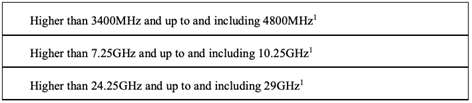
The Japanese Ministry of Internal Affairs and Communications (MIC) regulates the frequency bands used by UWB wireless systems.
Let's learn about UWB.
Ultra-wideband technology (also known as UWB or Ultra-wideband) is a short-range digital wireless communication technology.
It is customized according to the IEEE 802.15.4z standard. Compared with narrowband radio, this technology specifies a wider spectrum.
UWB is a carrier-free communication technology with the advantages of strong anti-interference, high-speed transmission, high security and low power consumption.
The transmission rate is as high as 480Mbps, which is 159 times that of Bluetooth and 18.5 times that of Wi-Fi standards. It is very suitable for large-scale transmission. Because UWB has a higher frequency and a shorter wavelength, it can achieve high-precision positioning.
UWB precise indoor positioning system can be used to locate the location of personnel, materials, equipment, and vehicles to facilitate various applications.
BTL now has the UWB standard testing capabilities. Manufacturers are welcome to contact the BTL team. BTL will share with you the most professional and comprehensive certification information.
Relevant information

CRA Implementation Enters a Critical Phase
In August 2026, preparations for the implementation of the EU Cyber Resilience Act (CRA) entered a critical stage. With the reporting obligations set to take effect on September 11, 2026, drawing near, the European Commission and the European Union Agency for Cybersecurity (ENISA) have been intensively issuing implementation guidance and materials related to the single reporting platform.
Canada's ISED Officially Releases RSS-310 Issue 6: Major Updates to Radio Frequency Equipment Requirements
Innovation, Science and Economic Development Canada (ISED) has formally issued RSS-310, Issue 6, “Licence-Exempt Radio Apparatus: Category II Equipment,” replacing Issue 5, which has been in effect since 2020