

The Bureau of Indian Standards (BIS) issued implementation guidelines for Amendment 1 to IS 16333 (Part 3):2022 on May 30, 2025, introducing new requirements for digital user manuals to further streamline product compliance procedures.
As the world’s most populous and linguistically diverse country, India has over 121 languages spoken by more than 10,000 people each, with 29 languages exceeding one million speakers. Currently, Hindi serves as India’s primary official language, English as the secondary official language, and the Constitution recognizes 22 scheduled regional languages.
To ensure local users can conveniently operate electronic devices in this complex linguistic landscape, BIS introduced IS 16333 (Part 3), which specifically governs mobile devices’ support for Indian languages, including Native language input support and font display, to eliminate language barriers. The standard mandates that mobile phones must support display for all 22 official Indian languages and English, as well as text input for English, Hindi, and at least one additional official Indian language.
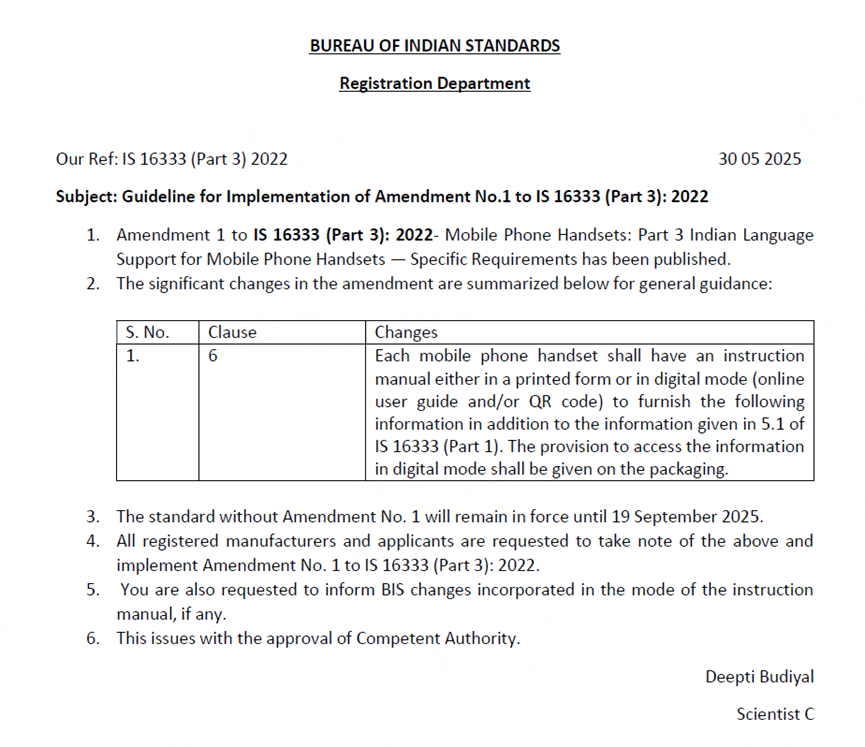
The recently released Amendment 1 to IS 16333 (Part 3):2022 modifies Chapter 6 on product labeling. The revised requirements state: Each mobile device must list the supported Indian languages for text input, the BIS certification mark, and brand and model information—either in a printed or digital mode (e.g., online manual/QR code). If a digital manual is used, packaging must include instructions for accessing it.
The original standard did not address digital manual mode.
The standard without Amendment No. 1 will remain in force until 19 September 2025, after which all mobile phones sold in India must comply with the amendment. Manufacturers must promptly adapt packaging and user manuals to meet BIS requirements.
Below is the official circus of the Implementation Guidelines for Amendment 1 to IS 16333 (Part 3):2022 for reference.
BTL advises manufacturers to closely monitor regulatory updates and align product designs with the new requirements to ensure smooth certification and lawful sales in the Indian market.
For more details on certification guidelines, please contact BTL’s International or Sales Department.
Relevant information

CRA Implementation Enters a Critical Phase
In August 2026, preparations for the implementation of the EU Cyber Resilience Act (CRA) entered a critical stage. With the reporting obligations set to take effect on September 11, 2026, drawing near, the European Commission and the European Union Agency for Cybersecurity (ENISA) have been intensively issuing implementation guidance and materials related to the single reporting platform.
Canada's ISED Officially Releases RSS-310 Issue 6: Major Updates to Radio Frequency Equipment Requirements
Innovation, Science and Economic Development Canada (ISED) has formally issued RSS-310, Issue 6, “Licence-Exempt Radio Apparatus: Category II Equipment,” replacing Issue 5, which has been in effect since 2020