

India Promotes Migration of Electronic Product Safety Standards to IS/IEC 62368-1:2023
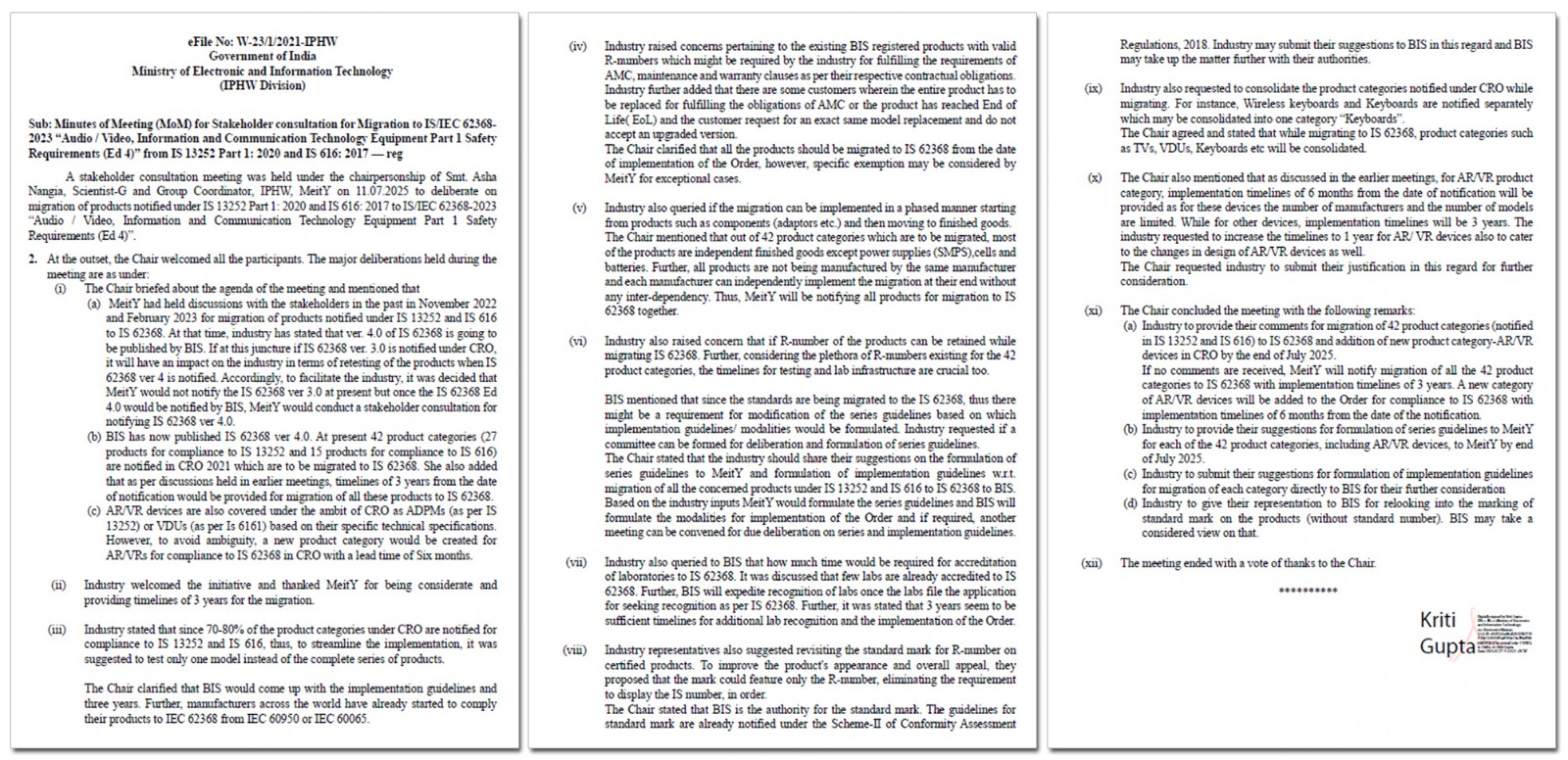
The Ministry of Electronics and Information Technology (MeitY) recently chaired a critical stakeholder consultation meeting, with the core agenda of transitioning relevant electronic products sold in the Indian market from the current safety standards IS 13252 (Part 1):2020 and IS 616:2017 to the new standard IS/IEC 62368-1:2023 (Fourth Edition).
The meeting reviewed the decision-making process for the standard transition. As early as 2022, the industry had discussed adopting the IS 62368 standard. To avoid imposing unnecessary burdens on enterprises due to a short-term upgrade from the third to the fourth edition, MeitY decided at that time to wait until the fourth edition was officially released before proceeding. Now that the fourth edition has been published, the transition work is officially on the agenda. According to the meeting, once the new standard takes effect, enterprises will be granted a transition period of up to three years from the date of the official notification.
Since the IS/IEC 62368-1:2023 standard covers as many as 42 product categories, its impact is extensive. Product upgrades, testing cycles, and associated costs have become key concerns for manufacturers. The meeting addressed several specific issues:
1. Simplified Testing Process: In response to industry suggestions for simplifying the process by testing only representative models within the same product series, the meeting chair noted that the Bureau of Indian Standards (BIS) will develop specific implementation guidelines and provide a three-year transition period. It was also mentioned that global manufacturers have already begun transitioning from the old standards to IEC 62368.
2.Validity of Existing Registration Numbers: Regarding how to maintain the validity of BIS registration numbers (R-numbers) for already registered products—such as replacing older models to fulfill warranty contracts—the chair responded that, in principle, all products must comply with the new standard after its implementation. However, MeitY would consider exemptions for certain special cases.
3. Phased Implementation Suggestion: Some enterprises suggested that the new standard could be implemented in phases, starting with components (e.g., adapters). The chair responded that the vast majority of products under the new standard are finished products, with only a few exceptions like switch-mode power supplies, cells, and batteries. Since the migration efforts of various enterprises are not interdependent, MeitY plans to notify all relevant products to transition to the new standard simultaneously.
4. Retention of Registration Numbers and Testing Capacity: Regarding whether existing product registration numbers can be retained during the transition and the capacity of testing laboratories, BIS indicated that transitioning to the new standard may require revising the existing "Series Model Guidelines" and developing specific "Implementation Guidelines" based on them. The meeting clarified that enterprises should submit suggestions on the "Series Model Guidelines" to MeitY and suggestions on the "Implementation Guidelines" to BIS. MeitY will be responsible for formulating the "Series Model Guidelines," while BIS will handle the "Implementation Mode," with further meetings scheduled if necessary.
5. Product Category Consolidation: The industry's suggestion to consolidate certain product categories during the transition period (e.g., merging "wireless keyboards" and "keyboards") received a positive response from the chair. The chair agreed to consolidate categories such as televisions, video display units, and keyboards.
6. Special Arrangements for AR/VR Devices: AR/VR products are currently classified as ADPM (under IS 13252) or VDU (under IS 616). To eliminate ambiguity in the current classification, the meeting decided to create an independent product category for them, requiring compliance with IS 62368. Given the limited number of manufacturers and models for such products, a six-month transition period was initially proposed. However, enterprises requested an extension to one year to accommodate design changes. The chair asked the industry to submit detailed justifications for MeitY's further consideration.
The meeting made it clear that the implementation of the IS/IEC 62368-1:2023 standard is inevitable. While the general direction of a three-year transition period has been set, specific implementation details—such as testing schemes for product series, special exemption conditions, retention of registration numbers, product category consolidation, and transition periods for specific products—will be finalized by MeitY and BIS after incorporating industry feedback. BTL will continue to monitor subsequent developments.
The meeting minutes are provided for reference.
BTL advises manufacturers to closely monitor regulatory updates and align product designs with the new requirements to ensure smooth certification and lawful sales in the Indian market. For more details on certification guidelines, please contact BTL’s International or Sales Department.
Relevant information

CRA Implementation Enters a Critical Phase
In August 2026, preparations for the implementation of the EU Cyber Resilience Act (CRA) entered a critical stage. With the reporting obligations set to take effect on September 11, 2026, drawing near, the European Commission and the European Union Agency for Cybersecurity (ENISA) have been intensively issuing implementation guidance and materials related to the single reporting platform.
Canada's ISED Officially Releases RSS-310 Issue 6: Major Updates to Radio Frequency Equipment Requirements
Innovation, Science and Economic Development Canada (ISED) has formally issued RSS-310, Issue 6, “Licence-Exempt Radio Apparatus: Category II Equipment,” replacing Issue 5, which has been in effect since 2020