

Recently, the Malaysian Ministry of Investment, Trade and Industry (MITI) and the national standards and certification body SIRIM jointly released the "Battery Energy Storage System Certification and Labelling Guidelines" (BESS). The aim is to improve the safety, market compliance and consumer confidence of battery products by establishing a unified certification and labelling system, in order to support the country's rapidly developing energy storage and electric mobility industry.
According to the guidelines, this mandatory certification applies to various types of battery products sold in the Malaysian market, primarily including:
•Lithium-ion batteries
•Lead-acid batteries
•Ni-based batteries (such as nickel-cadmium and nickel-metal hydride batteries)
•Other emerging battery technologies
The guide provides manufacturers with two certification options for core products:
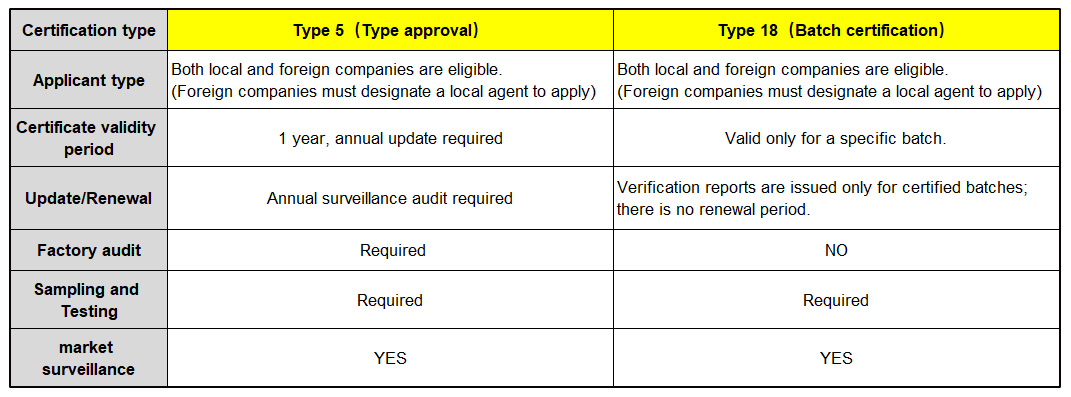
The new regulations mark a further strengthening of the regulation of battery products in Malaysia, requiring all related products to obtain the corresponding certification and affix the SIRIM certification label before being sold.
BTL's recommendations to relevant manufacturers:
A. Primary task: Determine the product scope and certification type.
1. Self-check products: Immediately confirm whether the battery products you manufacture or plan to export fall within the chemical types covered by the guidelines.
2. Strategic Certification Path Selection:
a. Type 5 (Type Approval): This is the preferred option if you plan to enter the Malaysian market in a long-term, large-volume manner. Although it requires factory audits and annual maintenance, the certificate is widely applicable and suitable for branded products.
b. Type 18 (Lot Approval): This path is faster and more economical if you are testing the market, placing small orders, or undertaking a one-off project. No factory audit is required.
B. Prepare key aspects in advance
1. Select a local agent: All foreign applicants must appoint a local Malaysian company as the certification application entity, so choosing a reliable and authorized local partner is crucial.
2. Preparation of Technical Documents and Tests: Prepare product technical specifications, circuit diagrams, safety design specifications, and other relevant documents in advance.
Whether it's the "if applicable" testing of Type 5 or the mandatory testing of Type 18, the testing standards and items must be confirmed with SIRIM or an accredited laboratory beforehand.
3. Preparing for Factory Audits (Type 5 Only): If you choose Type 5, you need to ensure that the quality management system of the production plant meets the requirements and prepare for the SIRIM audit.
C. Focus on Labeling and Market Surveillance
1. Certification Label: After a product obtains certification, it must bear the SIRIM certification label; this is a necessary condition for market circulation.
2. Continuous Compliance: Even after obtaining certification, products will still be subject to market surveillance and random checks.
It is necessary to ensure that mass-produced products remain consistent with certified samples to maintain stable quality.
BTL has years of experience in international certification and a long-term, stable partnership with Malaysia, enabling companies to obtain certification quickly and easily.
Meanwhile, to meet the increasingly urgent needs of the new energy battery and industrial automation industries, BTL Dongguan put its second 10-meter semi-anechoic chamber into operation this year.
This chamber can test high-power, large-size products (such as electric vehicle charging piles, inverters, and energy storage systems). The chamber meets the following parameters:
| High-power power support. | Large Testing Space and Load Capacity |
• AC Power: 450V, 228A, 150KW • DC Power: 1500V, 200A, 200KW • Filtering Capacity: 690VAC/500A; 1500VDC/200A; 480VDC/500A; | • Anechoic Chamber Load Capacity: 5T • Turntable Diameter: 5m • Door Dimensions: 3.6m (W) * 4.2m (H) |
BTL will continue to monitor the latest legal developments in the Malaysian market. For further information or assistance, please contact BTL's Business Department or International Department.
Relevant information
CRA Implementation Enters a Critical Phase
In August 2026, preparations for the implementation of the EU Cyber Resilience Act (CRA) entered a critical stage. With the reporting obligations set to take effect on September 11, 2026, drawing near, the European Commission and the European Union Agency for Cybersecurity (ENISA) have been intensively issuing implementation guidance and materials related to the single reporting platform.
Canada's ISED Officially Releases RSS-310 Issue 6: Major Updates to Radio Frequency Equipment Requirements
Innovation, Science and Economic Development Canada (ISED) has formally issued RSS-310, Issue 6, “Licence-Exempt Radio Apparatus: Category II Equipment,” replacing Issue 5, which has been in effect since 2020