

A Win for Industry:FCC Unveils Flexible Pathway for Equipment Variant Certification
FCC held a TCBC meeting on January 28, 2026, to explain the revision of KDB 484596 D01 v03, "Referencing Test Data," a guidance document of significant industry interest. This update aims to address practical engineering needs by providing more operationally aligned pathways for reasonable equipment variant certification, while maintaining rigorous testing standards and preventing non-compliance. The core of the revision is to replace qualitative judgment with technical analysis, promoting a shift in certification from "strict restriction" to "flexible compliance," helping enterprises reduce testing costs and accelerate product iteration and time-to-market. Prior to the release of the official revised version, the guidance provided during this workshop will serve as an interim supplement to KDB 484596 D01.
Key updates include:
1. Variants with Added Functionalities
• Software-enabled new frequency bands:
A variant with no change in components (“a depopulation of zero components”, for instance s/w or tune-up related changes) may be eligible, in general, for Data Referencing.
-- Example: enabling a band via s/w requires full testing for the added band and related simultaneous transmissions, but the tests pertaining to the other bands can be referenced.
• Adding transmitter components:
A variant featuring the addition of transmitter components (“chips” and/or discrete components), using existing antennas and the same existing PCB board(s) layout (i.e., previously designed for that possible addition)
--requires testing for the added band(s) and applicable simultaneous transmissions.
--It may be eligible, in general, for Data Referencing for other existing bands.
2. Component Replacements
• In general, just replacing components in a device to enable a different transmission band will not qualify as a variant.
• However, a variant may be considered acceptable if its design and engineering considerations show that the changes made in the variant do not alter the EM emissions patterns.
• To be considered for Data Referencing, the replacement of components requires specific, additional technical justification, to be included in the Data Referencing Plan.
• Assessing RF Equivalence: One possible approach is to develop a dedicated test effort comparing the modified circuitry to the original and demonstrating equivalence. That information must then be included in the Data Referencing Plan document submitted to the TCB for approval.
• Custom Testing: In some cases, the applicant may have to develop custom hardware and related tests to demonstrate that the replacement component is suitable for Data Referencing, especially if the component manufacturer does not provide sufficient support.
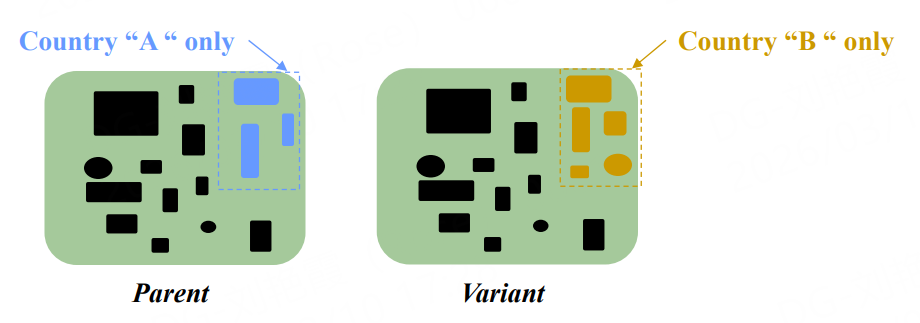
3. Changes in Circuitry Inactive in the U.S.
• A Parent model device may include hardware that is inactive when connected to the U.S. cellular network but becomes operational only when connected to cellular networks in other countries.
• In this case, circuitry changes in a Variant may be allowed if:
The changes are made only to the circuitry that is inactive in the U.S.
Technical analysis is provided to show that the changes do not impact the field distribution of any other antennas of the transmitters that have been authorized (i.e., they can operate in the U.S.) in the parent model.
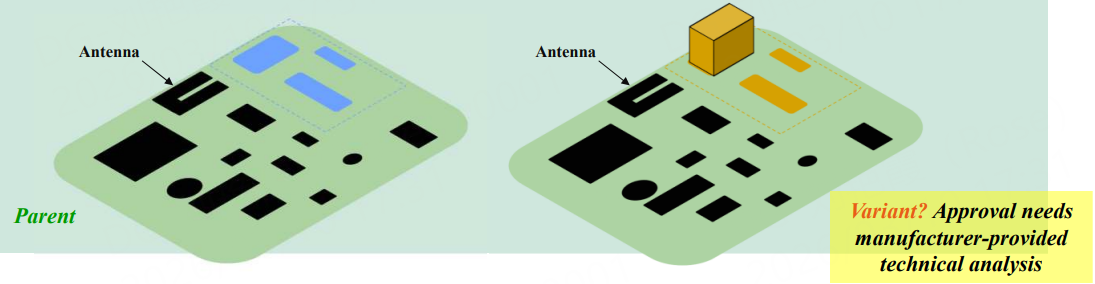
4. PCB Layout Examples
• Compatible Case:
The changes in the Variant could be limited to surface-mounted components, with essentially the same PCB traces.
The authorized transmitter antennas (those that are operational in the U.S.) are not affected by the physical structure of the new (inactive) components.
• A Case That May Not Be Compatible:
A significantly taller component is placed near a patch antenna. This may alter the near field emissions and lead to reflections that could increase the RF exposure Total Exposure Ratio (TER).
The Variant may not be permitted unless specific field analysis is provided.
Background and Significance
The original KDB 484596 D01 v03, released on March 21, 2025, streamlined the test data referencing process by eliminating the need for ECR inquiries and shifting review authority to TCBs. However, it initially restricted data referencing to variants involving component removal or reduction only.
The core principle emphasized in the update is that "some compliance test data obtained from the parent device is also sufficient to demonstrate compliance for the variant." The revision mandates reliance on technical analysis rather than qualitative "ballpark estimates" and expands the scope of data referencing to include variants involving component addition or substitution.
This update aims to streamline equipment variant certification by providing more flexible, engineering-based pathways, thereby reducing compliance costs and accelerating product iteration and time-to-market.
If you have different products and want to apply for different FCC IDs, but are not sure whether data can be referenced between products, how much testing can be reduced, or how much testing can be reduced, please feel free to contact the BTL team at any time, and we will serve you wholeheartedly!
Relevant information

CRA Implementation Enters a Critical Phase
In August 2026, preparations for the implementation of the EU Cyber Resilience Act (CRA) entered a critical stage. With the reporting obligations set to take effect on September 11, 2026, drawing near, the European Commission and the European Union Agency for Cybersecurity (ENISA) have been intensively issuing implementation guidance and materials related to the single reporting platform.
Canada's ISED Officially Releases RSS-310 Issue 6: Major Updates to Radio Frequency Equipment Requirements
Innovation, Science and Economic Development Canada (ISED) has formally issued RSS-310, Issue 6, “Licence-Exempt Radio Apparatus: Category II Equipment,” replacing Issue 5, which has been in effect since 2020