

Recently, the Bureau of Indian Standards (BIS) released a set of Frequently Asked Questions (FAQs) regarding the migration of electronic and electrical products from the old standards IS 13252(Part1):2010 or IS 616:2017 to the new standard IS/IEC 62368-1:2023, clarifying key compliance points. To help you efficiently complete the standard transition and ensure the legal sale of your products in the Indian market, we have summarized the core highlights as follows:
1. Licence Number (R-no.) Remains Unchanged
After migrating from IS 13252(Part1):2010 or IS 616:2017 to IS/IEC 62368-1:2023, the existing licence number (R-no.) will remain unchanged.
2. Separate Licences (R-nos.) for Different Categories Must Undergo Migration Individually
If you hold separate licences under the old standards for different product categories (e.g., power adaptors for IT equipment, power adaptors for AV equipment, etc.), each licence must undergo the standard migration separately. After migration, each licence will remain independently valid.
3. New Models Tested per the New Standard May Be Included Under Existing Licence (R-no.)
New models tested per IS/IEC 62368-1:2023 may be included under existing licence (R-no.) previously issued under the old standard, subject to compliance with applicable BIS requirements. However, please note that failure to complete the migration within the parallel-running transition period may result in BIS cancelling the licence and/or deleting the relevant models.
4. All Lead Models Must Be Tested
During migration, it is necessary to identify all previously certified lead models, arrange for testing by BIS-recognized laboratories against the new standard on a one-by-one basis, and submit complete test reports for all lead models to BIS. Submitting only one representative sample per licence number (R-no.) for testing is not acceptable.
5. If a Lead Model Has Been Discontinued, It May Be Replaced
If the original lead model has reached End-of-Life (EOL), the licensee may withdraw it from the licence. Subsequently, a new lead model within the same series may be re-designated in accordance with the series guidelines issued by the Ministry of Electronics and Information Technology (MeitY).
6. Separate Test Reports Are Required for Products Manufactured at Different Manufacturing Locations
Under the Compulsory Registration Scheme (CRS), a separate licence is granted for each manufacturing location. Therefore, products manufactured at different locations require separate test reports.
7. Marking Requirements
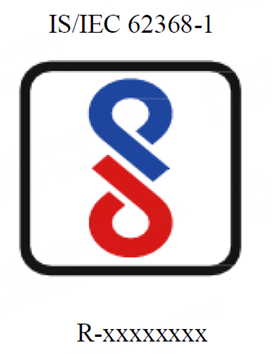
Products complying with IS/IEC 62368-1:2023 shall bear the BIS Standard Mark in accordance with the labelling and marking requirements (Regulation 6 and Annexures I, II and III) of Scheme II of Schedule II under the BIS Conformity Assessment Regulations, 2018. An illustration is provided below for reference:
8. Critical Components Must Be Upgraded to Comply with the New Standard
According to Clause 4.1.2 of IS/IEC 62368-1:2023, critical components (e.g., those related to safeguards) must either comply directly with the requirements of the new standard or meet the safety requirements of relevant IEC component standards. Components that only comply with the old standards (IS 13252 or IS 616) will not be accepted.
Applicants may apply for registration of critical components and end products in parallel in accordance with the BIS Parallel Testing Guidelines to avoid certification delays.
For more detailed certification requirements, please feel free to contact BTL's International Department or Business Department. We are pleased to provide you with professional technical support to help your business achieve efficient compliance.
Relevant information

CRA Implementation Enters a Critical Phase
In August 2026, preparations for the implementation of the EU Cyber Resilience Act (CRA) entered a critical stage. With the reporting obligations set to take effect on September 11, 2026, drawing near, the European Commission and the European Union Agency for Cybersecurity (ENISA) have been intensively issuing implementation guidance and materials related to the single reporting platform.
Canada's ISED Officially Releases RSS-310 Issue 6: Major Updates to Radio Frequency Equipment Requirements
Innovation, Science and Economic Development Canada (ISED) has formally issued RSS-310, Issue 6, “Licence-Exempt Radio Apparatus: Category II Equipment,” replacing Issue 5, which has been in effect since 2020