

Safety profile
Introduction of safety
Safety certification is a passport for market access. Application of a safety standard is intended to reduce the likelihood of pain, injury and, in the case of fire. A product safety standard that classifies energy sources, prescribes safeguards against those energy sources, and provides guidance on the application of, and requirements for, those safeguards.
An energy source that causes pain or injury does so through the transfer of some form of energy to or from a body part.

Forms of energy
Electrical energy
Thermal energy
Chemical reaction
Kinetic energy
Thermal energy
Radiated energy
Examples of body response related to energy sources
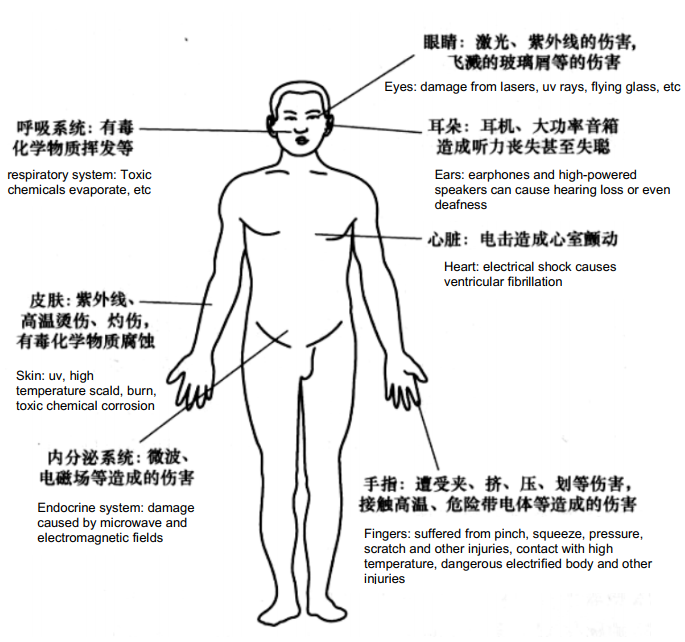
Many products necessarily use energy capable of causing pain or injury. Product design cannot eliminate such energy use. Consequently, such products should use a scheme that reduces the likelihood of such energy being transferred to a body part. The scheme that reduces the likelihood of energy transfer to a body part is a safeguard. Safety provide designers with basis of requirements of these safeguards.

Common safety testing items
1. input test
2. Durability of marking test
3. Plug discharge test
4. Hazards voltage and SELV measurement
5. Limited power source test
6. Limited current circuit test
7. Resistance of protective earthing conduction
8. Humidity test
9. Torque test
10. Stability test
11. Enclosure force test
12. Drop test
13. Steel ball test
14. Vibration test
15. Stress relief test
16. Battery charge and discharge test
17. Heating test
18. Ball pressure test
19. Needle flame test
20. Glow-Wire Test
21. Softening Temperature of Thermoplastics Test
22. Touch current test
23. Electric strength tests
24. Insulation resistance test
25. Working voltage measurement
26. Abnormal test / Component fault test
27. Pull and torque test for fixed cord
28. Safety structure design
Safety testing standards for common products:
| Product type | Standard |
| Audio, video and similar electronic apparatus | EN 60065 |
| IEC 60065 | |
| GB 8898 | |
| CNS 14408 | |
| UL 60065/CSA.-C22.2 No. 60065 | |
| AS/NZS 60950.1 | |
Information Technology Equipment | EN 60950-1 |
| IEC 60950-1 | |
| GB 4943.1 | |
| CNS 14336-1 | |
| UL 60950-1/1/CSA-C22.2 No. 60950-1 | |
| AS/NZS 60065 | |
| Audio/video, information and communication technology equipment | IEC 62368-1 |
| EN 62368 -1 | |
| UL 62368 -1/CSA-C 22.2 No.62368-1 | |
| AS/NZS 62368.1 | |
| Household and similar electrical appliances | GB 4706.1 & GB 4706.2 series |
| IEC 60335-1 & IEC 60335-2 series | |
| EN 60335-1 & EN 60335-2 series | |
| AS/NZS 60335.1 & AS/NZS 60335.2 series |
Relevant information

EU Releases Exemption Guidelines on Removability and Replaceability of Portable and LMT Batteries — Multiple Product Categories Relief Granted
On July 14, 2026, the European Commission published the "Commission Guidelines to Facilitate the Harmonised Application of Provisions on the Removability and Replaceability of Portable and Light Means of Transport (LMT) Batteries" (Commission Notice C(2026) 5032 final). These guidelines aim to provide a uniform interpretative framework for the implementation of Article 11 of the EU Battery Regulat

6G Developments: Past, Present and Future
The formulation of 6G standards has entered a more concrete phase. At the 3GPP RAN Plenary Meeting held in Singapore in June 2026, the industry made progress in multiple key research areas and finalized the timeline for Release 21, which is regarded as the first standard version expected to formally define 6G.

Overview of EN IEC 61000-4-29:2026
The key focus of the 2026 edition is to address new DC power distribution environments, especially higher-voltage DC systems. It also clarifies test generator capability, duration tolerance, current limitation during short interruptions, inrush current verification, result evaluation, and test report requirements. For products using 24 Vdc, 48 Vdc, 380 Vdc, 400 Vdc, 800 Vdc, or other DC input pow