

On July 24, 2019, the official version of EN 300 328 V2.2.2 has been officially published by ETSI. Major changes are:
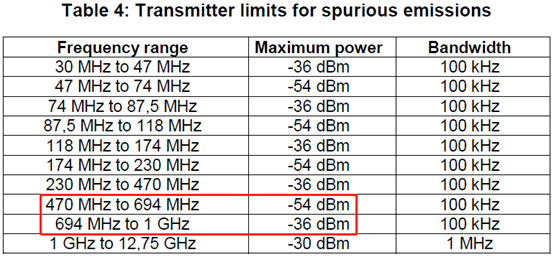
1. Change of transmitter unwanted emissions in the spurious domain
The limit value is adjusted from -54dBm/100KHz to -36dBm/100KHz in 694MHz ~ 862MHz frequency band. The limit value is increased by 18db, making it easier to pass.
V2.1.1
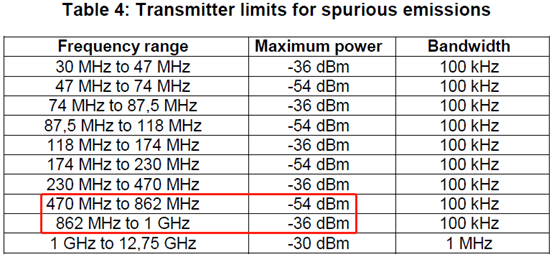
V2.2.2
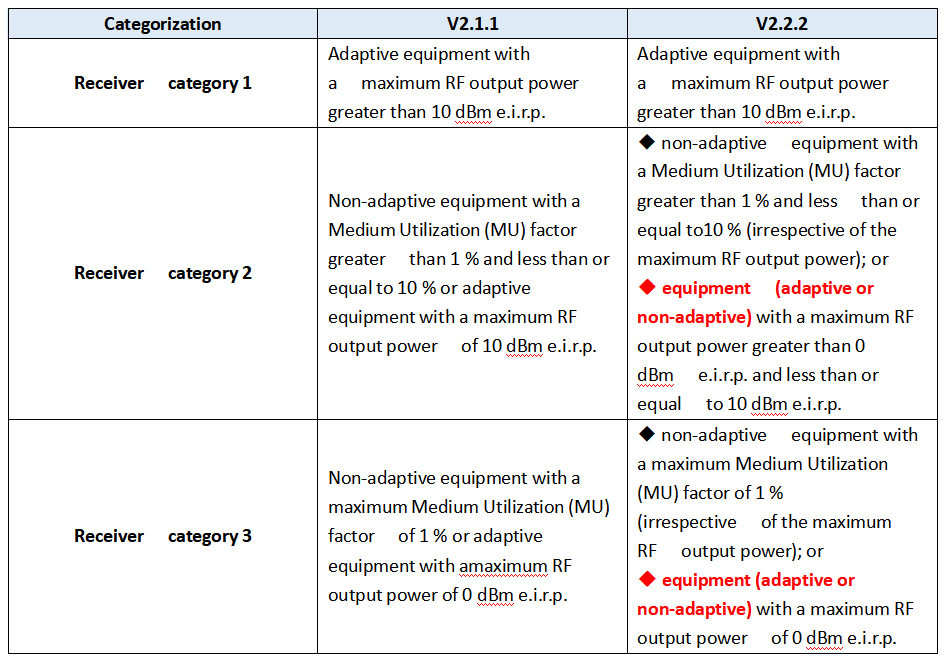
2. Change of receiver category categorization
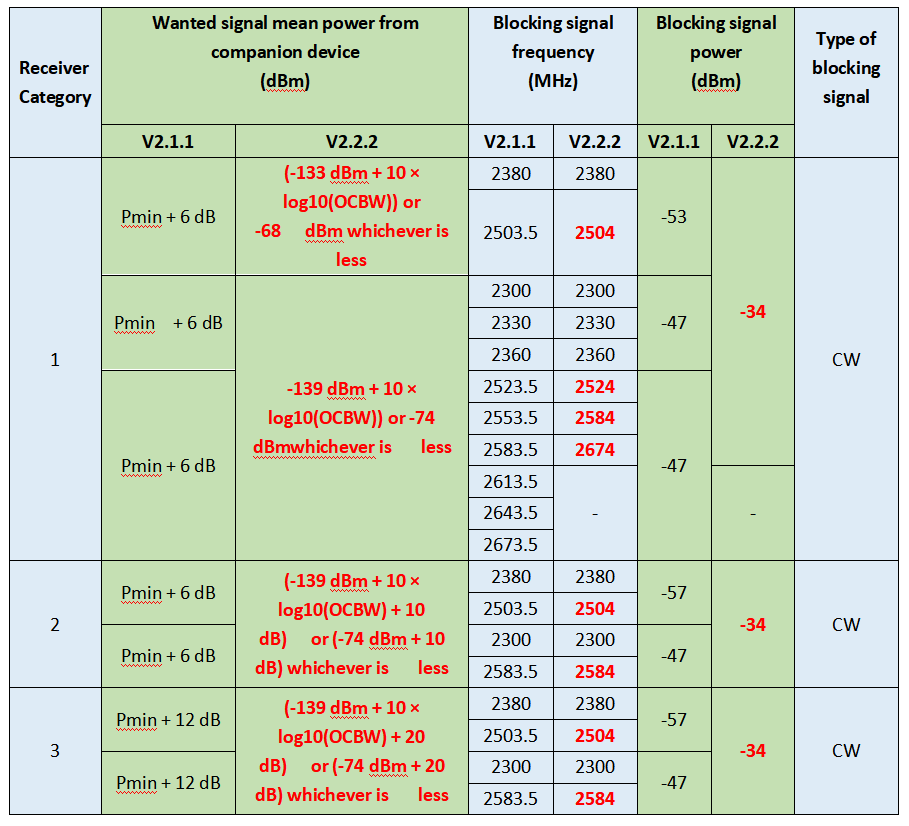
3. Change of receiver blocking
3.1 Performance Criteria
V2.1.1
The minimum performance criterion shall be a PER less than or equal to 10 %. The manufacturer may declare alternative performance criteria as long as that is appropriate for the intended use of the equipment.
V2.2.2
For equipment that supports a PER or FER test to be performed, the minimum performance criterion shall be a PER or FER less than or equal to 10 %.
For equipment that does not support a PER or a FER test to be performed, the minimum performance criterion shall be no loss of the wireless transmission function needed for the intended use of the equipment.
3.2 Limit
3.3 Test channel

4. Other
4.1 At present, the version published in OJ is EN 300 328 V2.1.1, so it is necessary to apply for CE VoC certification with V2.1.1. If you want to apply for v2.2.2, you need to apply for CE NB (Notified Body) to obtain the certificate.
4.2 According to the current progress of EU’s work programme, it is expected to be published to OJ on December 18, 2019.
4.3 According to EN 300 328 V2.2.2, its mandatory date (dop) is April 30, 2020, while the date of withdrawing the old version (dow) is October 31, 2021. Therefore, the update needs to be completed before this date, and the old version of V2.1.1 will be withdrawn.
Relevant information

EU Releases Exemption Guidelines on Removability and Replaceability of Portable and LMT Batteries — Multiple Product Categories Relief Granted
On July 14, 2026, the European Commission published the "Commission Guidelines to Facilitate the Harmonised Application of Provisions on the Removability and Replaceability of Portable and Light Means of Transport (LMT) Batteries" (Commission Notice C(2026) 5032 final). These guidelines aim to provide a uniform interpretative framework for the implementation of Article 11 of the EU Battery Regulat

6G Developments: Past, Present and Future
The formulation of 6G standards has entered a more concrete phase. At the 3GPP RAN Plenary Meeting held in Singapore in June 2026, the industry made progress in multiple key research areas and finalized the timeline for Release 21, which is regarded as the first standard version expected to formally define 6G.

Overview of EN IEC 61000-4-29:2026
The key focus of the 2026 edition is to address new DC power distribution environments, especially higher-voltage DC systems. It also clarifies test generator capability, duration tolerance, current limitation during short interruptions, inrush current verification, result evaluation, and test report requirements. For products using 24 Vdc, 48 Vdc, 380 Vdc, 400 Vdc, 800 Vdc, or other DC input pow