

Equipment introduction
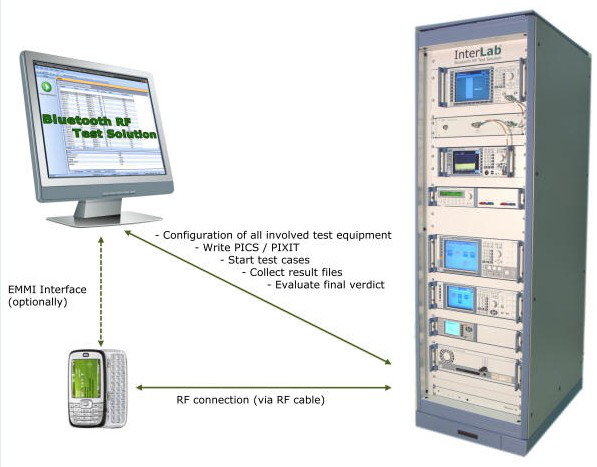
BTL use the US 7layers ‘InterLab” Bluetooth RF Test Solution, which is officially approved by SIG as the Test system and it integrates the R&S equipment made in Germany. The Test stability and efficiency have been greatly improved, and it supports the latest Bluetooth specification.
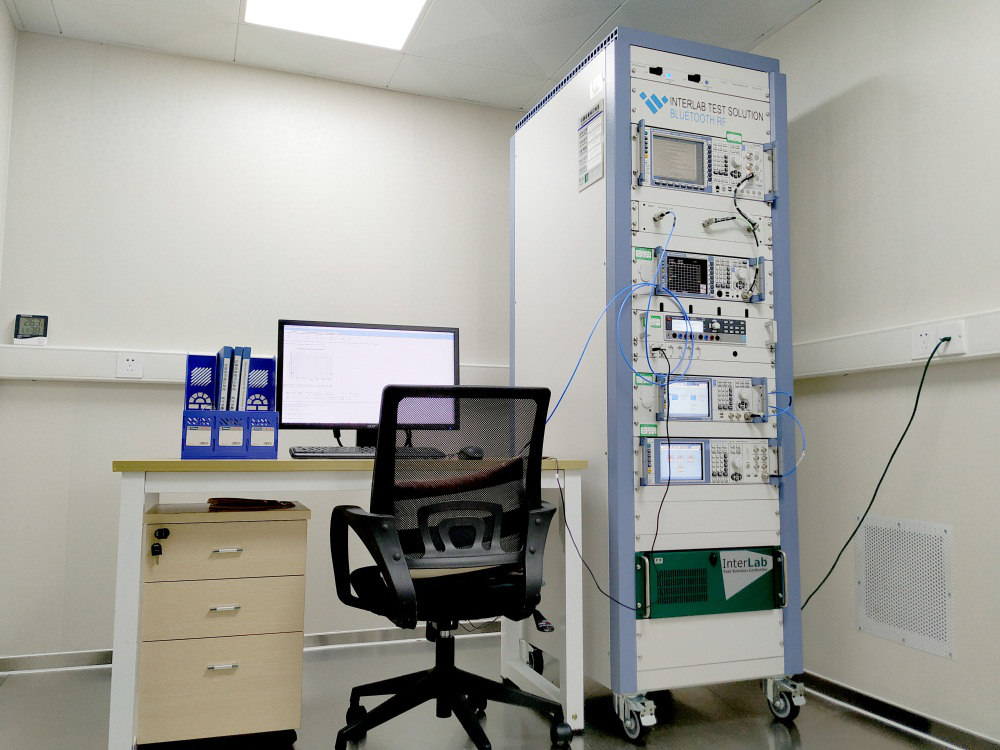
BTL BQB Test Site:
BQB Test Items
Bluetooth RF Test Specification RF.TS.5.1.0 |
Output Power |
Power Density |
Power Control |
TX Output Spectrum - Frequency range |
TX Output Spectrum - 20 dB Bandwidth |
TX Output Spectrum - Adjacent channel power |
Modulation Characteristics |
Initial Carrier Frequency Tolerance |
Carrier Frequency Drift |
EDR Relative Transmit Power |
EDR Carrier Frequency Stability and Modulation Accuracy |
EDR Differential Phase Encoding |
EDR In-band Spurious Emissions |
Enhanced Power Control |
EDR Guard Time |
EDR Synchronization Sequence and Trailer |
Sensitivity - single slot packets |
Sensitivity - multi-slot packets |
C/I performance |
Blocking performance |
Intermodulation Performance |
Maximum Input Level |
EDR Sensitivity |
EDR BER Floor Performance |
EDR C/I Performance |
EDR Maximum Input Level |
Bluetooth Low Power RF Test Specification RF-PHY.TS.5.1.1 |
Output power |
In-band emissions, uncoded data at 1 Ms/s |
Modulation Characteristics, uncoded data at 1 Ms/s |
Carrier frequency offset and drift, uncoded data at 1 Ms/s |
In-band emissions at 2 Ms/s |
Stable Modulation Characteristics, uncoded data at 1 Ms/s |
Modulation Characteristics at 2 Ms/s |
Stable Modulation Characteristics at 2 Ms/s |
Carrier frequency offset and drift at 2 Ms/s |
Modulation Characteristics, LE Coded (S=8) |
Carrier frequency offset and drift, LE Coded (S=8 ) |
Receiver sensitivity, uncoded data at 1 Ms/s |
C/I and Receiver Selectivity Performance, uncoded data at 1 Ms/s |
Blocking Performance, uncoded data at 1 Ms/s |
Intermodulation Performance, uncoded data at 1 Ms/s |
Maximum input signal level, uncoded data at 1 Ms/s |
PER Report Integrity, uncoded data at 1 Ms/s |
Receiver sensitivity at 2 Ms/s |
C/I and Receiver Selectivity Performance at 2 Ms/s |
Blocking performance at 2 Ms/s |
Intermodulation performance at 2 Ms/s |
Maximum input signal level at 2 Ms/s |
PER Report Integrity at 2 Ms/s |
Receiver Sensitivity, uncoded data at 1 Ms/s, Stable Modulation Index |
C/I and Receiver Selectivity Performance, uncoded data at 1 Ms/s, Stable Modulation Index |
Blocking Performance, uncoded data at 1 Ms/s, Stable Modulation Index |
Intermodulation Performance, uncoded data at 1 Ms/s, Stable Modulation Index |
Maximum input signal level, uncoded data at 1 Ms/s, Stable Modulation Index |
PER Report Integrity, uncoded data at 1 Ms/s, Stable Modulation Index |
Receiver sensitivity at 2 Ms/s, Stable Modulation Index |
C/I and Receiver Selectivity Performance at 2 Ms/s, Stable Modulation Index |
Blocking performance at 2 Ms/s, Stable Modulation Index |
Intermodulation performance at 2 Ms/s, Stable Modulation Index |
Maximum input signal level at 2 Ms/s, Stable Modulation Index |
PER Report Integrity at 2 Ms/s, Stable Modulation Index |
Receiver sensitivity, LE Coded (S=2) |
Receiver sensitivity, LE Coded (S=8) |
C/I and Receiver Selectivity Performance, LE Coded (S=2) |
C/I and Receiver Selectivity Performance, LE Coded (S=8) |
PER Report Integrity, LE Coded (S=2) |
PER Report Integrity, LE Coded (S=8) |
Receiver sensitivity, LE Coded (S=2), Stable Modulation Index |
Receiver sensitivity, LE Coded (S=8), Stable Modulation Index |
C/I and Receiver Selectivity Performance, LE Coded (S=2), Stable Modulation Index |
C/I and Receiver Selectivity Performance, LE Coded (S=8), Stable Modulation Index |
PER Report Integrity, LE Coded (S=2), Stable Modulation Index |
PER Report Integrity, LE Coded (S=8), Stable Modulation Index |
General Profile |
A2DP-Audio/Video Distribution Transport Protocol |
AVRCP-Audio/Video Control Transport Protocol |
FTP-File Transfer Profile |
GAVDP-Generic Audio/Video Distribution Profile |
HFP-Hands-Free Profile |
HSP-Headset Profile |
IOPT-Interoperability Test Specification |
MAP-Message Access Profile |
OPP-Object Push Profile |
PAN-Personal Area Networking Profile |
PBAP-Phone Book Access Profile |
SAP-SIM Access Profile |
BAS-Battery Service |
DIS-Device Information Service |
HOGP-HID over GATT Profile |
Relevant information

EU Releases Exemption Guidelines on Removability and Replaceability of Portable and LMT Batteries — Multiple Product Categories Relief Granted
On July 14, 2026, the European Commission published the "Commission Guidelines to Facilitate the Harmonised Application of Provisions on the Removability and Replaceability of Portable and Light Means of Transport (LMT) Batteries" (Commission Notice C(2026) 5032 final). These guidelines aim to provide a uniform interpretative framework for the implementation of Article 11 of the EU Battery Regulat

6G Developments: Past, Present and Future
The formulation of 6G standards has entered a more concrete phase. At the 3GPP RAN Plenary Meeting held in Singapore in June 2026, the industry made progress in multiple key research areas and finalized the timeline for Release 21, which is regarded as the first standard version expected to formally define 6G.

Overview of EN IEC 61000-4-29:2026
The key focus of the 2026 edition is to address new DC power distribution environments, especially higher-voltage DC systems. It also clarifies test generator capability, duration tolerance, current limitation during short interruptions, inrush current verification, result evaluation, and test report requirements. For products using 24 Vdc, 48 Vdc, 380 Vdc, 400 Vdc, 800 Vdc, or other DC input pow