

Brief introduction of Bluetooth version, certification and test
Bluetooth has been developed for more than 20 years. The Bluetooth version has been updated from the original version 0.7 to the latest version 5.3. The Bluetooth mode has also changed from the original Bluetooth classic (single-mode) to the later Bluetooth classic + Bluetooth low energy (dual-mode), and the use scene has also changed from the original audio and data transmission to the later mesh networking and location service. Bluetooth products are becoming more and more diversified. Bluetooth headset, Bluetooth speaker, Bluetooth mouse and Bluetooth keyboard are well-known. Smart home products also use Bluetooth technology more, as well as emerging products such as Bluetooth loss preventer... Facing the technological innovation of Bluetooth, BTL is also well prepared to provide RF certification services for manufacturers.
※ Bluetooth version timeline -------------------------------------------->>>
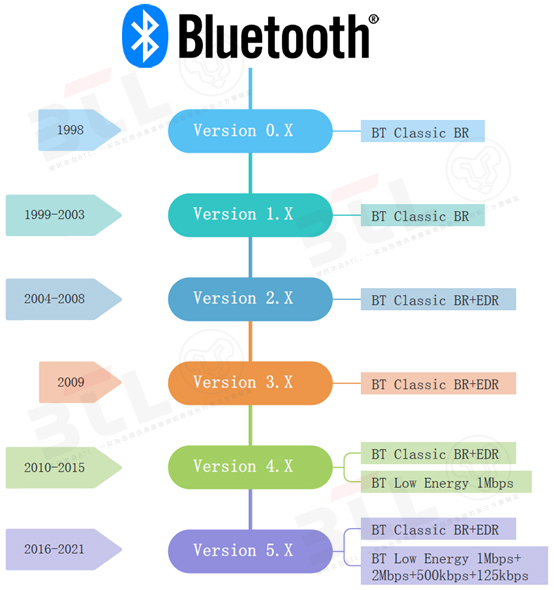
It can be seen from the update of Bluetooth in recent years that the Bluetooth classic has become stable, and the Bluetooth low energy technology is also developing to more dimensions such as indoor positioning, direction finding and long range, such as BLE 500 kbps (coded PHY S = 2) and 125 kbps (coded PHY S = 8), which can expand the use range of Bluetooth devices by up to four times.
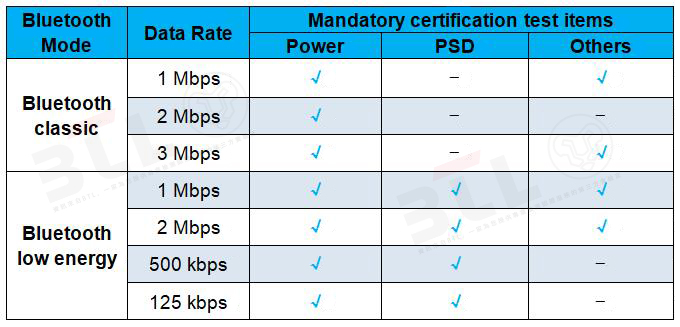
※ Bluetooth RF test -------------------------------------------->>>
From the perspective of RF mandatory certification, for the latest and complete Bluetooth technology, BTL's test strategy is as follows:
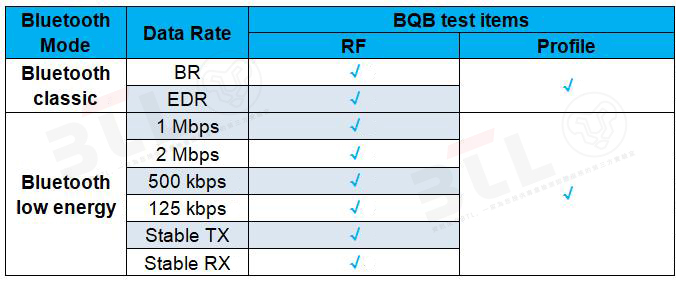
※ Bluetooth BQB test -------------------------------------------->>>
From the perspective of BQB certification, for the latest and complete Bluetooth technology, BTL's test strategy is as follows:
In recent years, with the rapid development of smart phones, almost everyone has one or more. As one of the important members in the wireless field, Bluetooth is an essential function of smart phones. For this function, manufacturers have launched their own Bluetooth products, such as true wireless (TWS) Bluetooth earphones, smart Watch / bracelet, Bluetooth loss preventer and so on. Among them, the market of TWS earphones is the best. At present, most smart phones have cancelled the 3.5mm wired earphone interface, which makes the market demand for wireless earphones increasing. For TWS earphones, since both the left and right earphones have independent Bluetooth functions, many manufacturers ask whether they can apply for an ID and certificate. To solve this problem, the following is the professional answer of BTL:
● For CE certification, as long as they are jointly sold, they can apply for one certificate.
● For FCC/ISED/JRL certification, if the PCB layout / components of the left and right earphones are exactly the same or mirror design, you can apply for one ID and certificate.
● For FCC/ISED/JRL certification, if the PCB layout / components of the left and right earphones are not exactly the same or mirror design, and there are great differences. ID and certificates are required to be independently applied to the earphone.
● For FCC/ISED certification, if the PCB layout / components of the left and right earphones are not exactly the same or mirror design, and there are only minor differences. The specific differences need to be submitted to the TCB for evaluation to define whether one ID and certificate can be applied for.
● For BQB certification, if the QDID of the Bluetooth chip reference protocol part of the left and right earphones are the same, one DID and certificate can be used. If the QDID are different, one DID and certificate cannot be used.
If you want to know more about Bluetooth certification, you are welcome to contact the BTL team at any time. BTL will share the most professional and comprehensive information with you.
Relevant information

EU Releases Exemption Guidelines on Removability and Replaceability of Portable and LMT Batteries — Multiple Product Categories Relief Granted
On July 14, 2026, the European Commission published the "Commission Guidelines to Facilitate the Harmonised Application of Provisions on the Removability and Replaceability of Portable and Light Means of Transport (LMT) Batteries" (Commission Notice C(2026) 5032 final). These guidelines aim to provide a uniform interpretative framework for the implementation of Article 11 of the EU Battery Regulat

6G Developments: Past, Present and Future
The formulation of 6G standards has entered a more concrete phase. At the 3GPP RAN Plenary Meeting held in Singapore in June 2026, the industry made progress in multiple key research areas and finalized the timeline for Release 21, which is regarded as the first standard version expected to formally define 6G.

Overview of EN IEC 61000-4-29:2026
The key focus of the 2026 edition is to address new DC power distribution environments, especially higher-voltage DC systems. It also clarifies test generator capability, duration tolerance, current limitation during short interruptions, inrush current verification, result evaluation, and test report requirements. For products using 24 Vdc, 48 Vdc, 380 Vdc, 400 Vdc, 800 Vdc, or other DC input pow