

Interpretation of FCC Wi-Fi new band 5.9GHz (UNII-4) regulation
In the past 20 years, Wi-Fi technology has been used in 2.4 GHz (2.4-2.4835 GHz) and 5 GHz (5.15-5.35 GHz & 5.47-5.85 GHz) frequency bands for a long time. This situation has not been broken by Wi-Fi 6E (5.925-7.125 GHz) frequency band until recent years. As the first country to adopted the Wi-Fi 6E band, the FCC did not stop there, but chose to pursue the victory. In November 2020, it voted to adopt a new rule: expand the UNII band from 5.85 GHz to 5.895 GHz (UNII-4), so that unlicensed services such as Wi-Fi can be used in the new 45 MHz band. Previously, the spectrum from 5.85-5.925 GHz was designated for Intelligent Transportation System (ITS) operations under Part 90 and Part 95.
The KDB 291074 draft guidance for 5.9 GHz (UNII-4) devices was released on November 9, 2021. Just a few days ago, the official version of KDB was finally released on March 3, 2022.
Here is the interpretation of relevant regulations:
UNII Bands ->->->->->->->->->->->->->->->->
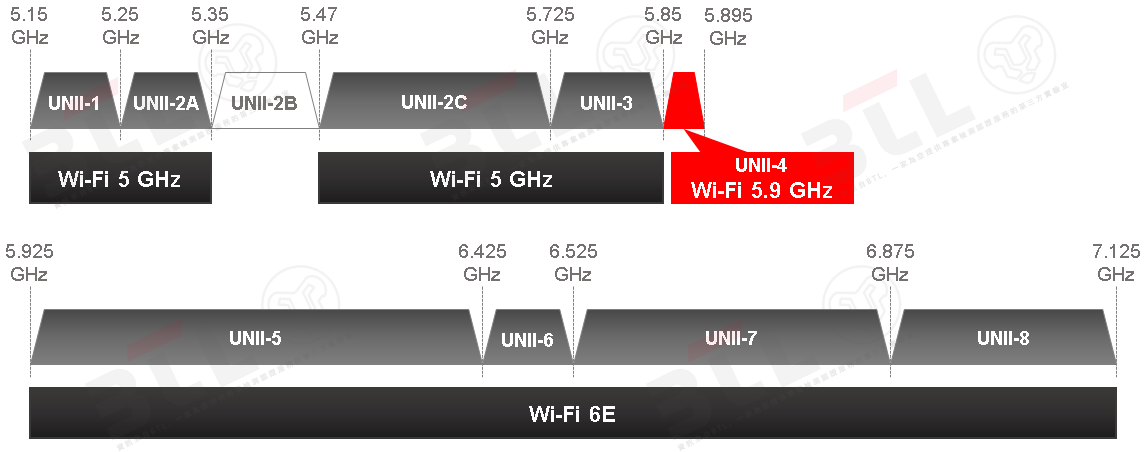
As shown in the figure above, the UNII band of FCC at this stage is divided into:
● Wi-Fi 5 GHz:
○ UNII-1:5.15-5.25 GHz
○ UNII-2A:5.25-5.35 GHz
○ UNII-2C:5.47-5.725 GHz
○ UNII-3:5.725-5.85 GHz
● Wi-Fi 5.9 GHz(new):
○ UNII-4:5.85-5.895 GHz
● Wi-Fi 6E:
○ UNII-5:5.925-6.425 GHz
○ UNII-6:6.425-6.525 GHz
○ UNII-7:6.525-6.875 GHz
○ UNII-8:6.875-7.125 GHz
Channel & Frequency ->->->->->->->->->->->->->->->->
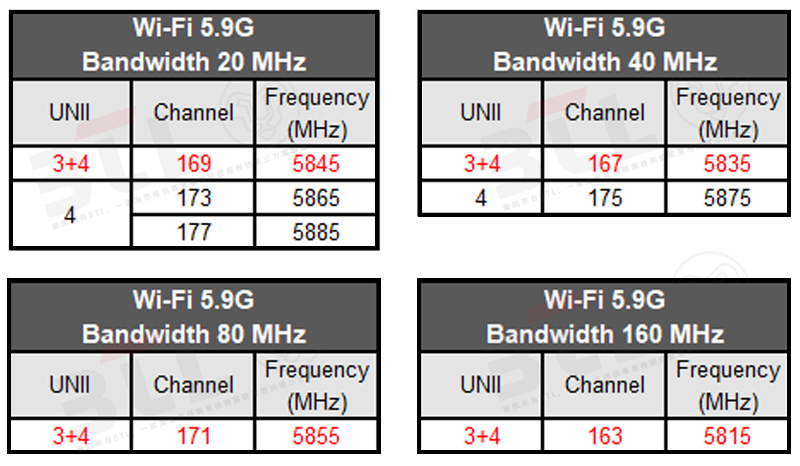
Since the UNII-4 band is close to the UNII-3 band, in addition to the channels only falling in the UNII-4 band, some channels span UNII-3 and UNII-4:
Types of Devices ->->->->->->->->->->->->->->->->
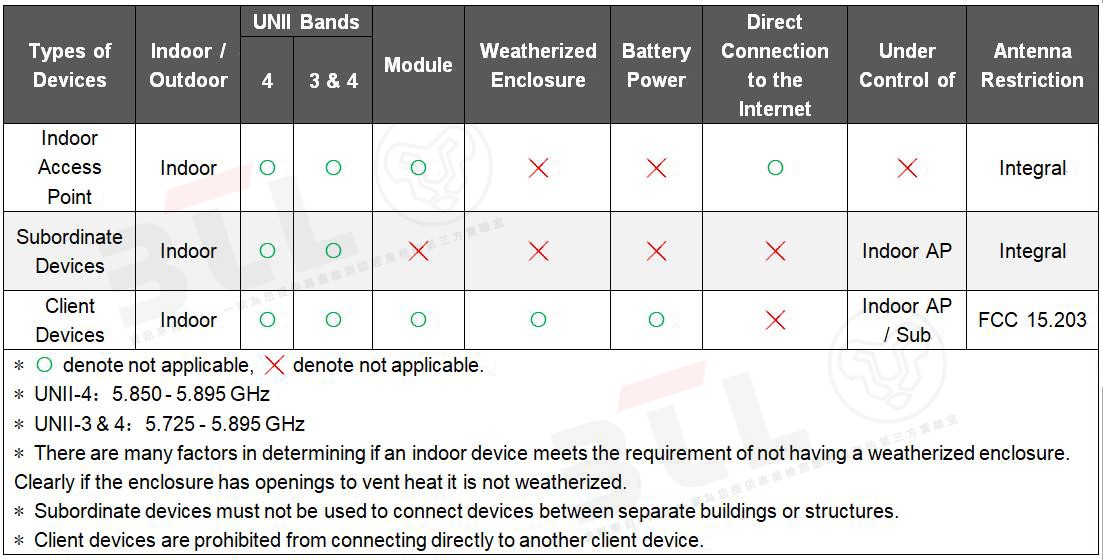
Devices operating in the U-NII-4 Band and channels that span U-NII-3 and U-NII-4 Bands are restricted to three category types:
Test Items ->->->->->->->->->->->->->->->->
FCC Wi-Fi 5.9 GHz UNII-4 / UNII-3 & UNII-4 equipment needs to perform the following test items:
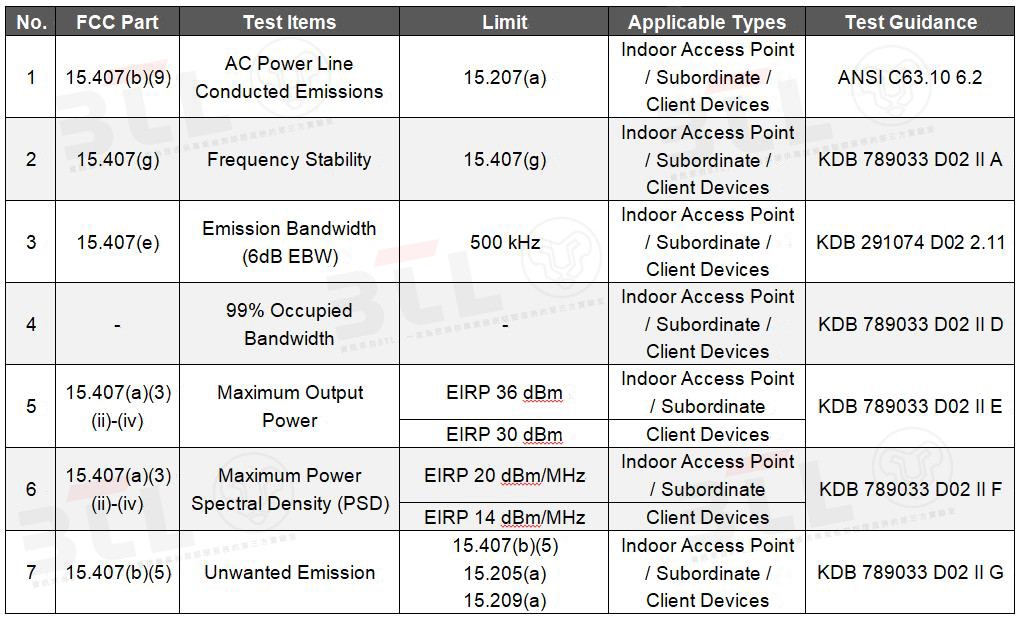
For item 7 unwanted emission, the limits of harmonics above 1 GHz and band edge are as follows:
● Harmonics (Consistent with Wi-Fi 6E):
○ In the Restricted Bands: 74 dBμV/m (Peak) & 54 dBμV/m (AVG)
○ Outside of the Restricted Bands: 88.2 dBμV/m (Peak) & 68.2 dBμV/m (AVG)
● Band Edge (The limit below 5.725 GHz in the left band edge is consistent with the UNII-3 band edge):
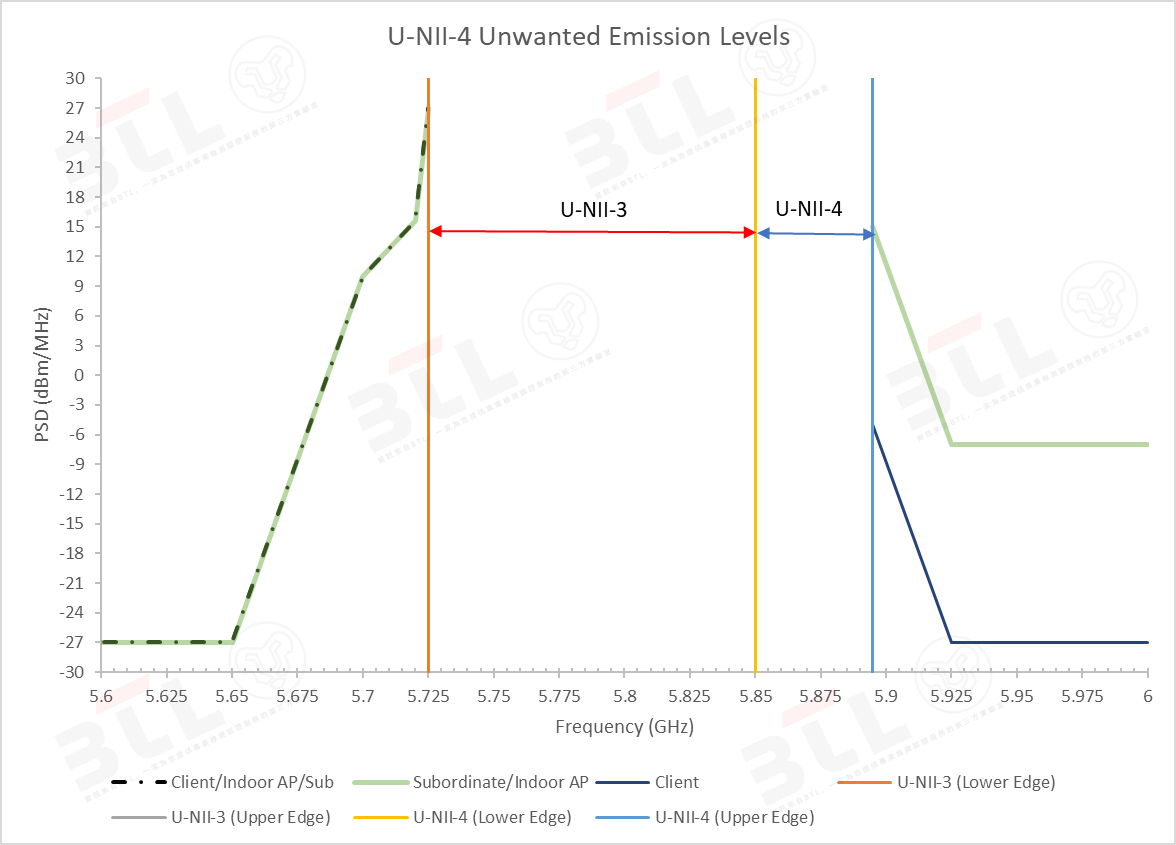
○ Left Band Edge:all emissions below 5.725 GHz shall not exceed an e.i.r.p. of −27 dBm/MHz (68.2 dBμV/m,Peak) at 5.65 GHz increasing linearly to 10 dBm/MHz (105.2 dBμV/m,Peak) at 5.7 GHz, and from 5.7 GHz increasing linearly to a level of 15.6 dBm/MHz (110.8 dBμV/m,Peak) at 5.72 GHz, and from 5.72 GHz increasing linearly to a level of 27 dBm/MHz (122.2 dBμV/m,Peak) at 5.725 GHz. As illustrated in Figure 1 below
○ Right Band Edge:For an indoor access point or subordinate device, all emissions at or above 5.895 GHz shall not exceed an e.i.r.p. of 15 dBm/MHz (110.2 dBμV/m,AVG) and shall decrease linearly to an e.i.r.p. of −7 dBm/MHz (88.2 dBμV/m,AVG) at or above 5.925 GHz;
Or For a client device, all emissions at or above 5.895 GHz shall not exceed an e.i.r.p. of −5 dBm/MHz (90.2 dBμV/m,AVG) and shall decrease linearly to an e.i.r.p. of −27 dBm/MHz (68.2 dBμV/m,AVG) at or above 5.925 GHz. As illustrated in Figure 1 below, the peak emissions must be limited to no more than 20 dB above the average limit
Just in February this year, ISED of Canada also publicly consulted on "the Technical and Policy Framework for Radio Local Area Network (RLAN) Devices in the 5850-5895 MHz Frequency Band and for Intelligent Transportation Systems (ITS) in the 5895-5925 MHz Frequency Band", and the closing date for comments was April 29, 2022. Then ISED replied to the comments of all parties, and the closing date for reply comments was June 3, 2022. It is expected that ISED will release new rules after this date. Please look forward to it.
Relevant information

EU Releases Exemption Guidelines on Removability and Replaceability of Portable and LMT Batteries — Multiple Product Categories Relief Granted
On July 14, 2026, the European Commission published the "Commission Guidelines to Facilitate the Harmonised Application of Provisions on the Removability and Replaceability of Portable and Light Means of Transport (LMT) Batteries" (Commission Notice C(2026) 5032 final). These guidelines aim to provide a uniform interpretative framework for the implementation of Article 11 of the EU Battery Regulat

6G Developments: Past, Present and Future
The formulation of 6G standards has entered a more concrete phase. At the 3GPP RAN Plenary Meeting held in Singapore in June 2026, the industry made progress in multiple key research areas and finalized the timeline for Release 21, which is regarded as the first standard version expected to formally define 6G.

Overview of EN IEC 61000-4-29:2026
The key focus of the 2026 edition is to address new DC power distribution environments, especially higher-voltage DC systems. It also clarifies test generator capability, duration tolerance, current limitation during short interruptions, inrush current verification, result evaluation, and test report requirements. For products using 24 Vdc, 48 Vdc, 380 Vdc, 400 Vdc, 800 Vdc, or other DC input pow