

Major technical change of the IEC 62368-1:2023 (ED4.0)
On May 26, 2023, the International Electrotechnical Commission (IEC) released the IEC 62368-1:2023 (Fourth Edition) standard; It is expected that the European Union and North America will release the corresponding national standards in the coming 6-12 months.
The major technical changes of the IEC 62368-1 ED4.0 compare with the previous edition are as follows:
1. Clause 4.1.1, deleted “to accept the components or subassemblies that previous complied with IEC 60950-1 or IEC 60065”
This means that the fourth edition no longer accepts components or subassemblies which certified by IEC 60950-1 and IEC 60065.
2. Clause 4.1.8, updated the equipment which applicable to pressurized LFC testing (G.15)
Delete 'G.15 not applicable to equipment with more than 1L of liquid', meaning that equipment with more than 1L of liquid also needs to be evaluated for the test of G.15
3. Clause 4.4.3.1, added testing requirements for thermoplastic material
As an inaccessible thermoplastic material for safety protection such as insulation sheets for internal isolation purposes, stress relief tests (T.8) are also required.
4. Clause 4.8, added exclusion from equipment types which containing button cell batteries and the warning requirements
The update clarifies that clause 4.8 is not applicable to devices where coin/button cell are unlikely to be taken out by children, but related battery warnings (4.8.2) are required.
5. Clause 4.8.3, updated the structural design requirements for the button cell cover
Clause 4.8.3 has added multiple acceptable types of structural design.
6. Clause 4.10.3 added requirements for the mains power supply cord
It is clarified that the mains power supply cord only needs to comply with G.7, and there is no need to treat the mains power supply cord as an external cord to comply with the requirements of clause 6, especially the fire protection requirements of clause 6.5 for external cords.
7. Clause 5.5.2.2, added requirements for plug discharge of equipment with industrial plug
Requirement of the plug discharge test for equipment of Pluggable Equipment Type B has been added, which is extended to 5 seconds for measuring the accessible voltage.
8. Clause 5.6.2.2, updated the color requirements for grounding conductors
It is clarified that the wires used for functional grounding cannot use yellow-green colors (wires), except for multipurpose preassembled components (for example, multi-conductor cables or EMC filters)
9. Clause 6.2.3.2, updated the testing method for Resistive PIS
Simplified the testing method of resistive PIS. When using the “control fire spread” method, except for secondary lithium-ion batteries, the parts and conductors in the PS2 circuit are not considered as resistive PIS, and all parts in the PS3 circuit are resistive PIS.
10. Clause 6.3.1, updated the components for which the external material requirements for fire-resistant enclosures are not applicable
Loudspeaker drivers, mesh, foam, grid covering materials, etc. are added to the parts where the requirements for external materials of fire-proof enclosures are not applicable.
At the same time, relevant tests for mesh, foam and grid covering materials that need to comply with Annex S.6 are added (the requirements are the same as UL60065).
11. Clause 6.4.6, updated the requirements for controlling fire spread in the PS3 circuit
It is added that if the distance between the varistor and the combustible enclosure is less than 13mm, then the varistor needs to meet the requirements of G.8.2, regardless of the fire rating of the enclosure.
12. Clause 6.4.8.3.4, updated the requirements for bottom openings in fire enclosures
For professional equipment intended for use in environments where combustible materials are unlikely to be adjacent to the product (for example, in data centers and server rooms), extended bottom surfaces are considered to be a suitable fire enclosure as illustrated in Figure 44 if the bottom surface complies with 6.4.8.3.4.
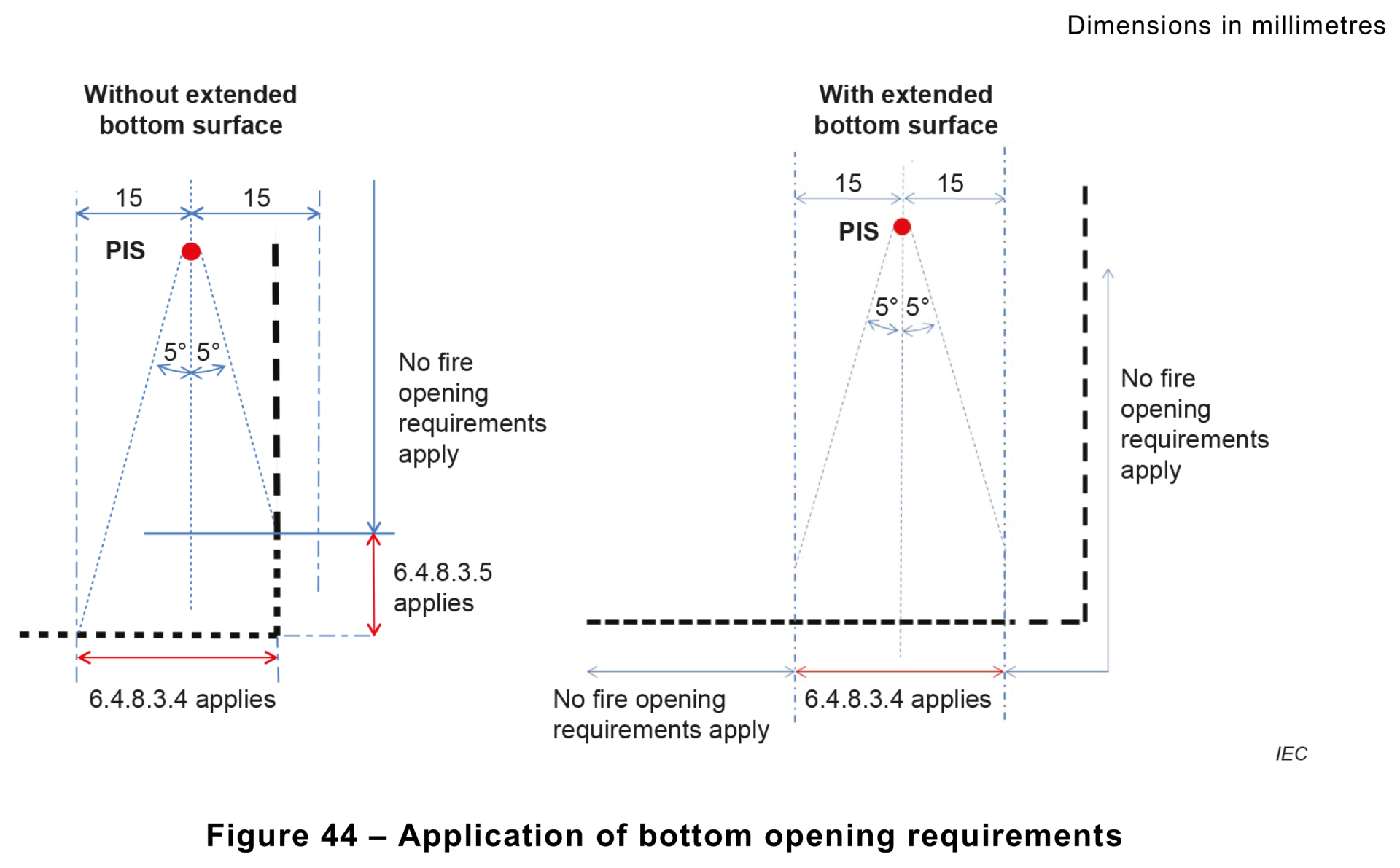
13. Clause 6.4.8.3.5, updated the requirements for side openings in fire enclosures
Side openings that comply with the maximum dimensions as illustrated in Figure 45 are considered to meet the requirements of this subclause without further consideration.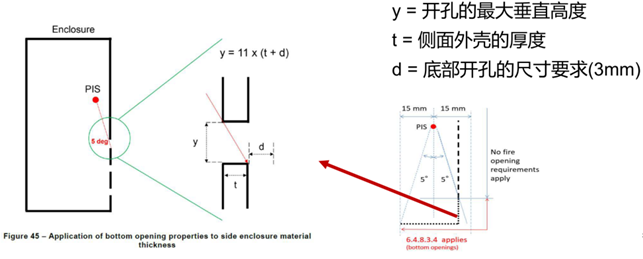
14. Annex P 2.1, updated the requirements for side openings in foreign object proof enclosures
New requirement for side openings that do not exceed 11 times the thickness of the enclosure, as described in Figure P.3.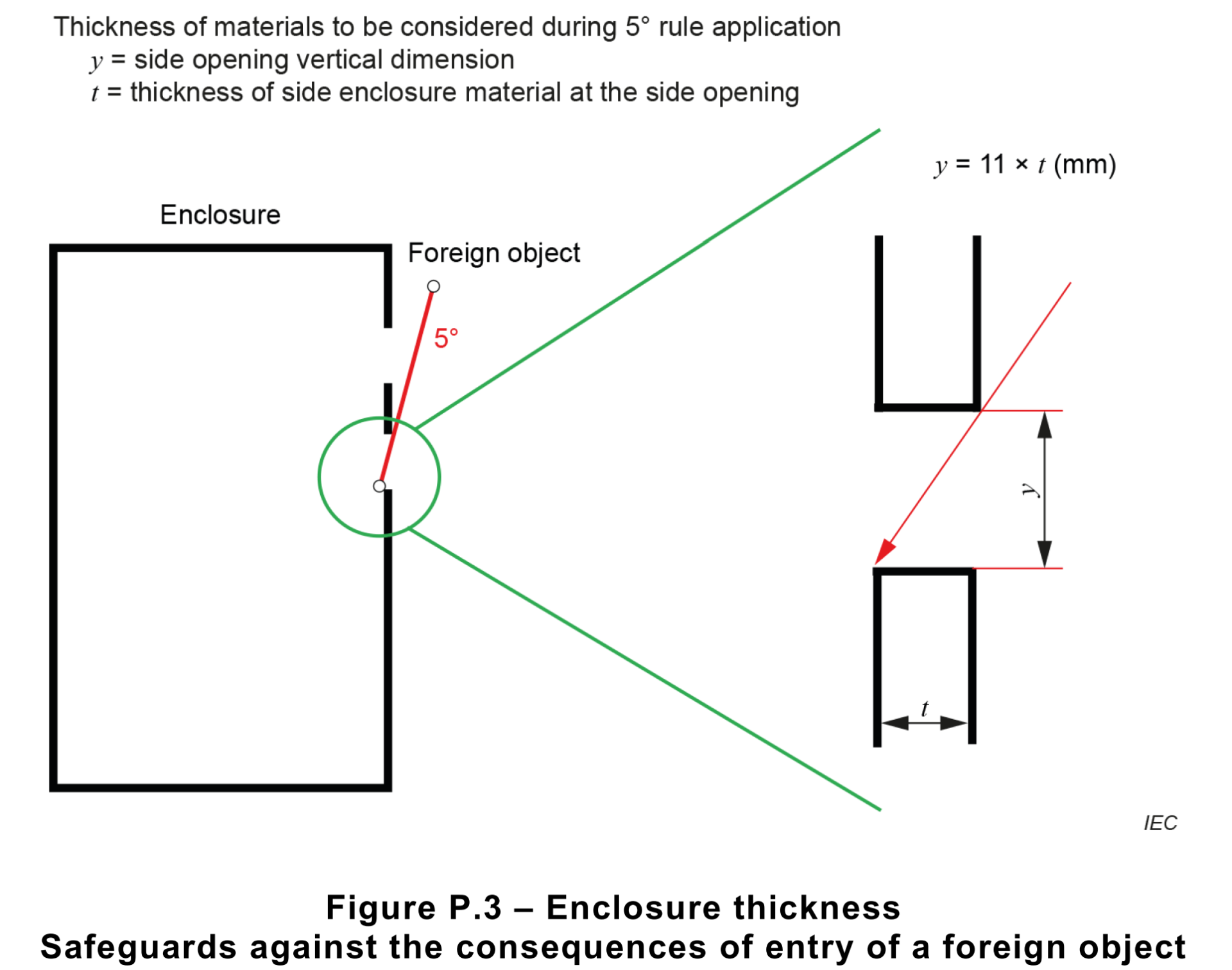
15. Clause 9.6, updated the requirements for wireless power transmitters
It is clarified that the testing requirements for wireless power transmitters are only applicable to the transmitters with substantially flat surface contact with receiver. If the contact surface is not flat, such as with a slope, then this test is not applicable.
16. Clause 9.6.3, updated the testing methods and qualification criteria
- Modify the testing method: 1) during the test, reliable fixation methods should be used on foreign objects; 2) The test with the first time allowing the transmitter to work and then placing foreign objects, the second time placing foreign objects before allowing the transmitter to work. Repeat the above for another 3 cycles,
- Relaxation of temperature limit requirements.
17. Annex B 2.5, updated the judgment requirements for input testing
Revised the judgment for equipment not supplied by the mains, the measured input current or input power shall be less or equal to the ratings of the equipment.
18. Annex F 3.5.3, updated the marking requirements for fuses
Clarified the situations in which fuses require indicative safety protection and the marking elements for indicative safety protection.
19. Annex F 3.6.2 updated the labeling requirements for Class II equipment with functional grounding
Confirmed that the Class II equipment with functional grounding needs to be labeled with a functional grounding symbol (IEC 60417-6092).

20. Annex G 7.3, updated the requirements of strain relief test
It is clarified that the interconnecting cables of ES2/ES3/PS3 circuits also subject to strain relief test.
21. Annex G 15, updated the testing requirements for pressurized liquid filled components (LFC)
Added requirements for Self-contained LFC and Modular LFC to cope with liquid cooling equipment greater than 1 liter.
22. Annex M 4, updated the applicable product categories
Removing the term 'portable' means that the requirements of M.4 also apply to non-portable battery products, expanding the scope of applicable devices.
There are additional safety requirements for the new added stationary equipment with lithium batteries,
23. Annex M 4.3, updated the testing requirements for power sources (PS) of battery cell
It is clarified that both single cell and combination cell require the evaluation of PS energy source, and only when the output is below PS1 can be exempted the fire enclosure.
Relevant information

EU Releases Exemption Guidelines on Removability and Replaceability of Portable and LMT Batteries — Multiple Product Categories Relief Granted
On July 14, 2026, the European Commission published the "Commission Guidelines to Facilitate the Harmonised Application of Provisions on the Removability and Replaceability of Portable and Light Means of Transport (LMT) Batteries" (Commission Notice C(2026) 5032 final). These guidelines aim to provide a uniform interpretative framework for the implementation of Article 11 of the EU Battery Regulat

6G Developments: Past, Present and Future
The formulation of 6G standards has entered a more concrete phase. At the 3GPP RAN Plenary Meeting held in Singapore in June 2026, the industry made progress in multiple key research areas and finalized the timeline for Release 21, which is regarded as the first standard version expected to formally define 6G.

Overview of EN IEC 61000-4-29:2026
The key focus of the 2026 edition is to address new DC power distribution environments, especially higher-voltage DC systems. It also clarifies test generator capability, duration tolerance, current limitation during short interruptions, inrush current verification, result evaluation, and test report requirements. For products using 24 Vdc, 48 Vdc, 380 Vdc, 400 Vdc, 800 Vdc, or other DC input pow