

Last August, the FCC updated KDB 987594, removing the restrictions on Wi-Fi 6E Phase 2 applications, which means the FCC began accepting certification applications for three types of devices: 6SD-Standard Power Access Point, 6FC-Fixed Client, and 6FX-Standard Client. The reason for the previous restrictions was that the Automated Frequency Coordination (AFC) system in the United States has not yet been completed and approved, which cannot provide effective management and services for standard power Wi-Fi. Therefore, while removing the restrictions on standard power device applications, the FCC also announced commencement of testing the 6 GHz AFC system. As of February 23, 2024, the FCC has approved a total of seven AFC system applications, which is critical to allowing standard power Wi-Fi to begin operating in 6 GHz band.
So what exactly is an AFC system?
What type of product needs to undergo this AFC test?
What requirements and qualifications are required for testing AFC?
Below is a detailed explanation for everyone:
>> AFC system <<
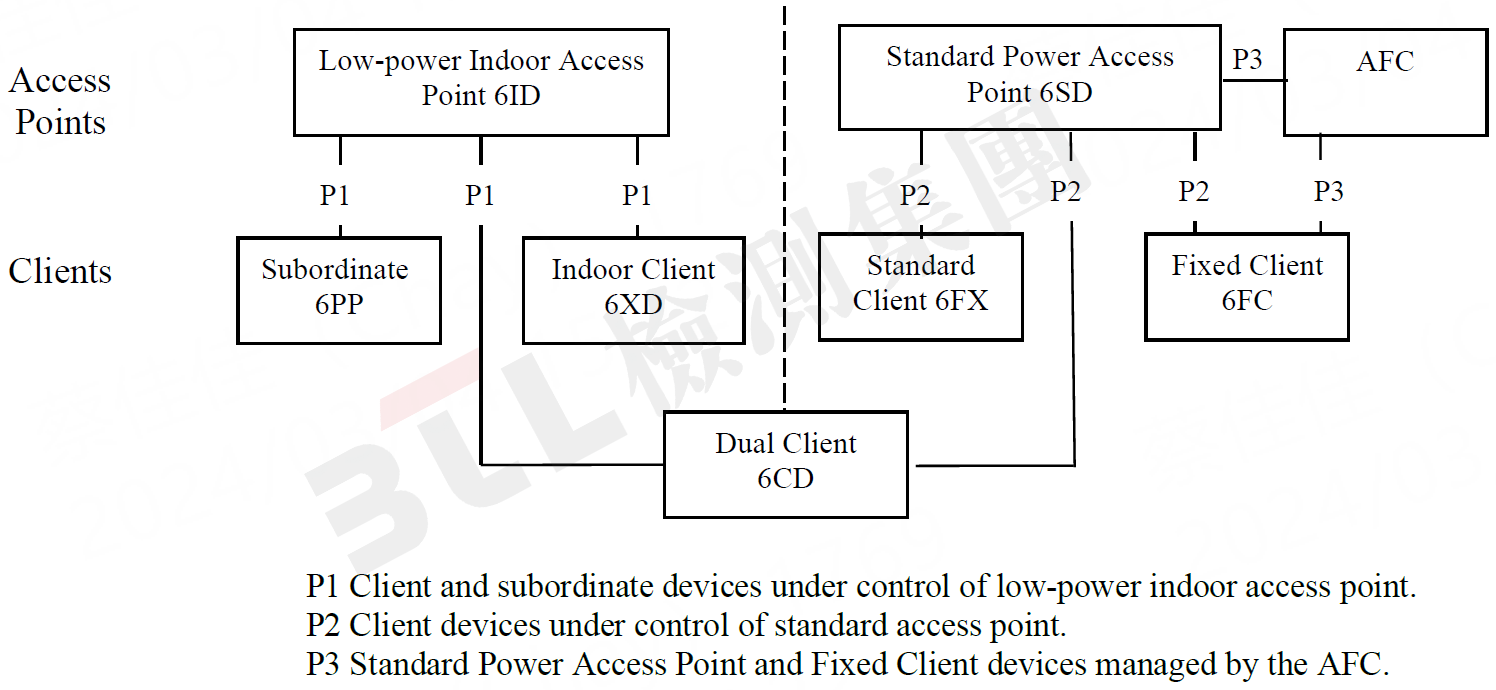
Automated frequency coordination (AFC) system: A system that automatically determines and provides lists of which frequencies are available and the maximum permissible power for use by standard power access points (6SD) and fixed client (6FC) devices operating in the 5.925-6.425 GHz (UNII-5) and 6.525-6.875 GHz (UNII-7) bands. 6SD and 6FC devices may transmit only on frequencies and at power levels that an AFC system indicates as available. As shown in the following figure.
The requirements for the AFC system are detailed in FCC Part 15.407(k)~(m). As mentioned above, seven operators have already obtained approval for their AFC systems, which means that they have all met the requirements of the regulation through testing. The FCC is currently approving these companies to operate spectrum management services in the 6 GHz frequency band.
If manufacturers want to apply for 6SD or 6FC device certification, they do not need to meet all the requirements of FCC Part 15.407(k)~(m) for the AFC part. They only need to meet the AFC related requirements of 15.407(k)(1), 15.407(k)(8), 15.407(k)(9), and 15.407(n), as detailed below.
>> Technical requirements for standard power device <<
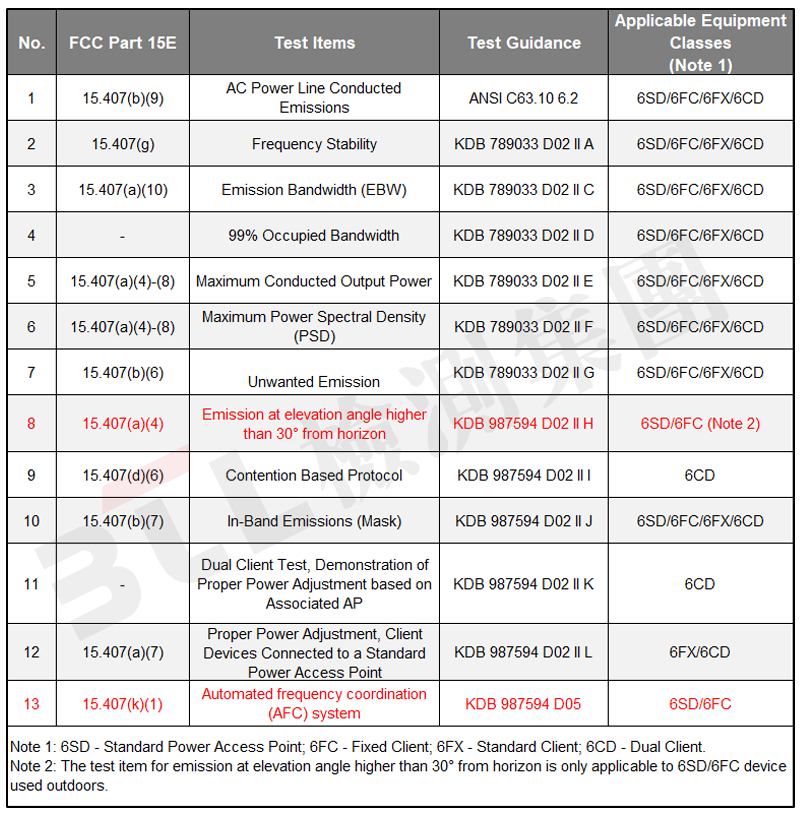
The technical requirements for equipment involving standard power are shown in the table below:
Key analysis:
* No. 8 - Emission at elevation angle higher than 30° from horizon is to protect incumbent Fixed-Satellite Services. 6SD and 6FC devices located outdoors must limit their maximum e.i.r.p. at any elevation angle above 30 degrees as measured from the horizon to 21 dBm (125 mW).
* No. 13 - AFC system is to protect incumbent Fixed Microwave Services and Radio Astronomy Services, which need to meet many requirements, including but not limited to:
> 6SD and 6FC devices must access an AFC system to determine the available frequencies and the maximum permissible power in each frequency range at their geographic coordinates prior to transmitting.
> Must register with and be authorized by an AFC system prior to the 6SD and 6FC device's initial service transmission, or after a 6SD or 6FC device changes location, and must obtain a list of available frequencies and the maximum permissible power.
> 6SD and 6FC devices must register with the AFC system by providing the following parameters: Geographic coordinates, antenna height above ground level, FCC identification number, and unique manufacturer's serial number.
> 6SD and 6FC devices must provide the registration information to the AFC system either directly and individually or by a network element. The 6SD, 6FC device or its network element must register with the AFC system via any communication link, wired or wireless, outside UNII-5 and UNII-7 bands.
> 6SD and 6FC devices must contact an AFC system at least once per day to obtain the latest list of available frequencies and the maximum permissible power. If the 6SD or 6FC device fails to successfully contact the AFC system during any given day, the 6SD or 6FC device may continue to operate until 11:59 p.m. of the following day at which time it must cease operations until it re-establishes contact with the AFC system.
> 6SD and 6FC devices must incorporate adequate security measures to prevent it from accessing AFC systems not approved by the FCC, etc.
> A 6SD and a 6FC device must include either an internal geo-location capability or an integrated capability to securely connect to an external geolocation devices or service, to automatically determine the standard power access point's geographic coordinates and location uncertainty.
> An external geo-location source may be connected to a 6SD or 6FC device through either a wired or a wireless connection.
> An external geo-location source must be connected to a 6SD or 6FC device using a secure connection.
> The applicant for certification of a 6SD or 6FC device must demonstrate the accuracy of the geo-location method used and the location uncertainty.
>> AFC testing of 6SD & 6FC <<
According to KDB 987594 D05 AFC DUT Test Harness Testing v01r01, some AFC requirements for the 6SD and 6FC devices mentioned above can be tested using testing tool, while others cannot, as described below:
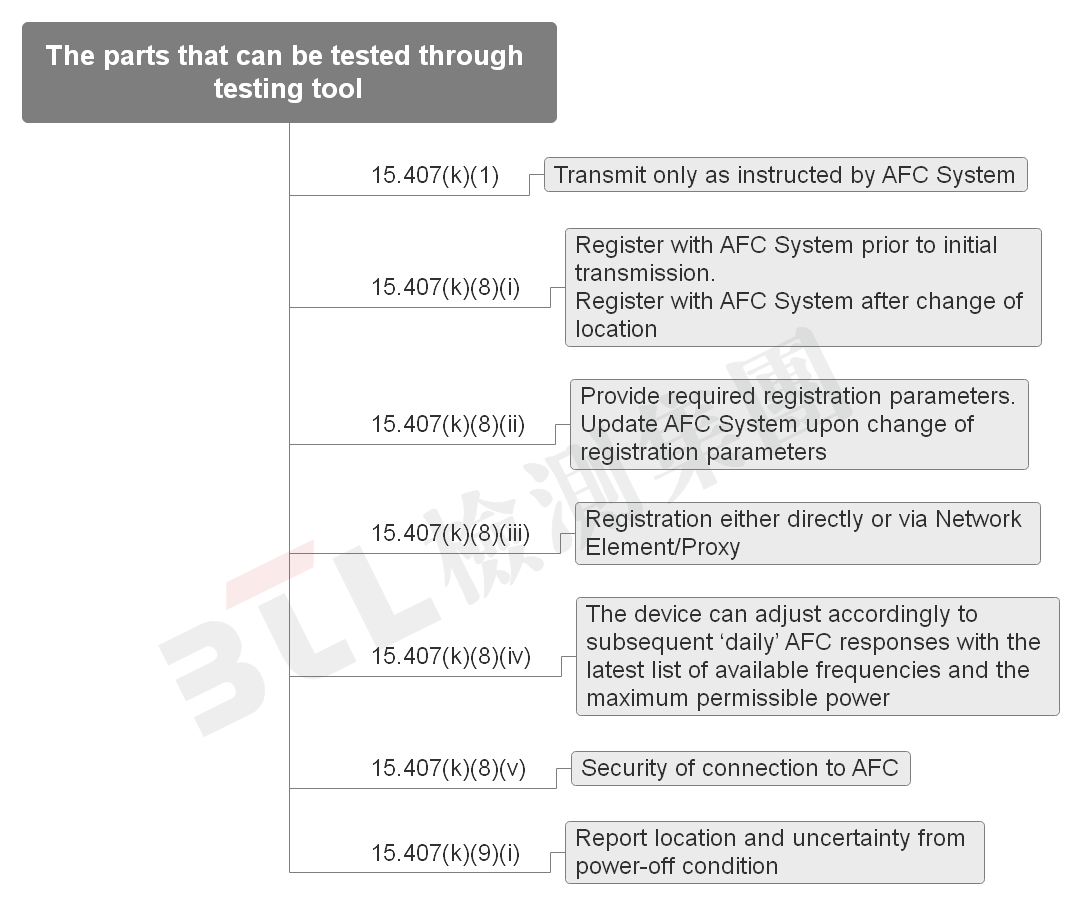
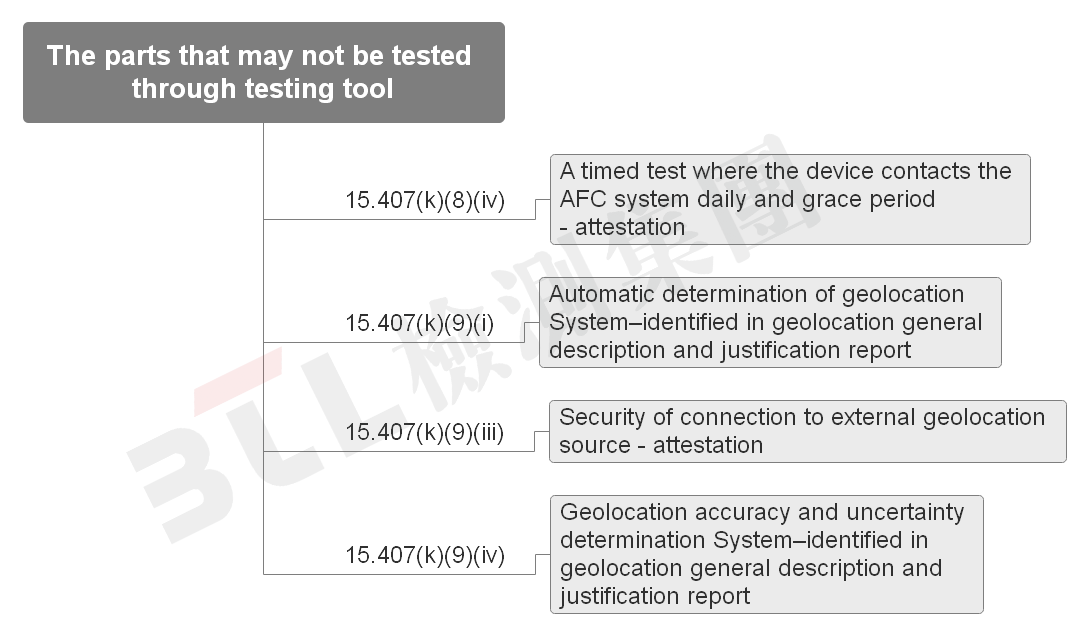
* Separate attestations and test reports are required by the manufacturer when testing through a test tool is not available.
The testing tool mentioned above is "AFC DUT test harness", developed by the Wi-Fi Alliance. So there are questions from manufacturers, do they need to join the Wi-Fi alliance and gain its recognition in order to obtain this testing tool? Have manufacturers heard that testing laboratories still need to have CBSD qualifications to test AFC?
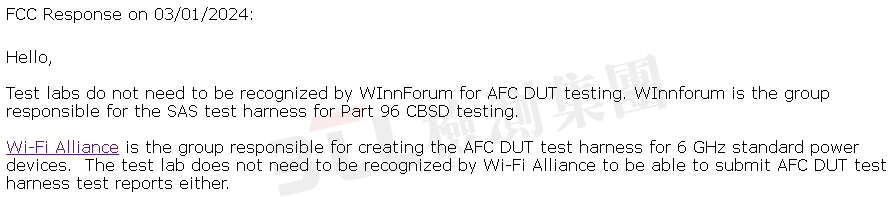
In response to the above questions, BTL believes after research that obtaining the AFC DUT test harness testing tool does not require joining the Wi-Fi Alliance and obtaining its recognition, and AFC testing for 6SD and 6FC devices does not require obtaining CBSD qualifications. BTL also consulted the FCC official, and the official response confirmed that our understanding is correct.
Manufacturers of low-power indoor access point (6ID) or indoor client (6XD) devices can feel that although their power limit is 30 dBm / 24 dBm, the PSD limit is very low, resulting in low power in low bandwidth mode and poor actual user experience. And standard power devices do not have this kind of problem, their power and PSD limits are very loose, and the power can be done very large. Therefore, manufacturers who want high-power devices can consider making standard power devices!
BTL now has the recognized qualification and testing energy for FCC Wi-Fi 6E standard power devices, you are welcome to contact the BTL team. BTL will share the most professional and comprehensive information with you.
Relevant information

EU Releases Exemption Guidelines on Removability and Replaceability of Portable and LMT Batteries — Multiple Product Categories Relief Granted
On July 14, 2026, the European Commission published the "Commission Guidelines to Facilitate the Harmonised Application of Provisions on the Removability and Replaceability of Portable and Light Means of Transport (LMT) Batteries" (Commission Notice C(2026) 5032 final). These guidelines aim to provide a uniform interpretative framework for the implementation of Article 11 of the EU Battery Regulat

6G Developments: Past, Present and Future
The formulation of 6G standards has entered a more concrete phase. At the 3GPP RAN Plenary Meeting held in Singapore in June 2026, the industry made progress in multiple key research areas and finalized the timeline for Release 21, which is regarded as the first standard version expected to formally define 6G.

Overview of EN IEC 61000-4-29:2026
The key focus of the 2026 edition is to address new DC power distribution environments, especially higher-voltage DC systems. It also clarifies test generator capability, duration tolerance, current limitation during short interruptions, inrush current verification, result evaluation, and test report requirements. For products using 24 Vdc, 48 Vdc, 380 Vdc, 400 Vdc, 800 Vdc, or other DC input pow