

With the rapid development of modern technology, robots are slowly entering our engineering and medical industries such as industrial production, scientific research, and healthcare. Follow the editor to learn about the EMC evaluation and testing requirements for engineering medical robots in CISPR 11: 2024, and explore the differences from the previous version.
1. Engineering and Medical Robots
A. There are many types of robots, which ones belong to the category of engineering and medical robots?
EXAMPLE Welding robots, spraying robots, handling robots, processing robots, assembly robots, medical robots,l education and experimental robots. A comprehensive list of robots in the scope of this document is given on the IEcl EMC zone.
Flying robots, domestic helper robots, toy robots and entertainment robots are examples of robots in thescope of other CISPR standards.
B. How to arrange and evaluate the operation mode of EMC testing for engineering medical robots?
a) Testing arrangement for engineering medical robots:
The movable parts of the robot should be able to move freely during testing as they would during normal operation.
The installation of robots should be at the required height, allowing the propulsion system of the robot to move freely (such as 15cm, 40cm, 80cm insulation pads). When the use of 80cm insulation pads still cannot meet the requirements of free movement, the height can be increased as appropriate and recorded truthfully in the report.
b) Conduction test placement:
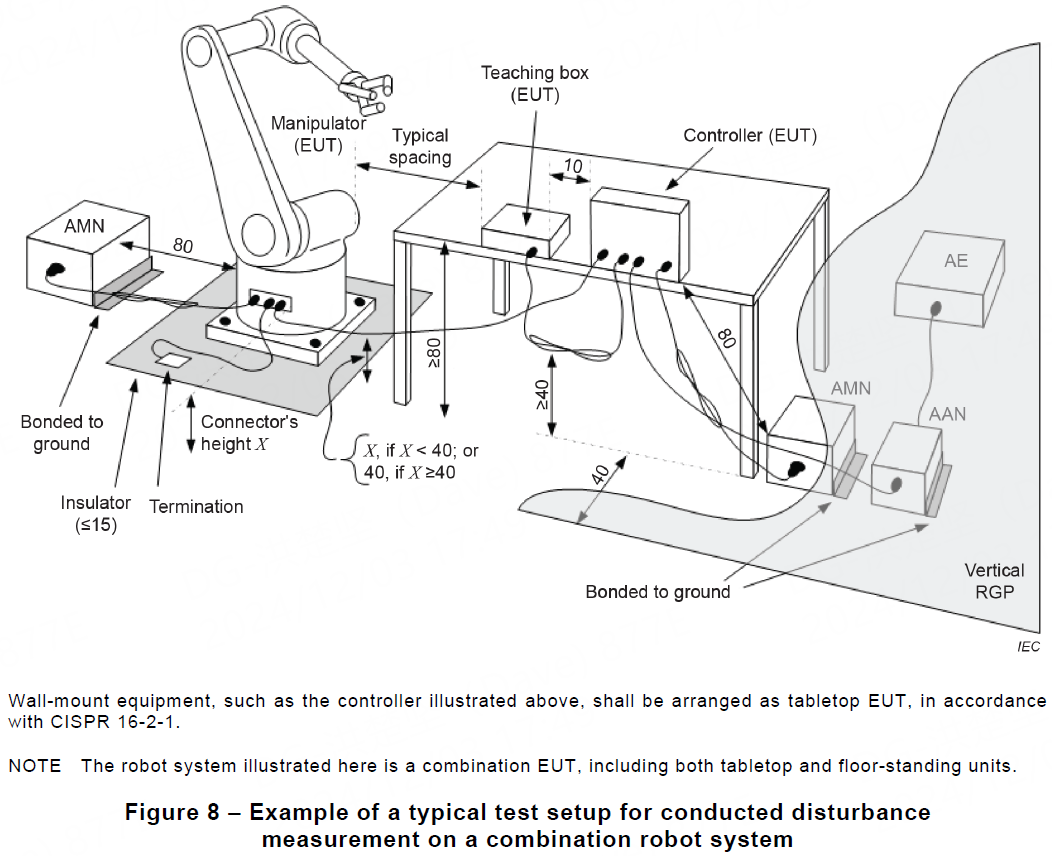
c) Radiation testing placement:
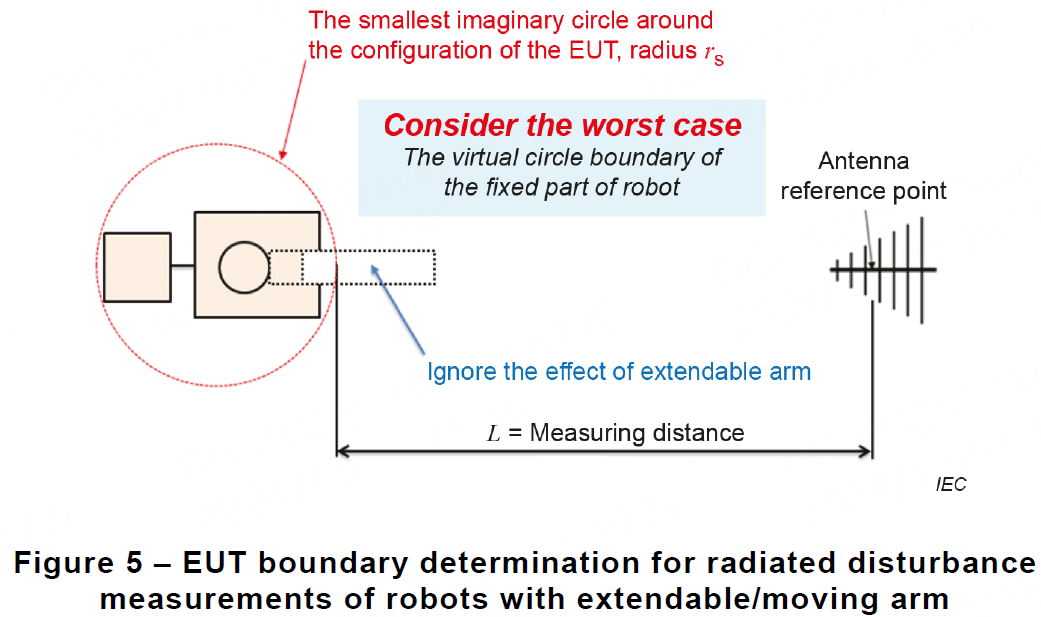
Note 1: During radiation RE testing, the EUT boundary is defined by the smallest circle of the fixed components of the robot and their corresponding EUT cable footprint, ignoring any parts that the robot moves during normal operation.
Note 2: If during the operation of the robot, radiation beyond the limit may be generated by the moving arm/component outside the EUT boundary, the measuring antenna should be repositioned to the maximum distance from that specific part of the robot's moving arm/component, the radiation should be remeasured, and the results should be recorded in the test report.
d) Operation mode evaluation of engineering medical robots:
Table 22 - Operation modes for fixed robots
| Operation mode | Description |
| Mode 1 | The robot is powered on but in its idle mode of operation (static state). |
| Mode 2 | Normal operation mode at rated load, rated speed, defined maximum pose and trajectory . |
| Mode 3 | Similar to mode 2, but with all corresponding parameters (e.g., load) set at approximately the middle of their specified range. |
表23-移动机器人的操作模式
| Operation mode | Description |
| Mode 1 | Battery charging mode: the battery charging level is less than or equal to 20 % at the beginning of the test and remains less than 80 % for the entire duration of the test; the robot is in charging mode, with its main function(s) idle. |
| Mode 2 | Normal operation mode at rated load and at rated speed. If the robot cannot operate at the same time at its rated load and rated speed, these two modes shall be evaluated in turn. |
| Mode 3 | Similar to mode 2, but with all corresponding parameters (e.g., load) set at approximately the middle of their specified range. |
| If the robot can be placed in both its normal mode of operation and in battery charging mode at the same time, then both mode 1 and mode 2 (or mode 1 and mode 3) can be evaluated for compliance with the limits throughl a single test, with the EUT connected to AC mains power. The test report shall specify how the EUT was placed in both operating modes for the test. | |
If it is estimated that other operating modes will also generate significant emissions based on the specific design, construction, and functionality of the tested robot, then in addition to the modes listed in Tables 22 and 23, other operating modes should also be evaluated.
2. Other new changes to CISPR 11:2024, except for engineering and medical robots:
According to the requirements of the universal emission standard, the radiation interference limit of Group 1 equipment in the frequency range above 1GHz has been introduced;
According to the requirements of the universal transmission standard, a limit for conducted interference at wired network ports has been introduced;
Introduced devices with wireless transmission / reception functions; And testing of related antenna ports.
I believe you have gained some understanding of EMC testing for engineering and medical robots. As early as 2021, IEC classified robots (such as service robots, educational robots, flying robots, etc.) and allocated some of them to relevant CISPR sub committees for research.
Paper is limited, passion is infinite!!!
BTL has years of testing experience, and the EMC engineering team in the South China region has dedicated installation personnel, project evaluation management personnel, and on-site testing personnel to achieve greater professionalism, meticulousness, and efficiency; And the venue resources are abundant, with multiple complete sets of EMC equipment, the testing site can meet the testing requirements of the vast majority of robots.
To learn more about the scope of CISPR standards for robots, please feel free to call us for consultation. We are happy to answer your questions and welcome your call !
Relevant information

EU Releases Exemption Guidelines on Removability and Replaceability of Portable and LMT Batteries — Multiple Product Categories Relief Granted
On July 14, 2026, the European Commission published the "Commission Guidelines to Facilitate the Harmonised Application of Provisions on the Removability and Replaceability of Portable and Light Means of Transport (LMT) Batteries" (Commission Notice C(2026) 5032 final). These guidelines aim to provide a uniform interpretative framework for the implementation of Article 11 of the EU Battery Regulat

6G Developments: Past, Present and Future
The formulation of 6G standards has entered a more concrete phase. At the 3GPP RAN Plenary Meeting held in Singapore in June 2026, the industry made progress in multiple key research areas and finalized the timeline for Release 21, which is regarded as the first standard version expected to formally define 6G.

Overview of EN IEC 61000-4-29:2026
The key focus of the 2026 edition is to address new DC power distribution environments, especially higher-voltage DC systems. It also clarifies test generator capability, duration tolerance, current limitation during short interruptions, inrush current verification, result evaluation, and test report requirements. For products using 24 Vdc, 48 Vdc, 380 Vdc, 400 Vdc, 800 Vdc, or other DC input pow