

For multimedia equipment with audio output, the standard has special testing requirements. Here is some interpretation and insight, so that customers can determine whether their products comply with such tests, and EMC design can be considered in the early stages of the product to help customers reduce certification costs and shorten the certification cycle.
What equipment is included in the EN 55035 Scope?
Applicable to information technology equipment, audio equipment, video equipment, broadcast receiving equipment, entertainment lighting control equipment and their combinations with a rated AC voltage RMS or DC voltage not exceeding 600V.
What is audio equipment?
Equipment whose primary function includes at least one of audio signal generation, input, storage, playback, retrieval, transmission, reception, amplification, processing, conversion or control.
Product testing
For devices with audio output function, Appendix G has special testing requirements for RS and CS, and the product sound interference ratio during the interference process needs to be monitored.
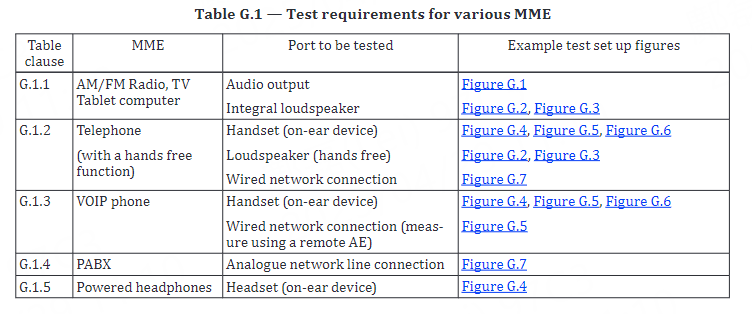
1. Common MME equipment test ports and sample test diagrams
2. Supports phone function sound/electricity limit values
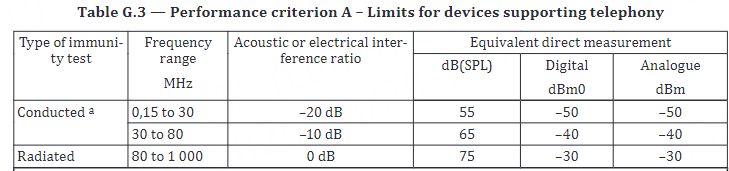
3. Except for devices supporting phone functions, limit value (-20dB or better)

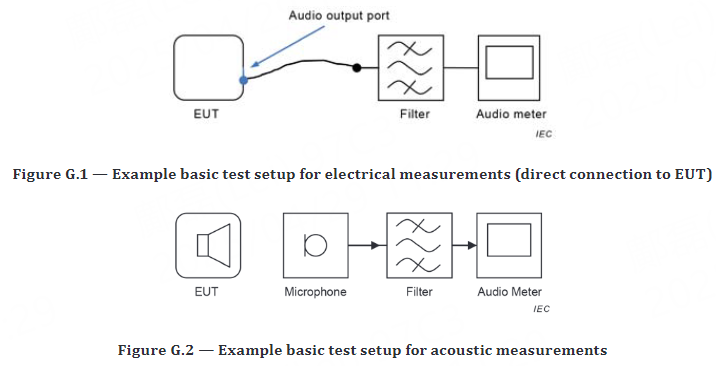
4. Acoustic/Electrical Test Example Diagram
Early stage of product design - EMS problem analysis:
Interference analysis:
When the RS shell shielding performance is intact, the interference signal is usually transmitted by the antenna, then coupled through the exposed power line and signal line, amplified by the audio function, and monitored by the sound analysis instrument;
CS directly adds the interference signal to the power supply or signal end of the product through CDN, and then transmits it to the inside of the product, amplifies it through the audio function, and is monitored by the sound analysis instrument;
Early stage of product design - some layout suggestions on RS/CS
Conducted Immunity:
1. Optimize power supply filtering:
Install a suitable power filter at the power inlet to suppress the introduction of conducted interference;
Ensure that the filter is well grounded and the grounding wire is as short as possible.
2. Improve grounding design:
Choose a suitable grounding method according to the circuit frequency, such as single-point grounding, multi-point grounding or mixed grounding;
Reduce grounding impedance, ensure the stability of the grounding system, and avoid interference caused by ground potential difference.
3. Add decoupling capacitors:
Add appropriate decoupling capacitors between the VCC and GND of the IC to reduce the impact of noise on the power line on the IC.
4. Optimize wiring:
Rationally wire to avoid mutual interference between signal lines, power lines, and ground lines.
Shield strong interference sources (such as crystal oscillators and high-frequency circuits).
5. Add protection circuits:
Add protection circuits to the power lines and signal lines, such as transient voltage suppressor diodes (TVS), varistors (MOV), etc.
Radiated immunity:
1. Strengthen shielding:
Add shielding covers or shielding layers to key circuits or equipment housings, use highly conductive materials and ensure good grounding.
2. Optimize PCB layout:
Separate high-frequency circuits from low-frequency circuits to avoid mutual interference.
Ensure the integrity of the PCB ground plane to reduce interference caused by ground loops.
3. Add filters:
Add filters to signal lines and power lines to suppress the transmission of electromagnetic interference.
4. Energy dispersion:
The control software is used to implement spread spectrum and frequency hopping technology to disperse the frequency band energy and reduce the electromagnetic wave intensity radiated by a single point frequency.
5. Reduce loop area:
Reduce the high-frequency current loop area to avoid the formation of "antenna effect" and thus reduce radiation interference. For example, shorten the length of the connection and eliminate unnecessary long pins.
BTL has extensive experience in the certification of multimedia devices (laptops/tablets/mobile phones/monitors/TVs/gateways/headphones/speakers, etc.) and has a professional team to provide technical support and certification solutions to help your products quickly enter the market.
Relevant information

EU Releases Exemption Guidelines on Removability and Replaceability of Portable and LMT Batteries — Multiple Product Categories Relief Granted
On July 14, 2026, the European Commission published the "Commission Guidelines to Facilitate the Harmonised Application of Provisions on the Removability and Replaceability of Portable and Light Means of Transport (LMT) Batteries" (Commission Notice C(2026) 5032 final). These guidelines aim to provide a uniform interpretative framework for the implementation of Article 11 of the EU Battery Regulat

6G Developments: Past, Present and Future
The formulation of 6G standards has entered a more concrete phase. At the 3GPP RAN Plenary Meeting held in Singapore in June 2026, the industry made progress in multiple key research areas and finalized the timeline for Release 21, which is regarded as the first standard version expected to formally define 6G.
Overview of EN IEC 61000-4-29:2026
The key focus of the 2026 edition is to address new DC power distribution environments, especially higher-voltage DC systems. It also clarifies test generator capability, duration tolerance, current limitation during short interruptions, inrush current verification, result evaluation, and test report requirements. For products using 24 Vdc, 48 Vdc, 380 Vdc, 400 Vdc, 800 Vdc, or other DC input pow