

Voltage Dips & Short Interruptions Immunity Test
1. Why is this update important?
IEC 61000-4-34 applies to voltage dips and short interruption immunity testing for high-current equipment. Amendment 2 (2025) clarifies test procedures, especially for three-phase systems.
2. Key Updates in A2
• Clear requirement for simultaneous three-phase testing
• Default phase angle defined as 0°
• Improved test consistency across laboratories
3. Do I need re-testing?
If previous tests did not include simultaneous three-phase testing or phase angle documentation, re-evaluation is recommended.
4. Recommended Actions
• Review existing test reports
• Apply A2 conditions for new projects
• Confirm test setup with laboratory
5. Frequently Asked Questions
Q1:Is the old report still valid?
A: Acceptance depends on market and certification body; impact evaluation is recommended.
Q2:Are single-phase products affected?
A: Impact mainly applies to three-phase equipment.
Q3:Does A2 increase test severity?
A: Test levels remain unchanged; conditions are more clearly defined.
6. Do We Need Re-testing?
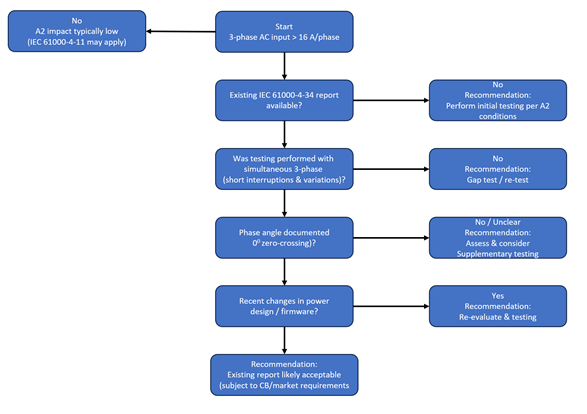
This page provides a practical decision flow based on BS EN / IEC 61000-4-34:2007+A2:2025 to help determine whether re-testing or gap testing is recommended.
Decision Flow
Step 1: Is the product three-phase AC powered and has a rated current >16 A/phase?
→ No: Generally unaffected by A2 (IEC 61000-4-11 applies)
→ Yes: Proceed to Step 2
Step 2: Was the original test clearly recorded for simultaneous three-phase testing?
→ No: Retesting is recommended.
→ Yes: Proceed to Step 3
Step 3: Was the original test conducted at a 0° (positive zero crossover) phase angle?
→ Uncertain / Not recorded: Evaluation and retesting are recommended.
→ Yes: Proceed to Step 4
Step 4: Has the product design, firmware, or power architecture been changed recently?
→ Yes: Re-evaluation or retesting is recommended.
→ No: Existing test results are generally still acceptable.
7. Test Illustration and Practical Instructions (Summary)
• IEC 61000-4-34 requires phase control and vector configuration according to regulations during voltage sag and brief interruption tests on three-phase systems (refer to Annex C).
• A2:2025 provides additional explanations regarding the differences in three-phase vector angle conventions and adds Annex F, explaining the interpretation of voltage rise-time/fall-time.
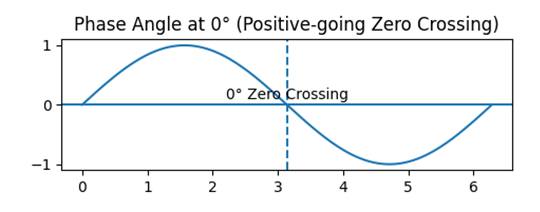
• In practical testing, a 0° phase angle (positive zero crossover) is often the most stringent condition, potentially causing system reset, communication interruption, or control anomalies, even if the hardware is not damaged.
• Whether a system is deemed FAIL must be determined according to product performance criteria and product specifications or customer agreements.
8. Lab Practical Notes
• For three-phase testing, ensure the dip generator has sufficient inrush current capability (Annex A).
• During testing, it is recommended to monitor the three-phase voltage and EUT status log to facilitate the interpretation of transient behavior.
• For phase-to-phase testing, avoid using the disallowed configuration shown in Figure 3d.
• It is recommended to clearly record the following in the test report: phase angle, test method (Method 1/2), and performance judgment criteria.
Figure 1 Voltage Dip & Short Interruption Waveform
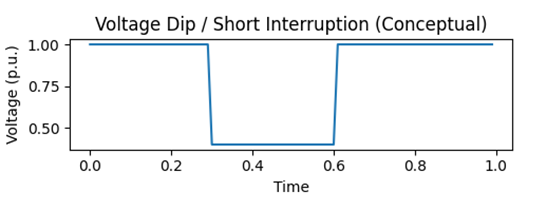
Conceptual waveform illustrating voltage dip and short interruption. This figure is for explanation only, not a standard reproduction.
Figure 2 Phase Angle 0° (Zero Crossing)
Relevant information

EU Releases Exemption Guidelines on Removability and Replaceability of Portable and LMT Batteries — Multiple Product Categories Relief Granted
On July 14, 2026, the European Commission published the "Commission Guidelines to Facilitate the Harmonised Application of Provisions on the Removability and Replaceability of Portable and Light Means of Transport (LMT) Batteries" (Commission Notice C(2026) 5032 final). These guidelines aim to provide a uniform interpretative framework for the implementation of Article 11 of the EU Battery Regulat

6G Developments: Past, Present and Future
The formulation of 6G standards has entered a more concrete phase. At the 3GPP RAN Plenary Meeting held in Singapore in June 2026, the industry made progress in multiple key research areas and finalized the timeline for Release 21, which is regarded as the first standard version expected to formally define 6G.

Overview of EN IEC 61000-4-29:2026
The key focus of the 2026 edition is to address new DC power distribution environments, especially higher-voltage DC systems. It also clarifies test generator capability, duration tolerance, current limitation during short interruptions, inrush current verification, result evaluation, and test report requirements. For products using 24 Vdc, 48 Vdc, 380 Vdc, 400 Vdc, 800 Vdc, or other DC input pow