

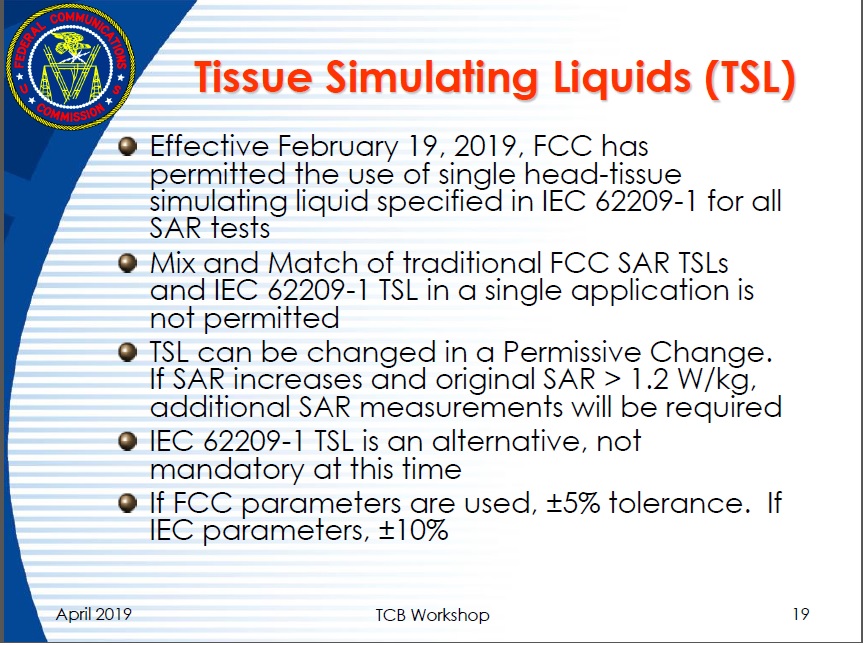
In the past, testing FCC SAR was a very tiring thing for SAR test engineers, because changing the tissue fluid, testing the head and body separately, and then replacing the liquid was a time-consuming and laborious task.At the meeting of FCC Workshop last week, the announcement was officially issued. In the future, when testing FCC SAR, head liquid can be used for testing because FCC accepts IEC 62209-1 tissue fluid requirements.
Therefore, in the subsequent FCC SAR test, the liquid will not need to be replaced and the test will be carried out directly.
However, when using TSL for Body SAR testing, the FCC also mentions some considerations:
1. Mix and Match of traditional FCC SAR TSLs and IEC 62209-1 TSL in a single application is not permitted;
2. TSL can be changed in a Permissive Change. If SAR increases and original SAR > 1.2 W/kg, additional SAR measurements will be required;
3. IEC 62209-1 TSL is an alternative, not mandatory at this time;
4. If FCC parameters are used, ±5% tolerance. If IEC parameters, ±10%;
If you want to know more, welcome to BTL to communicate with us to learn more details.
Relevant information
CRA Implementation Enters a Critical Phase
In August 2026, preparations for the implementation of the EU Cyber Resilience Act (CRA) entered a critical stage. With the reporting obligations set to take effect on September 11, 2026, drawing near, the European Commission and the European Union Agency for Cybersecurity (ENISA) have been intensively issuing implementation guidance and materials related to the single reporting platform.
Canada's ISED Officially Releases RSS-310 Issue 6: Major Updates to Radio Frequency Equipment Requirements
Innovation, Science and Economic Development Canada (ISED) has formally issued RSS-310, Issue 6, “Licence-Exempt Radio Apparatus: Category II Equipment,” replacing Issue 5, which has been in effect since 2020