

On July 11, 2019, Japanese MIC issued a decree updating the technology of WLAN.
There are three main points:
1. Expanding Operating Range of W56
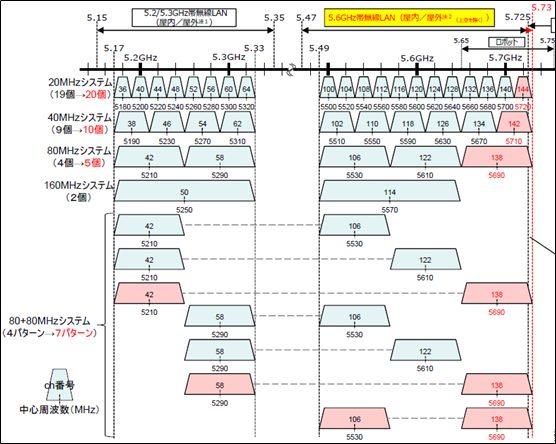
In order to alleviate the congestion of W56 channel and improve the utilization of high-speed WLAN, the operation range of W56 is expanded from 5725 MHz to 5730 MHz.
After the range is expanded, the available channel increases:
CH144 (20MHz system), CH142 (40MHz system), CH138 (80MHz system). The combination of 80 + 80MHz systems has also increased, and the number of channels for high-speed communication (80/160/80 + 80MHz system) has increased to 1.5 times the previous number.
2. Importing the IEEE 802.11ax
In order to improve the transmission speed of WLAN system, the IEEE 802.11ax is imported. Compared with 11ac, 11ax can increase throughput at least four times.
When 11ax was imported, the technical requirements were revised. The main change was OBW:
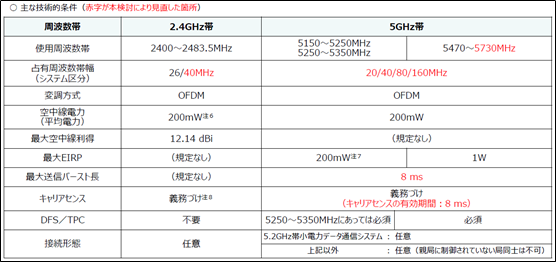
2.4G band OBW Limit is revised as follows:
For 20MHz system, there is no change, Limit is still 26MHz.
For 40MHz system, Limit is revised from 38MHz to 40MHz.
5G band OBW Limit is revised as follows:
19.7MHz → 20MHz (20MHz system)
38MHz → 40MHz (40MHz system)
78MHz → 80MHz (80MHz system)
158MHz → 160MHz (160MHz system)
Other amendments:
a. Transmission Burst Length of 5GHz band is modified to 8ms (original Limit is 4ms).
b. Carrier Sense Capability in 5GHz band adds Limit to 8ms.
3. W53 DFS Testing Requirements Increased
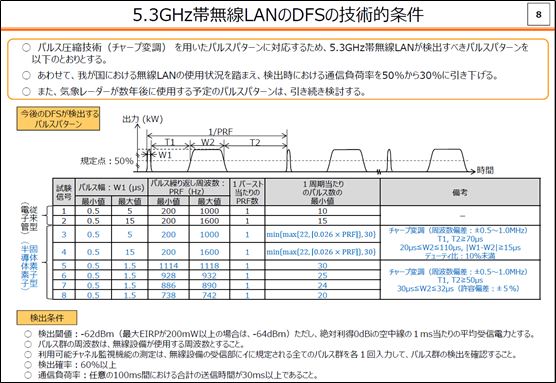
In order to share the frequency with meteorological radar in 5.3 GHz band WLAN and adapt to the changing trend of meteorological radar technology, a new W53 DFS test requirement is added.
The main changes are as follows:
a. The throughput decreased from 50% to 30%.
b. Radar type has been increased from 2 to 8. Radar parameters are detailed in the following figure.
c. The detection probability is consistent with the previous requirements, which should be more than 60%.
The transition period between the new version and the old version is one year, from July 11, 2019 to July 10, 2020 to July 10, 2020. On July 10, 2020, the new version will be enforced.
Relevant information

CRA Implementation Enters a Critical Phase
In August 2026, preparations for the implementation of the EU Cyber Resilience Act (CRA) entered a critical stage. With the reporting obligations set to take effect on September 11, 2026, drawing near, the European Commission and the European Union Agency for Cybersecurity (ENISA) have been intensively issuing implementation guidance and materials related to the single reporting platform.
Canada's ISED Officially Releases RSS-310 Issue 6: Major Updates to Radio Frequency Equipment Requirements
Innovation, Science and Economic Development Canada (ISED) has formally issued RSS-310, Issue 6, “Licence-Exempt Radio Apparatus: Category II Equipment,” replacing Issue 5, which has been in effect since 2020