

The European standard EN 62311 has been approved by CENELEC (European Committee for Electronic Technical Standards), and the official version of EN / IEC 62311: 2020 was officially released in January 2020. This standard requires mandatory requirements after 2020/7/24. For the current implementation If the products under certification are not affected, they can directly apply for the latest version.
Changes are shown below:
1. A clear distinction between intentional and unintentional radiators has been introduced.
For unintentionally radiating equipment, the compliance assessment to emissions of E or H field shall be made according to the highest internal frequency used within the equipment under assessment or at which the equipment operates with the following criteria:
– if the highest internal frequency of the equipment is less than 10 kHz, the assessments should be made up to 400 kHz;
– if the highest internal frequency of the equipment is less than 108 MHz, the assessments should be made up to 1 GHz;
– if the highest internal frequency of the equipment is between 108 MHz and 500 MHz, the assessment should be made up to 2 GHz;
– if the highest internal frequency of the equipment is between 500 MHz and 1 GHz, the assessment should be made up to 5 GHz.
If the highest internal frequency of the equipment is above 1 GHz, the assessment should be made up to 5 times the internal frequency or 6 GHz, whichever is greater.
2. The exposure to non-uniform fields is considered.
The reference level or the maximum permissible exposure level are calculated under the assumption that a human is exposed to uniform fields.
Under the situation that wavelength is longer than the distance between a human and an EM field source, for example a human is standing immediately adjacent to a high voltage transformer, the field is not uniform. If exposure is evaluated by the maximum value of field strength data at one hot spot, evaluation will be more excessive.
To consider non-uniformity of the fields, there are two methods:
1) Spatial averaging of field strength or power density (depending on the frequency and applicable exposure limit) data measured at several points assumed to be occupied by a human body. Examples of spatial averaging methods can be found in IEC 62110 for exposure around a power facility, such as a transformer, which is based on 3 to 5 measurement points, or in IEC 62232 for exposure from radiocommunication base stations.
2) Compensation by using a coupling factor. This method is used for local exposure, such as exposure to the fields from a domestic appliance or a small magnetic field source. Examples of coupling factors for local exposure to magnetic fields are given in IEC 622262- 1, or for the evaluation of a magnetic flux density in IEC 62233.
3. The treatment of uncertainty for the assessment procedures has been improved.
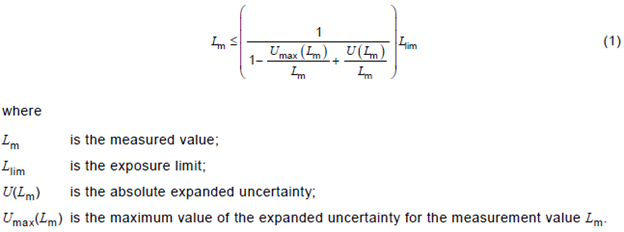
If the assessment uncertainty is less than or equal to a permissible maximum uncertainty Umax(Lm)/ Lm, then the measured value Lm shall be compared directly with the applicable limit Llim for the evaluation of compliance.
Formula (1) shall be used to determine whether the measured value Lm complies with the reduced limit if the actual assessment uncertainty of the applicable assessment method is a permissible maximum uncertainty or more.
For EMF evaluation, 30 % is often used for a permissible maximum uncertainty.
4. Various summation regimes are described in Annex A.
5.Add refrance standard EN 62232: 2017
IEC 62232:2017, Determination of RF field strength, power density and SAR in the vicinity of radiocommunication base stations for the purpose of evaluating human exposure.
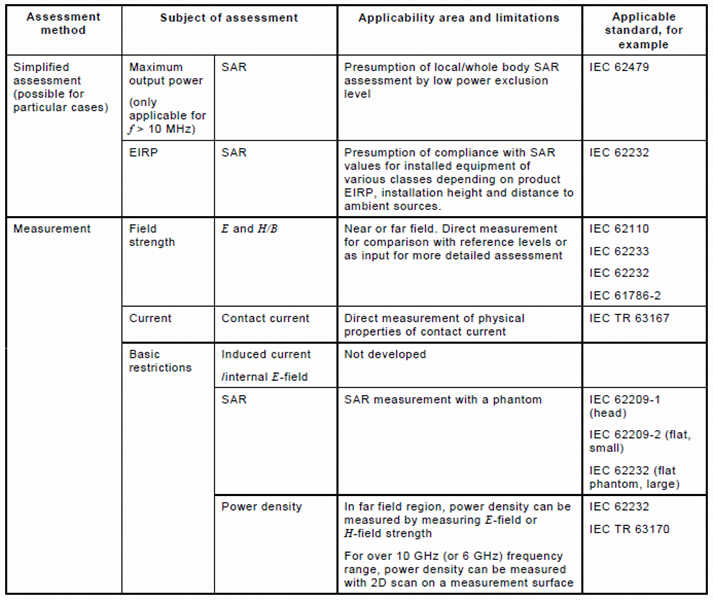
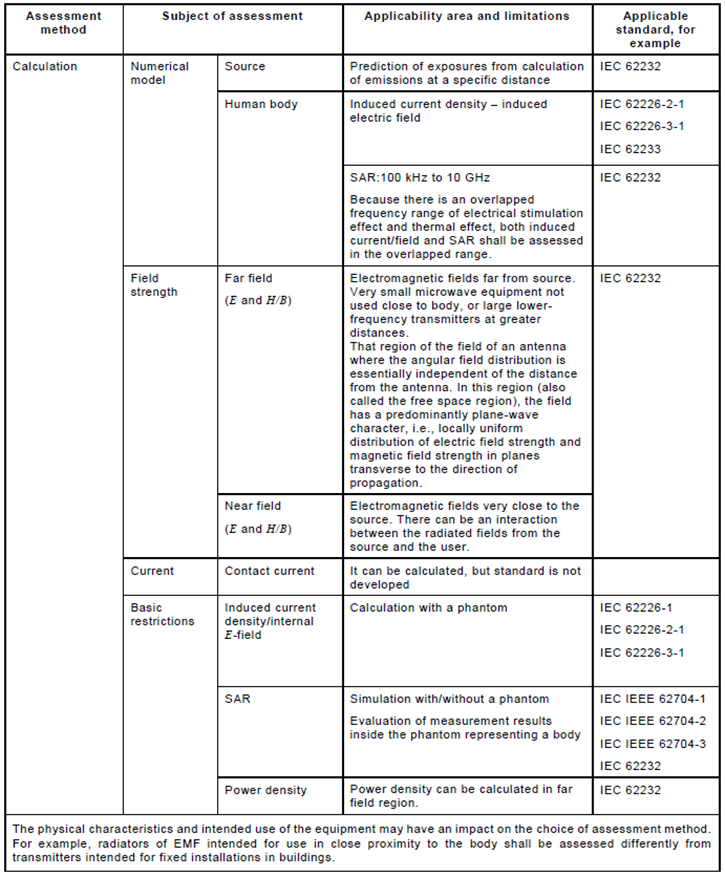
6. Defined and explained for Assessment methods list on added to applicable standard list.
Relevant information

CRA Implementation Enters a Critical Phase
In August 2026, preparations for the implementation of the EU Cyber Resilience Act (CRA) entered a critical stage. With the reporting obligations set to take effect on September 11, 2026, drawing near, the European Commission and the European Union Agency for Cybersecurity (ENISA) have been intensively issuing implementation guidance and materials related to the single reporting platform.
Canada's ISED Officially Releases RSS-310 Issue 6: Major Updates to Radio Frequency Equipment Requirements
Innovation, Science and Economic Development Canada (ISED) has formally issued RSS-310, Issue 6, “Licence-Exempt Radio Apparatus: Category II Equipment,” replacing Issue 5, which has been in effect since 2020