

ETSI UMTS Mobile standard jusr focus in Radio Frequency ? no OTA Performance requirment ?
Draft EN 301 908-2 V13.0.1 (2020-03) added two test items ~ (Total Radiated Power, TRP) & (Total Isotropic Sensitivity, TIS). It applies to handheld phones/DUTs that are narrower than 72 mm 。
The Procedure, reverberation chamber method Refer to ETSI TS 137 544。
The Total Radiated Power (TRP) is a measure of how much power the DUT actually radiates. The TRP is defined as the integral of the power transmitted in different directions over the entire radiation sphere:
The Total Isotropic Sensitivity (TIS) can also be calculated from measurements in a Rayleigh fading 3 dimensional isotropic environment with in average uniform elevation and azimuth distribution.
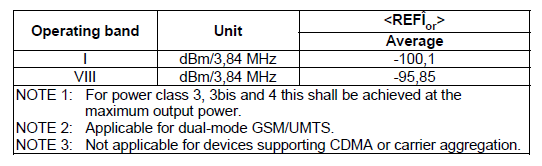
The average measured totalIsotropic sensitivity (TIS) of low, mid and high channel for handheld UE shall be lower than the average TIS requirement specified in table 4.2.14.2-1. The averaging shall be done in linear scale for the TIS results of both right and left side of the phantom head. Average TIS requirement is shown in the column "Average" on the requirement tables.

Table 4.2.14.2-1: TIS minimum requirements for UTRA FDD bands in the speech position Beside Head Hand Left and Beside Head Hand Right (BHHL/BHHR) for the primary mechanical mode
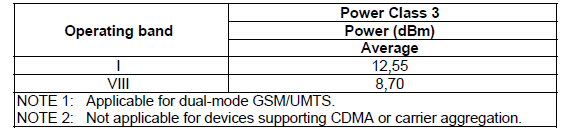
The average TRP of low, mid and high channel in beside head position shall be higher than minimum performance requirements for roaming bands shown in table 4.2.15.2-1. The averaging shall be done in linear scale for the TRP results of both right and left side of the phantom head.

Table 4.2.15.2-1: TRP minimum performance requirement for UTRA FDD bands in the speech position Beside Head Hand Left and Beside Head Hand Right (BHHL/BHHR) for primary mechanical mode
Note:
BHHL : Beside Head Hand Left (Head and Hand Phantom)
BHHR: Beside Head Hand Right (Head and Hand Phantom)
This part is the head-to-hand situation, which is mainly to simulate the movement of people when they answer the phone. Compared with the simple hand, the ambient environment changes when the phone is close to the head, so the radiation efficiency of the antenna is also affected.
The general test experience is as follows: radiation TRP is generally less problematic, while radiation TIS can be used to rectify the interference of electromagnetic noise in the product. When radiation TIS is not up to standard, it is necessary to consider whether conduction TIS is up to standard, or whether the devices in the rf circuit (such as the poor isolation degree of the diplexer), or whether the shielding cover is related to the common mode inductance to ground, as well as the matching of each power saving circuit.
In short, the smaller the TIS, the better. Just like the relationship between our ears and the sound we hear, we all hope that the lower the voice is, the better the sensitivity of this terminal phone is.
Relevant information

CRA Implementation Enters a Critical Phase
In August 2026, preparations for the implementation of the EU Cyber Resilience Act (CRA) entered a critical stage. With the reporting obligations set to take effect on September 11, 2026, drawing near, the European Commission and the European Union Agency for Cybersecurity (ENISA) have been intensively issuing implementation guidance and materials related to the single reporting platform.
Canada's ISED Officially Releases RSS-310 Issue 6: Major Updates to Radio Frequency Equipment Requirements
Innovation, Science and Economic Development Canada (ISED) has formally issued RSS-310, Issue 6, “Licence-Exempt Radio Apparatus: Category II Equipment,” replacing Issue 5, which has been in effect since 2020