

1. ISED changes
RSS Series Standard Core Guidelines (Exemptions and Antenna Requirements)
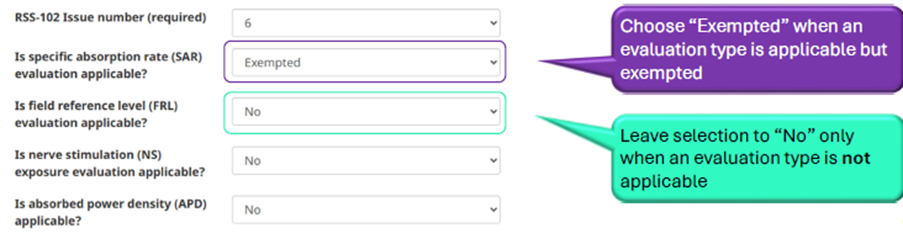
Declaration logic: It is necessary to first determine whether the evaluation type is applicable to the product;
Operating Specifications:
• If the assessment type applies to the product: select "Test type performed" or "Exempted" (only if the product meets the criteria for exemption in Section 6);
• If the evaluation type is not applicable to the product: Only "No" can be selected;
Example: If the SAR (Specific Absorption Rate) assessment applies to the product but meets the exemption criteria, select "Exempted" instead of "No".
Applicable equipment types:
• Low-power indoor access points;
• Indoor subordinate devices;
• Very low-power devices.
Compliance Methods (3 Options):
Method 1 (default): Use permanently attached antennas;
Method 2: Use a detachable antenna with a proprietary connector (connectors are not available in the market through other vendors);
Method 3: Use a detachable antenna with standard connectors, but with a certification protocol that ensures that the device (or module) only enables RF transmission when an authorized antenna is connected .
Emission Line Reduction Guidelines (Abbreviation Principle for Line Entry of Certificates):
Basic requirements:need to be listed one by one by frequency band;
Detailed rules:
• Under each frequency band, all unique emission designators (Emission Designers) must be listed;
• For each "Band + Transmit Identifier" combination, the maximum transmit power (regardless of bandwidth) and maximum bandwidth (regardless of power) should be listed;
• Prohibition of combining: If one transmitting line corresponds to the maximum bandwidth and the other corresponds to the maximum power under the same transmitting identifier, it cannot be combined into one and must be listed separately.
ANSI C63.10 Transition and Release Requirements
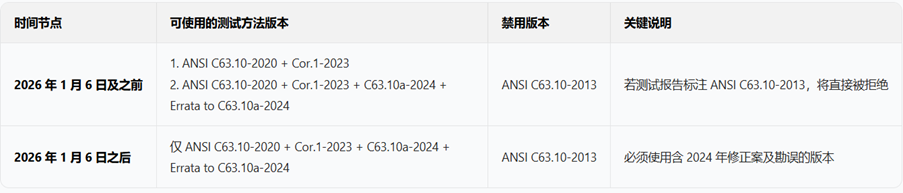
• ANSI C63.10 is the core test method for exempt wireless equipment, and the document specifies version validity and transition time, as detailed in the table below:
• C63.10-2013→2020 NEW: Dimensional Tolerances, FMCW Measurement Guidelines, Spectrogram Definitions (with Full Frequency Domain Information), UNII Band Elevation Mask Verification Methods, Blank Device Test Methods, WPT Integrated Device Test Guidelines;
• C63.10-2013→2020 Modification: Updated DTS method (remove peak integral, add gating to AVGSA-1), UNII 5725-5850 MHz band method, transmit combination rules, antenna and LISN Request;
• C63.10-2024 Amendment adds: 5925-7125 MHz band test process;
• C63.10-2024 Amendment Amendments: Expansion of applicable frequency bands to 750 GHz, allowing modification of environmental capsules to reduce reflections, update frequency stability requirements, minimum RBW required for transmit/occupied bandwidth, mmWave maximization process, ground/ Wall penetration test can be used as an alternative to sand pits.
RSS-247 Issue 4:
This frequency band is available for use, subject to certain conditions, which are as follows:
• Core Compliance Requirements: DFS (Dynamic Frequency Selection) compliance is required, and the test must comply with ETSI EN 301 893 V1.8.1;
• Certified Access Points (APs): If this frequency band is to be used, a C3PC filing (including the new FVIN) must be submitted with a DFS test report (proving that the channel covering the frequency band is compliant); If the 5470-5725 MHz full-band power meter is "consistent", no additional testing is required;
• Client device: Client device without radar detection function, this frequency band can be enabled without filing;
• Future Planning: ISED is consulting on the adoption of ETSI EN 301 893 V2.2.1, as detailed in Notice 2025DRS0006.
2. FCC / ISED Data Reuse Policy
Data reuse
• FCC Rule Core (KDB 484596 D01 v03).
• Data citation vs. Permissive Change:
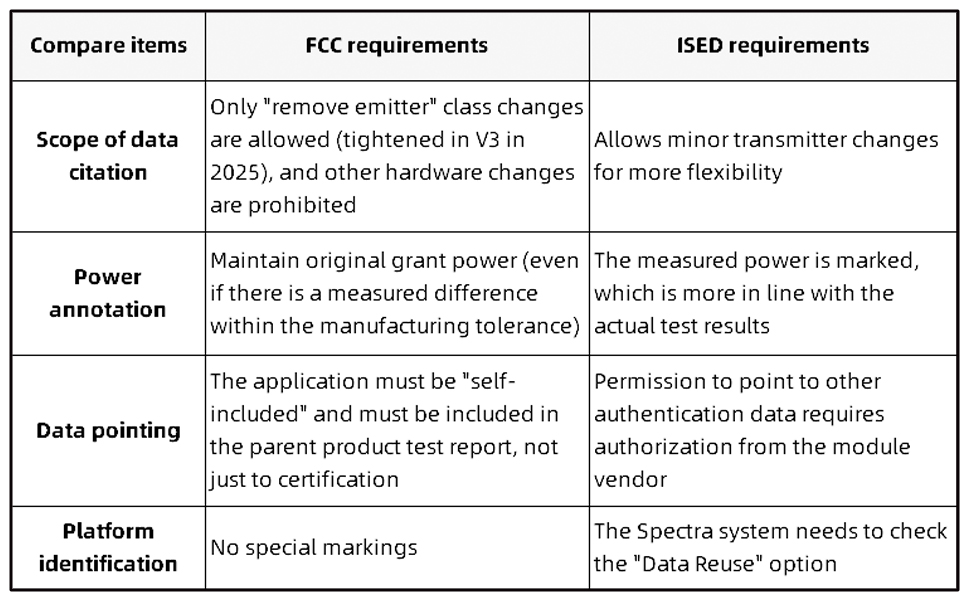
• Data citation: Applicable to new certifications (such as removing a cellular frequency band requires a new FCC ID), it is necessary to trace back to the test results of the "parent product" (fully configured version), and only "remove transmitter" class changes are allowed after the March 2025 V3 update. Other hardware changes (such as adding filters) are prohibited.
• Permitted Changes: Applicable to changes under the same FCC ID (e.g., screen/connector replacement ), which require testing of affected items (e.g., stray emissions), and the power difference within the manufacturing tolerance (e.g., conduction test ±0.5dB, radiated test ±3dB) to maintain the original grant power designation.
Key Limitations:
• Data cannot be referenced across FCC IDs;
If the difference between the measured results and the parent product exceeds 3% (updated in March 2024 , the original 25%), the entire test will need to be retested;
• The application must be "self-included", and the parent product test report must be included in the new application, and cannot only point to the parent product certification. Differences from Canadian ICED rules
Differences from Canadian ICED rules
wireless electrical module Data Reuse
• Rule: The conduction test results of the pre-certified module (e.g., output power, bandwidth) can be reused, but the stray emission, radiated performance, and spot check power must be retested to confirm no impact.
• Prerequisite: The module must meet the requirements of "modular certification" (such as independent masking, voltage regulation), and the final product application must include the module's schematic, BOM, and other documents, and cannot only point to module certification.
• FCC scenario: Data citation is only applicable to the new certification of "removing the transmitter", the test plan needs to be reviewed by TCB, and if the difference between the result and the parent product exceeds 3%, it needs to be fully retested;
• ISED scenario: You can use the module vendor's authorization to point to its authentication data, but you need to mark "data multiplexing" in the Spectra system; If it is a permitted change, the power must be marked according to the measured value;
• Module multiplexing: Both FCC and ISED need to retest the spurious emission and radiation performance, and the module test results cannot be fully reused.
Relevant information

CRA Implementation Enters a Critical Phase
In August 2026, preparations for the implementation of the EU Cyber Resilience Act (CRA) entered a critical stage. With the reporting obligations set to take effect on September 11, 2026, drawing near, the European Commission and the European Union Agency for Cybersecurity (ENISA) have been intensively issuing implementation guidance and materials related to the single reporting platform.
Canada's ISED Officially Releases RSS-310 Issue 6: Major Updates to Radio Frequency Equipment Requirements
Innovation, Science and Economic Development Canada (ISED) has formally issued RSS-310, Issue 6, “Licence-Exempt Radio Apparatus: Category II Equipment,” replacing Issue 5, which has been in effect since 2020