

EMC (Electro-Magnetic Compatibility)
Refers to the ability of a device or system to operate in its electromagnetic environment as required and not to cause intolerable electromagnetic interference to any device in its environment.
EMC has two parts:
1. EMI (Electro-Magnetic Interference)
Refers to the equipment in the normal operation of the environment generated by electromagnetic interference can not exceed a certain limit;
2. EMS (Electro-Magnetic Susceptibility)
Refers to the device has a certain degree of immunity to the electromagnetic interference in the environment;
So, EMC = EMI + EMS
Three elements of EMC
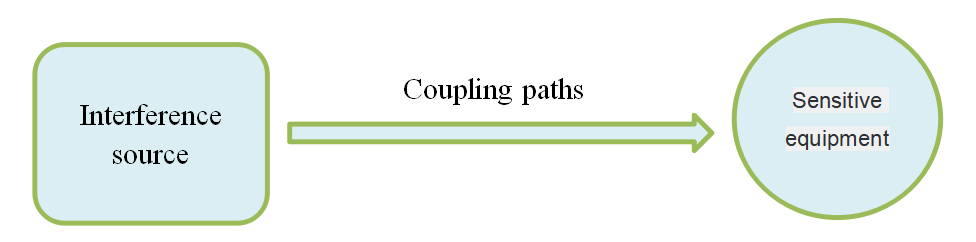
The energy emitted by the electromagnetic interference source is transmitted to the sensitive device through some coupling path, which results in some form of response and effect of the sensitive device.
For example:
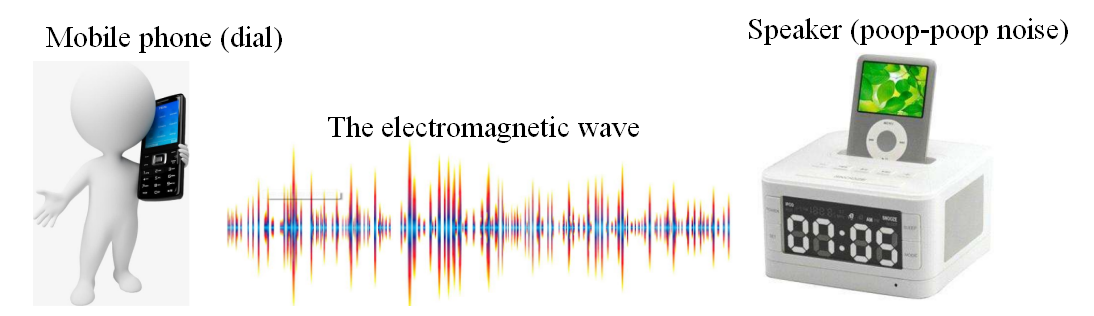
The absence of any one of the three elements does not constitute an EMC problem. Therefore, when an EMC problem occurs, the solutions to EMC problems can be found through the investigation and analysis of the three elements.
Common EMC test items
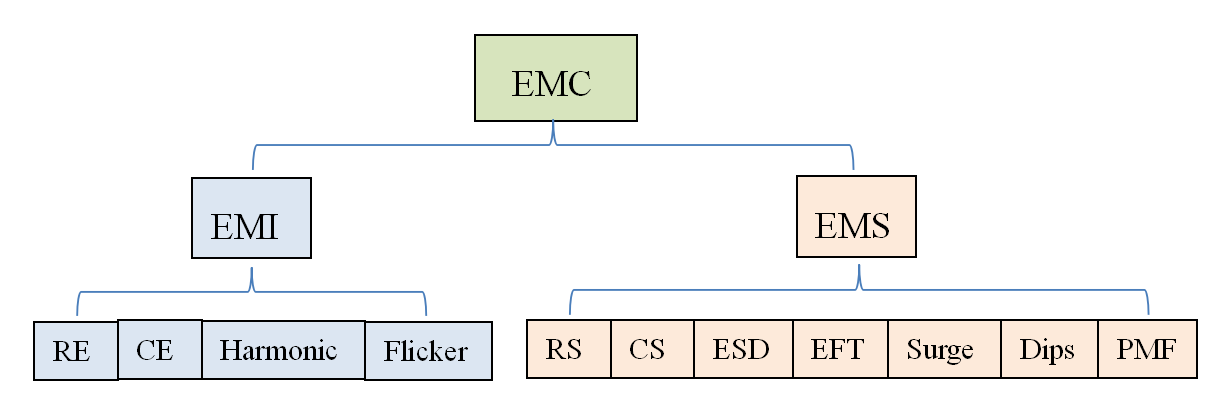
Note:
RE: Radiation emission
CE: Conducted emission
Harmonic: Harmonic current
Flicker: Voltage flicker
RS: Continuous RF electromagnetic field disturbances,
CS: Continuous induced RF disturbances
ESD: Electrostatic discharge immunity
EFT: Electrical fast transients/burst
Surge: Surge immunity
Dips: Voltage dips & interruptions
PMF: Power frequency magnetic field
EMC testing standards for common products
European
Product | EU | |
| EMI standards | EMS standards | |
| MME | EN 55032 | EN 55035 |
| ISM equipment | EN 55011 | - |
| Household appliances, toys | EN 55014-1 | EN 55014-2 |
| Lighting products | EN 55015 | EN 61547 |
| PLC equipment | EN 50561-1,EN 50561-3 | EN 50412-2-1 |
| Telecommunication network equipment | EN 300 386 | |
| Common requirements of Radio equipment | EN 301 489-1 | |
| Short-Range Devices (SRD) | EN 301 489-3 | |
| BT / WIFI products | EN 301 489-17 | |
| Satellite positioning and navigation products | EN 301 489-19 | |
| Cellular Communication mobile radio equipment | EN 301 489-52 | |
North America
| Product | USA | Canada |
| EMI standards | EMI standards | |
| ISM equipment | FCC Part 18 | ICES-001 |
| ITE, Various digital products | FCC Part 15B | ICES-003 |
| Lighting products | FCC Part 15B | ICES-005 |
Relevant information

EU Releases Exemption Guidelines on Removability and Replaceability of Portable and LMT Batteries — Multiple Product Categories Relief Granted
On July 14, 2026, the European Commission published the "Commission Guidelines to Facilitate the Harmonised Application of Provisions on the Removability and Replaceability of Portable and Light Means of Transport (LMT) Batteries" (Commission Notice C(2026) 5032 final). These guidelines aim to provide a uniform interpretative framework for the implementation of Article 11 of the EU Battery Regulat

6G Developments: Past, Present and Future
The formulation of 6G standards has entered a more concrete phase. At the 3GPP RAN Plenary Meeting held in Singapore in June 2026, the industry made progress in multiple key research areas and finalized the timeline for Release 21, which is regarded as the first standard version expected to formally define 6G.

Overview of EN IEC 61000-4-29:2026
The key focus of the 2026 edition is to address new DC power distribution environments, especially higher-voltage DC systems. It also clarifies test generator capability, duration tolerance, current limitation during short interruptions, inrush current verification, result evaluation, and test report requirements. For products using 24 Vdc, 48 Vdc, 380 Vdc, 400 Vdc, 800 Vdc, or other DC input pow