

With the COVID-19 outbreak,do you find wireless is not being used everywhere,because there are so many connected devices,remote work,remote learning and remote medical services,proving the importance of both WIFI and 4G/5G NR.
◆ ◆ ◆ ◆ ◆ WIFI 6E Keypoint ◆ ◆ ◆ ◆ ◆
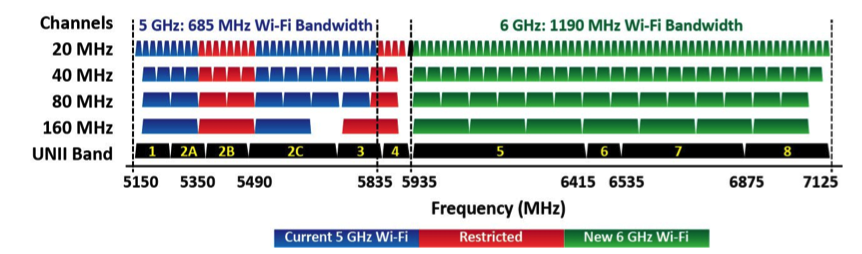
1. Frequency range
Divided into four different sub-bands for licence-free use, including:
5.925-6.425 GHz (U-NII-5 band)
6.425-6.525 GHz (U-NII-6 Band)
6.525-6.825 GHz (U-NII-7 Band)
6.875-7.125 GHz (U-NII-8 band).
2. What has changed
The most important enhancements to Wi-Fi 6 and Wi-Fi 6E(as opposed to Wi-Fi 5 or 802.11AC implemented in 2014) are the introduction of orthogonal frequency division multiple access (OFDMA) and multi-user, multi-input and multi-output (MU-MIMO) enhancements. OFDMA is a modulation scheme designed to reduce latency, increase capacity and improve efficiency by allowing up to 30 users to simultaneously share a channel. MU-MIMO, launched in 2015, is only available for output signals from routers (lower links), and Wi-Fi 6 will also allow routers to process input signals from multiple devices (uplinks).
3. Which countries use it
The US FCC announced on April 23, 2020 that the 6GHz frequency band (5.925GHz ~ 7.125 GHz) 1200MHz spectrum resources will be unlicensed and license-free, but it will also take relevant measures to protect the licenses already operating in this frequency band, the rights of licensed-users and transmission from being affected.
4. What changes have been made to the corresponding regulations in the US?
4.1 Article 15.401 Usage range, 5.925-6.425 GHz(U-NII-5), 6.425-6.525GHz(U-NII-6), 6.525-6.875 GHz(U-NII-7) and 6.875-7.125 GHz(U-NIi-8) bands are added.
4.2 As defined in Article 15.403, the definition of automatic frequency control (AFC) and its applicable frequency bands (5.925-6.425 GHz and 6.525-6.875 GHz) shall be added, and the Client Device shall be defined.
4.3 General Technical Requirements in Article 15.407, technical requirements for the maximum output power, effective isodirectional radiation power (EIRP), operation limitation, automatic frequency control (AFC) management of U-NII-5, U-NII-6, U-NIi-7 and U-NIi-8 wireless access points (AP) and user equipment shall be established.
5. What products are affected
The first to grab the spectrum are expected to be 802.11AX /Wi-Fi 6E, which will get up to seven 160MHz channels, and 5G NR-U, which will increase capacity via unlicensed frequencies.
6. What is AFC and WIFI6E
The FCC regulator must address several pending considerations that could profoundly affect how the 6 GHz band is deployed. These factors include maximum allowable transmit power and automatic frequency coordination (AFC). AFC is a database lookup mechanism designed to protect existing users in the 6 GHz spectrum. What the AFC means to users is that the FCC is trying to impose a different set of rules on each 6 GHz sub-band. Although the details have not been fully determined, at present u-NIi-6 and U-Nii-8 have similar rule sets, making them available only for indoor applications, with output power limited to conduction 24 dBm(250mW) and radiation 30 dBm(1W). For BOTH U-NII-5 and U-NII-7, THE AFC must be used for both indoor and outdoor applications. The output power in these frequency bands is limited to conducting 30dBm and radiating 36dBm.
7. Four major requirements of AFC free LPI products
1. The use of integrated antennas will prohibit the sale of any equipment with an external antenna installation.
2. Do not use any type of weatherproof shield. This will prohibit the use of battery-powered LPI devices.
3. The device must stop when it is not connected to the power supply.
4. Clear labelling requirements must be adhered to.
Relevant information

EU Releases Exemption Guidelines on Removability and Replaceability of Portable and LMT Batteries — Multiple Product Categories Relief Granted
On July 14, 2026, the European Commission published the "Commission Guidelines to Facilitate the Harmonised Application of Provisions on the Removability and Replaceability of Portable and Light Means of Transport (LMT) Batteries" (Commission Notice C(2026) 5032 final). These guidelines aim to provide a uniform interpretative framework for the implementation of Article 11 of the EU Battery Regulat

6G Developments: Past, Present and Future
The formulation of 6G standards has entered a more concrete phase. At the 3GPP RAN Plenary Meeting held in Singapore in June 2026, the industry made progress in multiple key research areas and finalized the timeline for Release 21, which is regarded as the first standard version expected to formally define 6G.

Overview of EN IEC 61000-4-29:2026
The key focus of the 2026 edition is to address new DC power distribution environments, especially higher-voltage DC systems. It also clarifies test generator capability, duration tolerance, current limitation during short interruptions, inrush current verification, result evaluation, and test report requirements. For products using 24 Vdc, 48 Vdc, 380 Vdc, 400 Vdc, 800 Vdc, or other DC input pow