

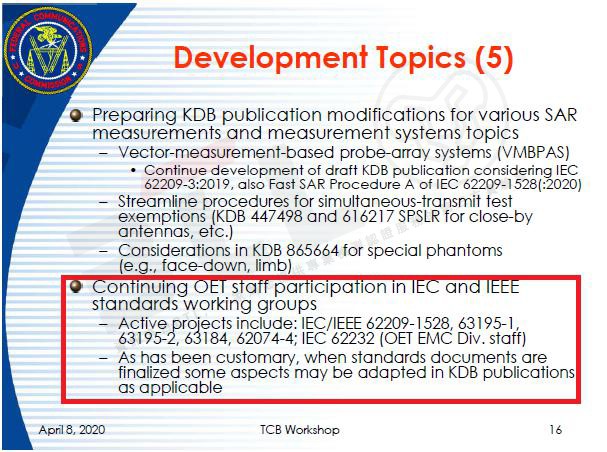
IEEE 62209-1528 was officially released in October. This regulation integrates the original IEEE 1528, 62209-1 and 62209-2, because it is mentioned in the FCC Workshop and ISED announcements that many test methods will follow this regulation. The KDB part will be updated later.
BTL explain to you the new parts of the standard.
This first edition of IEC/IEEE 62209-1528 cancels and replaces IEC 62209-1:2016,
IEC 62209-2:2010, IEC 62209-2:2010/AMD1:2019 and IEEE Std 1528-2013. This edition constitutes a technical revision.
This edition includes the following significant technical changes with respect to the previous edition:
a.
Extension of the frequency range down to 4 MHz and up to 10 GHz;
=> It will cover the WiFi 6E or 5G nr FR1 equidistance that can be opened in the future. It should be noted that the current WiFi 6E in FCC/ISED is currently tested by power density instead of the traditional SAR test.
b.
Testing of devices with proximity sensors;
=> The test method is close to FCC, steps are as follows;
1. Trigger distance in the vertical direction
2. Trigger distance in tilt direction
3. Confirmation of sensor coverage area
c.
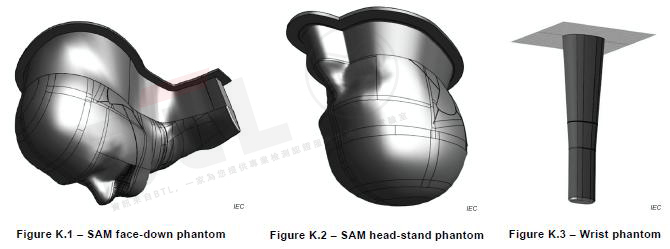
Application specific phantoms;
=> Add phantom such as wrist, top of head and face to correspond to SAR test of related products such as watches, earphones and glasses.
d.
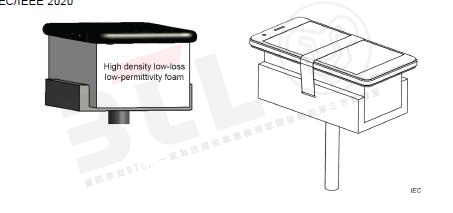
Device holder specifications;
=> Use low dielectric constant and low loss foam to install the DUT in the equipment support to prevent the support material from changing the DUT performance.
e.
Fast SAR testing procedures;
=> The main regulations currently define Class 1/2 two methods. The current IC announcement agrees to use the fast SAR Class 2 test method, and the fast SAR equipment must meet the requirements of the IEC 622209-3 regulations.
f.
Test reduction procedures;
=> Regulatory definitions can reduce the way testing is as follows:
a) test reduction for different operating modes at the same test frequency band using the same wireless technology;
b) test reduction based on characteristics of the DUT design;
c) test reduction based on peak SAR level analysis;
d) test reduction based on simultaneous multi-band transmission considerations.
g.
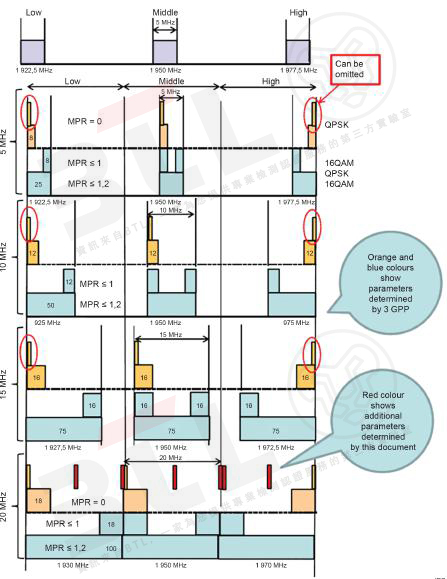
LTE assessment procedure;
=>
1. When MPR does not apply, the configurations in Clause W.2 are measured for the low and middle channels with RB offset = 0, and RB offset = maximum for the high channel.
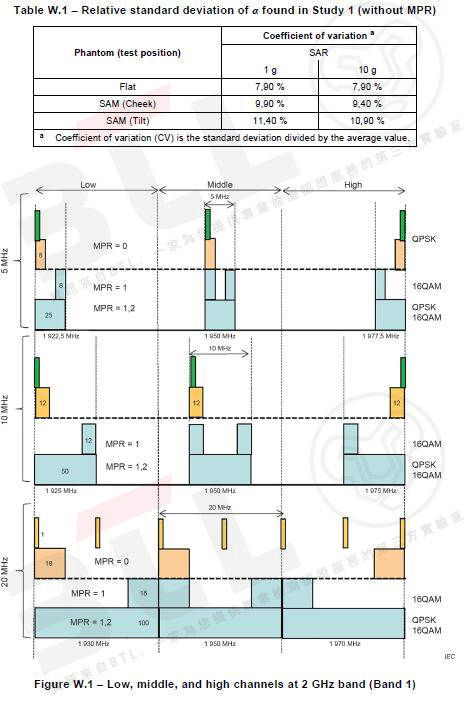
2. When MPR applies, the configurations in Clause W.3 are measured
i) for the low channel with RB offset = maximum,
ii) for middle channel with RB offset = 0 and maximum,
iii) for high channel with RB offset = 0.
For “QPSK modulation with 1 RB
h.
Revision of validation clause, including validation antennas;
=> Add the requirements above 6 GHz. When it is higher than 6 GHz, the system check test frequency should be within ±1 GHz of the band in the conformance test, and the distance between the antenna and the Phantom is 5mm
i.
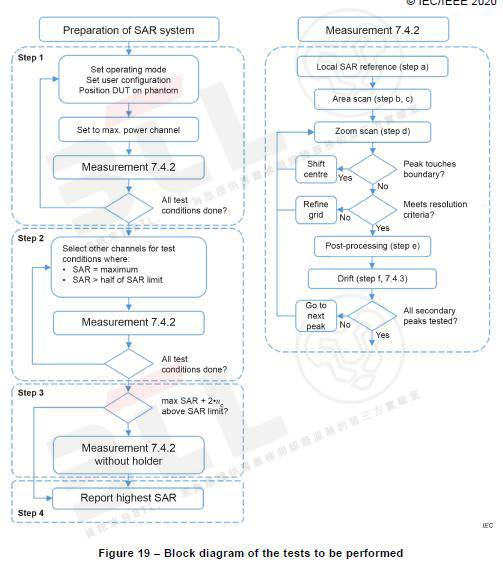
Revision of SAR assessment procedure;
=>Test start from the max power channel
j.
Time-average SAR measurement procedure;
=> Can use Class 2 fast SAR system, or probe SAR system for testing.
For Class 2 fast SAR testing (see 7.9.2), the measurement of SARtime-average shall be
performed over the averaging period, and the measurement of SARfull-power shall be performed over a time period long enough that the measurement is stable. Neither the DUT nor the sensors shall be moved during the averaging period. The sampling rate of the measurement shall be enough to ensure that the uncertainty component for TPAS is within the assessed value in 7.6.8..
For scanning probe SAR systems, including single probe SAR systems and Class 1 fast SAR testing systems (see 7.9.2), the following apply.
a) Both SARfull-power and SARtime-average are local SAR measurements.
b) The probe shall be positioned at the location of the peak SAR from an area scan
performed in accordance with the requirements of 7.4.2.
c) The SAR level at this location shall be above the noise level.
d) The probe or probe array shall be in the same position for both the SARfull-power and SARtime-average measurements.
e) SARtime-average shall be measured over the defined time period.
f) SARfull-power shall be measured over a time period long enough that the measurement is stable.
g) The sampling rate of the measurement shall be enough to ensure that the uncertainty
component for TPAS is within the assessed value in 7.6.8.
k.
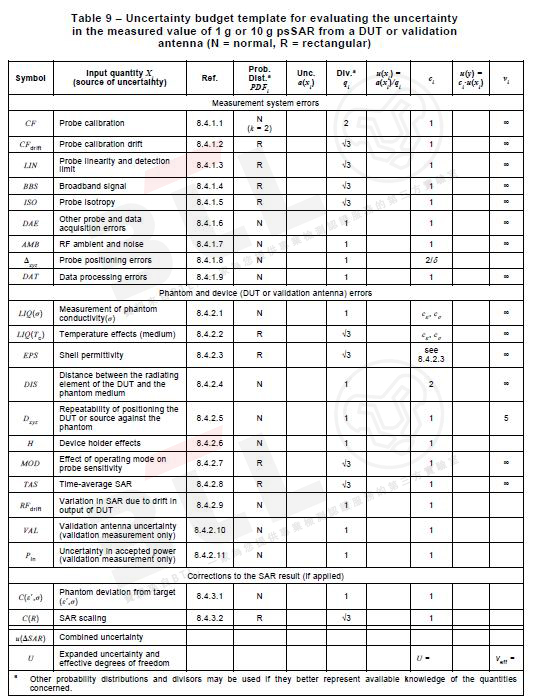
Uncertainty analysis;
=> Update uncertainty analysis, the new version requires the following table
The above is the main updated part. If you are interested in the detailed description of the regulations, you are welcome to come to BTL to interrupt the editor to discuss together. There will be new regulations in the future, and BTL will continue to follow up for you.
Relevant information

EU Releases Exemption Guidelines on Removability and Replaceability of Portable and LMT Batteries — Multiple Product Categories Relief Granted
On July 14, 2026, the European Commission published the "Commission Guidelines to Facilitate the Harmonised Application of Provisions on the Removability and Replaceability of Portable and Light Means of Transport (LMT) Batteries" (Commission Notice C(2026) 5032 final). These guidelines aim to provide a uniform interpretative framework for the implementation of Article 11 of the EU Battery Regulat

6G Developments: Past, Present and Future
The formulation of 6G standards has entered a more concrete phase. At the 3GPP RAN Plenary Meeting held in Singapore in June 2026, the industry made progress in multiple key research areas and finalized the timeline for Release 21, which is regarded as the first standard version expected to formally define 6G.

Overview of EN IEC 61000-4-29:2026
The key focus of the 2026 edition is to address new DC power distribution environments, especially higher-voltage DC systems. It also clarifies test generator capability, duration tolerance, current limitation during short interruptions, inrush current verification, result evaluation, and test report requirements. For products using 24 Vdc, 48 Vdc, 380 Vdc, 400 Vdc, 800 Vdc, or other DC input pow