

ETSI EN 301 908-1 V15.1.1(2021-09) Standard analysis
In this issue, we specifically introduce the new updates of EN 301 908-1 V15.1.1 (2021-09) for User Equipment (UE) end products.
1. New added radiated spurious frequency band test range:
The new added two radiated spurious emission, where applies for Band that the upper frequency edge of the Uplink band more than 2.69 GHz, test frequency is five times of its operating frequency and applies for Band that the upper frequency edge of the Uplink band more than 5.2 GHz, test frequency is up to 26 GHz.
The applicable frequency range of NR operating in FR1 falls in: fc - (1.5 x BWChannel + 5) MHz < f < fc + (1.5 x BWChannel + 5) MHz.
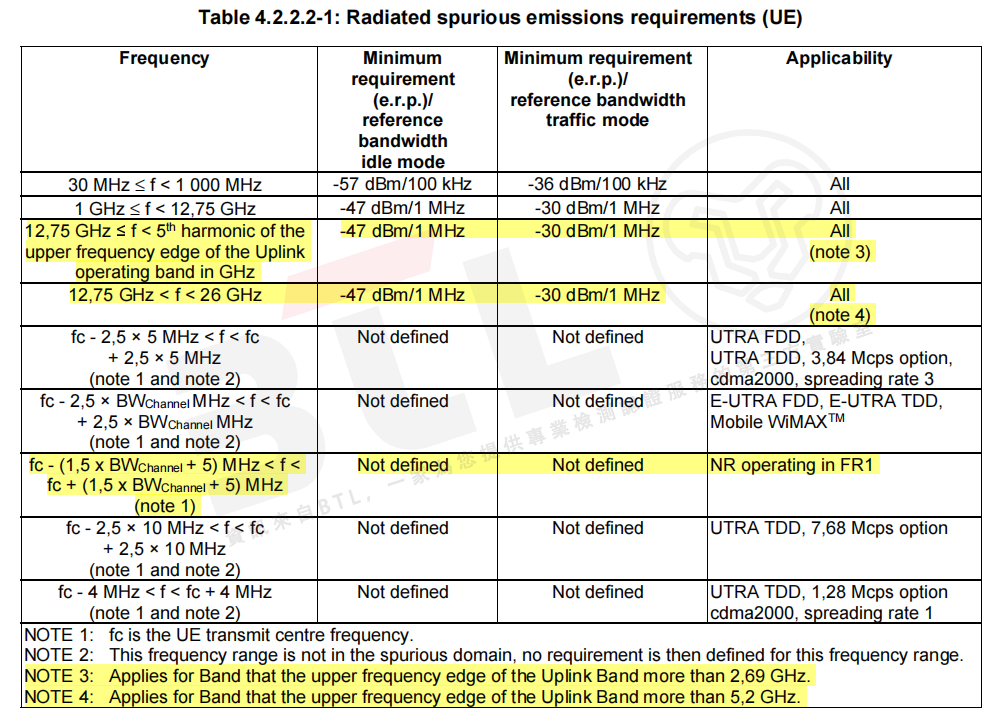
2. Explain the radiated spurious test configuration:
The new edition states that when the same Tx/Rx antenna is used for all supported radio technologies (i.e., WCDMA, E-UTRA, and NR FR1), regardless of the radio technology, the UE can only test for the test configuration corresponding to the maximum output power of the UE. The manufacturer should then declare whether the device uses the same set of Tx/Rx antennas for all supported radio technologies.
The above are the most highlight for reformation evolved significantly affect the radiation spurious test descriptions. ETSI officially adopt into the CE standard, without a doubt, not only embodies the IMT cellular communication performance test in the most intuitive way, but also enhances the intensity of the cellular communication radiation performance test.
3. Adds FR2 millimeter wave frequency band test description:
Adds FR2 radiation spurious control and monitoring test methods and limits.
4. Revise related LTE/FR1/FR2 frequency band table:
Pay special attention to the remarks of the following frequency bands, such as the scope of application of B41/N41/N77/N78/N257/N258.
The above is a brief summary of the new edition of the standard updates.
Relevant information

EU Releases Exemption Guidelines on Removability and Replaceability of Portable and LMT Batteries — Multiple Product Categories Relief Granted
On July 14, 2026, the European Commission published the "Commission Guidelines to Facilitate the Harmonised Application of Provisions on the Removability and Replaceability of Portable and Light Means of Transport (LMT) Batteries" (Commission Notice C(2026) 5032 final). These guidelines aim to provide a uniform interpretative framework for the implementation of Article 11 of the EU Battery Regulat

6G Developments: Past, Present and Future
The formulation of 6G standards has entered a more concrete phase. At the 3GPP RAN Plenary Meeting held in Singapore in June 2026, the industry made progress in multiple key research areas and finalized the timeline for Release 21, which is regarded as the first standard version expected to formally define 6G.

Overview of EN IEC 61000-4-29:2026
The key focus of the 2026 edition is to address new DC power distribution environments, especially higher-voltage DC systems. It also clarifies test generator capability, duration tolerance, current limitation during short interruptions, inrush current verification, result evaluation, and test report requirements. For products using 24 Vdc, 48 Vdc, 380 Vdc, 400 Vdc, 800 Vdc, or other DC input pow