

[Interpretation] Canadian Wi-Fi 6E standard RSS-248 update
Last November, ISED released the official version of Wi-Fi 6E standard RSS-248 Issue 1, which is only applicable to low-power indoor RLAN devices. During the just concluded labor day holiday in 2022, RABC-CCCR released RSS-248 Issue 2, May 2022 (Draft), which mainly added the certification requirements for licence-exempt standard-power RLAN devices operating in the frequency band 5925-6875 MHz.
What are the differences between RSS-248 Issue 2(Draft) and Issue 1? What are the differences with the current FCC Wi-Fi 6E? Here is a detailed explanation:
---------------------------- Scope ----------------------------
RSS-248 Issue 2(Draft) Scope:
“This Radio Standards Specification (RSS) sets out the certification requirements for licence-exempt RLAN devices operating in the 5925-7125 MHz frequency band, also referred to as the 6 GHz band.”
★ Difference from Issue 1:
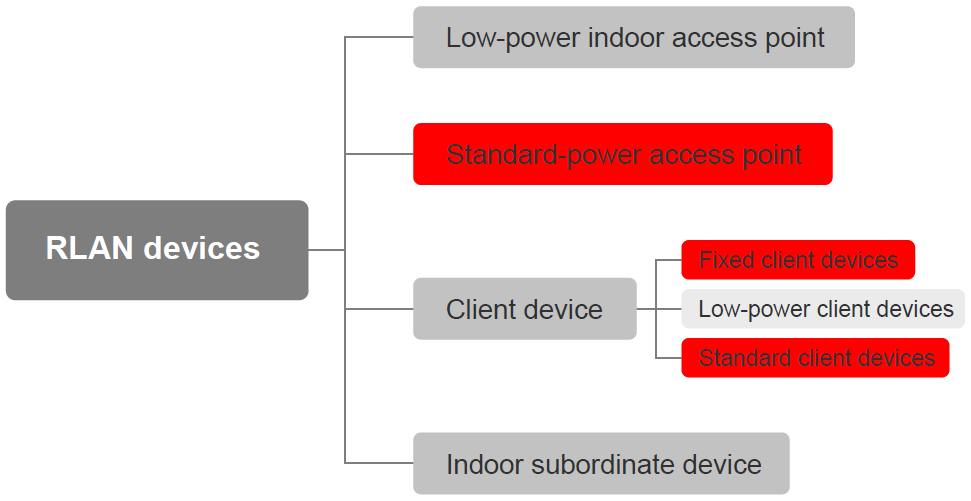
Compared with Issue 1, the scope of Issue 2 deletes the word low-power, indicating that the standard is not only applicable to low-power devices. So which devices are Issue 2 applicable to? See the definition in Issue 2:
-- RLAN device: A low-power indoor access point, a standard-power access point, a client device, or an indoor subordinate device.
-- Client device: include fixed client devices, low-power client devices, and standard client devices.
★ Difference from FCC:
The scope of FCC is consistent with that of Canada.
----------------------- Product Types -----------------------
RSS-248 Issue 2(Draft) defines the following six product types:
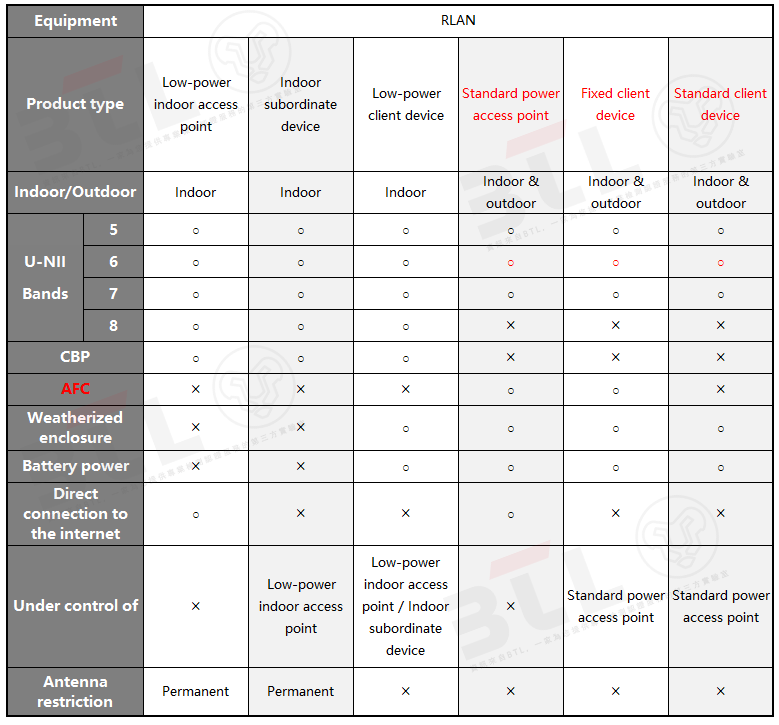
※ ○ denote not applicable, ╳ denote not applicable.
※ U-NII 5:5.925 - 6.425 GHz;※ U-NII 6:6.425 - 6.525 GHz;
※ U-NII 7:6.525 - 6.875 GHz;※ U-NII 8:6.875 - 7.125 GHz。
※ CBP(Contention-Based Protocol) consistent with FCC requirements. The equipment needs to detect interference and
avoid it.
※ AFC(Automated Frequency Coordination) system determines a list of available frequencies and associated maximum
power levels for use by a standard-power access point or a fixed client device at a specific time and geographic location.
※ The following operational requirements shall apply to RLAN devices:
a. Devices shall automatically stop transmitting if there is an absence of information to transmit or an operational failure.
b. Devices shall not be used for control of or communications with unmanned aircraft systems.
※ For standard-power access points, fixed client devices, low-power indoor access points and indoor subordinate devices,
the following requirements shall apply:
a. Operation on oil platforms, automobiles, trains, maritime vessels and aircraft shall be prohibited; but
b. Low-power indoor access points shall be permitted to operate in the 5925-6425 MHz band in large aircraft while flying
above 3,048 m (10,000 ft).
※ For standard client devices and low-power client devices, the following requirements shall apply:
a. Standard client devices and low-power client devices shall not connect directly to another standard client device or
low-power client device;
b. These devices may transmit brief messages to an access point after detecting a signal confirming that the access point
is operating on a particular frequency, in order to join the access point’s network.
★ Difference from Issue 1:
Issue 2 added three product types and added AFC and other operational requirements.
★ Difference from FCC:
FCC has an additional product type of dual client, and the FCC prohibits standard power access point, fixed client device and standard client device from operating in the U-NII band 6.
------------------------- Test Items -------------------------
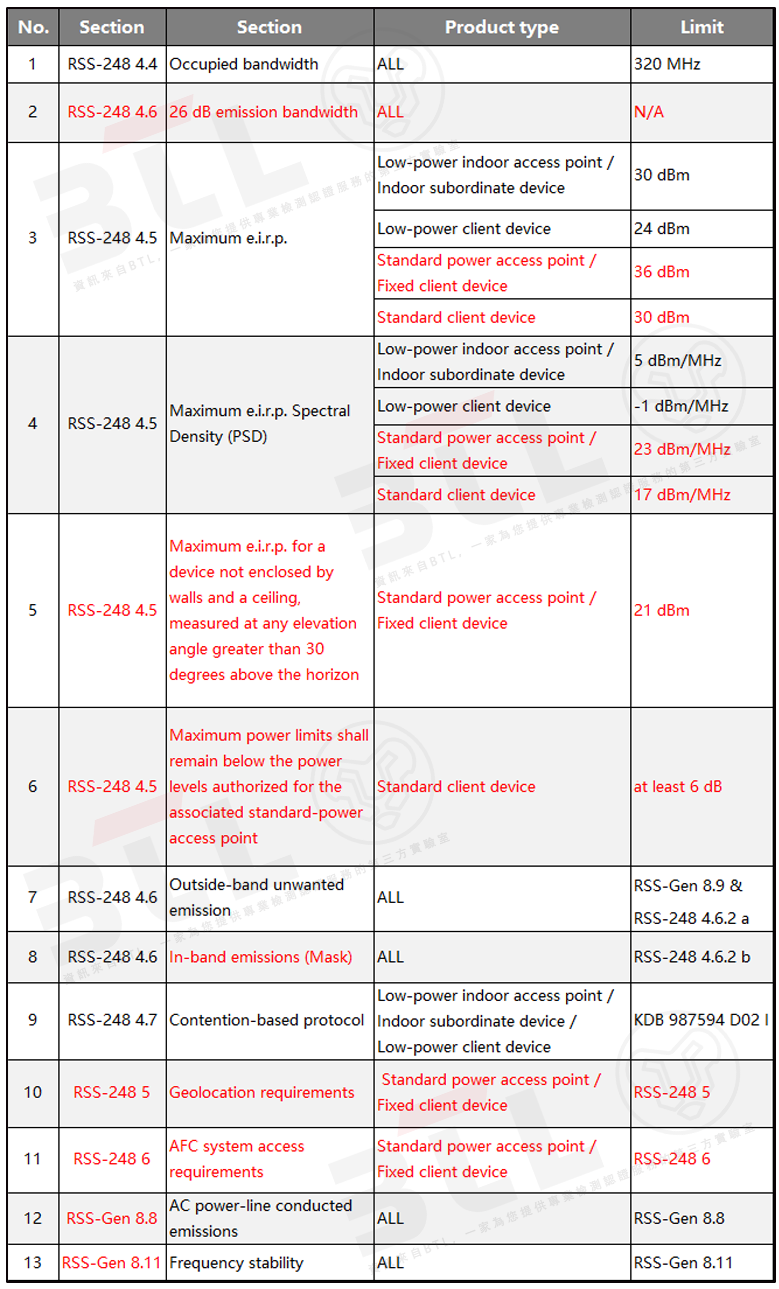
RSS-248 Issue 2(Draft) needs to perform the following test items:
★ Difference from Issue 1:
Issue 2 added test items related to three new product types and clarified that the limit of mask is to limit the waveform other than 26dB EBW / 99% OBW. Previously, Issue 1 only specified 99% OBW. After clarification, this part is consistent with FCC. Issue 2 also deleted AC power conduction and frequency stability, because these two items have been specified in RSS-Gen.
★ Difference from FCC:
FCC has added a test item for dual client, Dual Client Test, Demonstration of Proper Power Adjustment based on Associated AP.
At present, RSS-248 Issue 2(Draft) is still in the consultation stage. The consultation is ended on July 15. After that, ISED will repair the standard according to the consultation results and publish it on the official website of ISED. Note that RSS-248 Issue 2(Draft) cannot be used for certification application at this stage. It can not be applied until issue 2 is published on the official website of ISED.
Relevant information

EU Releases Exemption Guidelines on Removability and Replaceability of Portable and LMT Batteries — Multiple Product Categories Relief Granted
On July 14, 2026, the European Commission published the "Commission Guidelines to Facilitate the Harmonised Application of Provisions on the Removability and Replaceability of Portable and Light Means of Transport (LMT) Batteries" (Commission Notice C(2026) 5032 final). These guidelines aim to provide a uniform interpretative framework for the implementation of Article 11 of the EU Battery Regulat

6G Developments: Past, Present and Future
The formulation of 6G standards has entered a more concrete phase. At the 3GPP RAN Plenary Meeting held in Singapore in June 2026, the industry made progress in multiple key research areas and finalized the timeline for Release 21, which is regarded as the first standard version expected to formally define 6G.

Overview of EN IEC 61000-4-29:2026
The key focus of the 2026 edition is to address new DC power distribution environments, especially higher-voltage DC systems. It also clarifies test generator capability, duration tolerance, current limitation during short interruptions, inrush current verification, result evaluation, and test report requirements. For products using 24 Vdc, 48 Vdc, 380 Vdc, 400 Vdc, 800 Vdc, or other DC input pow