

The Delegated Regulation (EU) 2019/320 activates Article 3(3)(g) of the Radio Equipment Directive (RED) 2014/53/EU. It requires smartphone vendors to demonstrate compliance with Galileo, Wi-Fi and AML (Advanced Mobile Location) in order to sell devices on the European market, from March 17, 2022 onwards.
The motivation for E112 is to provide the caller location information to emergency services, which will allow emergency responders to get to the scene of an accident faster.
E112 test certification requirements, details are as follows:
A. GNSS:ETSI TS 103 246-5 V1.3.1 (2020-10)
1. NMEA (National Marine Electronics Association) OUTPUT TEST
The compatibility and interoperability of the smartphone with the Galileo system shall be demonstrated as follows:
− During the test, the smartphone shall expose and log the output the navigation solution in a NMEA-0183 protocol format. The log messages shall include the Coordinated Universal Time (UTC) time stamp and the latitude and longitude coordinates include NMEA sentences such as RMC, GGA or GNS.
− One or more Galileo satellites must be used in a valid position solution (i.e., it is present in the GSA message).
− The GNSS receiver being a part of the smartphone shall be capable of receiving and
processing individual GNSS signals in L1/E1 band from at least two global navigation
satellite systems, one of them being Galileo (GSA message shall include satellites from
at least two constellations one of them being Galileo)
2. TIME TO FIRST FIX TEST:
Test the capability to get a first position fix from any of the processed GNSS signals
selected by the DUT manufacturer. The first position fix appears in a maximum of 60 seconds for signal levels down to -130 dBm. The scenario is a static one.
The test starts with a dedicated reset of the GNSS memory stored on the DUT, i.e. a cold-start without assistance.
To record a good result, two criteria have to be passed:
● First, the position output data is generated within the max. TTFF response time.
● Second, the horizontal and vertical position errors, calculated from the difference between the measured and true position, are less than 100 m. In other cases, a bad result is reported.
3. HORIZONTAL ACCURACY TEST
The scenario is a static one. The duration of the simulated scenario is 20 minutes
(1200 seconds). A position fix is collected each second. Each position fix is compared
with the original position and the difference is stored.
Horizontal position errors < 5 meters for open sky and < 25 meters for urban canyon with a confidence level of 95 %.
4. GALILEO OPEN SERVICE NAVIGATION MESSAGE AUTHENTICATIONREADINESS
In order to demonstrate the readiness to use satellite navigation message authentication,
specifically Galileo OSNMA, the smartphone shall be able to expose and record the binary
stream of the Galileo I/NAV navigation message from at least one Galileo satellite for a
minimum period of 45 seconds, which shall contain an entire subframe of the I/NAV message.
5. EXPOSUREOF ADDITIONAL GALILEO OBSERVABLES
In this test case, the requirement on the exposure of additional Galileo observables is
assessed. An example of a set of additional GNSS observables are the GNSS raw
measurements. These measurements are defined as a set of baseline additional Galileo observables provided by the DUT to evaluate the quality of the navigation solution
in terms of satellites used and the signal strength.
The logs of the DUT are formatted in accordance with NMEA-0183 standard, in the
form of GSV sentences for the Galileo constellation.
B. AML:ETSI TS 103 625 V1.2.1 (2022-04)
AML TEST (advanced mobile positioning): Compatibility of the processing and transmission mechanisms of handset-derived caller location with the national Public Safety Answering Point (PSAP) systems via SMS or HTTP.
C. Wireless Local Area Positioning(ISO/IEC 18305:2016)
WLAN TTFF: capability to get a first position fix from signals from Wi-Fi Access Points in
maximum 20 seconds,for Entity to be Localised/Tracked (ELT) of type person carrying the smartphone and the building types defined in ISO/IEC 18305
WLAN position accuracy: capability to achieve a horizontal position error of maximum
30 metres from signals from Wi-Fi Access Points with a confidence level of 67 % (1σ
coverage factor)
The following test scenarios defined in ISO/IEC 18305 should be used for the compliance
assessment:
− The Test Scenarios 1 and 2 should be repeated four times by the ELT with the
smartphone in the right hand stood facing north, west, south, and east when
prompting the emergency communications to generate the location estimate during
the test scenario
During the test, the customer must provide the following support
1. Grant ADB root permission
2. Update Google Play Services to the latest version
3. Provide the method of capturing THE GNSS NMEA log by the mobile phone default positioning software, and the path of storing or exporting the NMEA log
4. Open AT COM port on mobile phone (if not, manual test is required)
The Device (UE) under test should allow Engineering debug mode operation, capable of capturing NMEA logs, allowing Keysight tools to retrieve the logs from device, able to install the CA certificates to the root directory of the phone's storage and not to enter into sleep mode for at least 30min or always stay awake option is enabled.
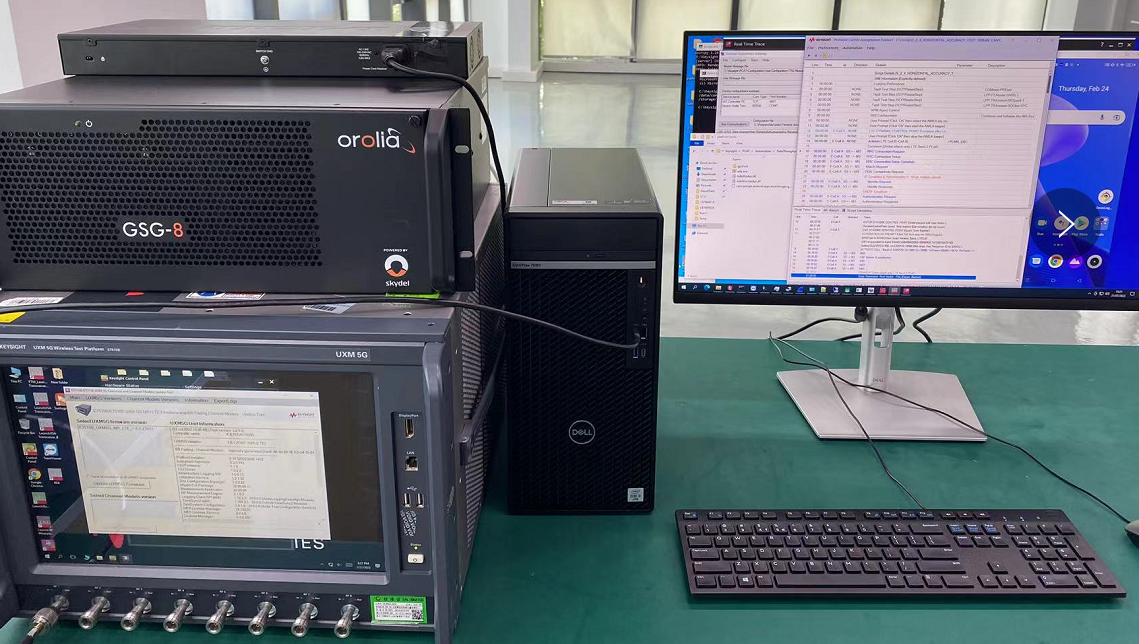
The Keysight S8706A test system and WiFi indoor positioning test scheme introduced by BTL have been verified at the same time, and BTL has the ability to test all items of E112 since then.
If you have any questions about the test project, please contact BTL Mobile Communication Department, we will provide you with professional technical answers.
Relevant information

EU Releases Exemption Guidelines on Removability and Replaceability of Portable and LMT Batteries — Multiple Product Categories Relief Granted
On July 14, 2026, the European Commission published the "Commission Guidelines to Facilitate the Harmonised Application of Provisions on the Removability and Replaceability of Portable and Light Means of Transport (LMT) Batteries" (Commission Notice C(2026) 5032 final). These guidelines aim to provide a uniform interpretative framework for the implementation of Article 11 of the EU Battery Regulat

6G Developments: Past, Present and Future
The formulation of 6G standards has entered a more concrete phase. At the 3GPP RAN Plenary Meeting held in Singapore in June 2026, the industry made progress in multiple key research areas and finalized the timeline for Release 21, which is regarded as the first standard version expected to formally define 6G.

Overview of EN IEC 61000-4-29:2026
The key focus of the 2026 edition is to address new DC power distribution environments, especially higher-voltage DC systems. It also clarifies test generator capability, duration tolerance, current limitation during short interruptions, inrush current verification, result evaluation, and test report requirements. For products using 24 Vdc, 48 Vdc, 380 Vdc, 400 Vdc, 800 Vdc, or other DC input pow