

Interpretation | Immunity to conducted disturbances - Electromagnetic compatibility (EMC) standard BS EN IEC 61000-4-6 update 2023 version!!!
At present, the conducted anti-interference standard BS EN IEC 61000-4-6 has been updated to the 2023 edition.
The relevant times are as follows:
DOP: 2024-04-11
DOW: 2026-07-11
Oh, by the way! Remember the previous version was still BS EN 61000-4-6:2014, and now the 2023 version has already been released!
First, let's briefly understand the main differences in focus compared to the previous version, as follows:
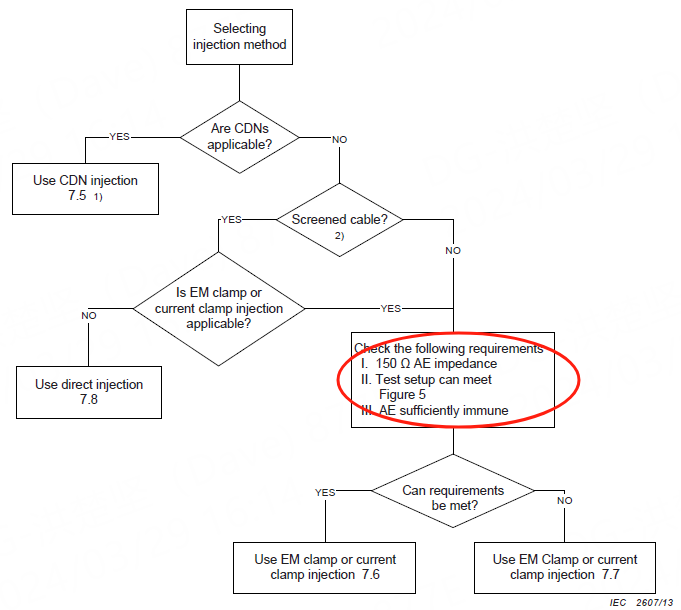
a. Revised the principles for selecting injection methods; Removed the requirement to check the impedance of the AE end before using the clamp injection method
2014 version Below image:
2023 version Below image:
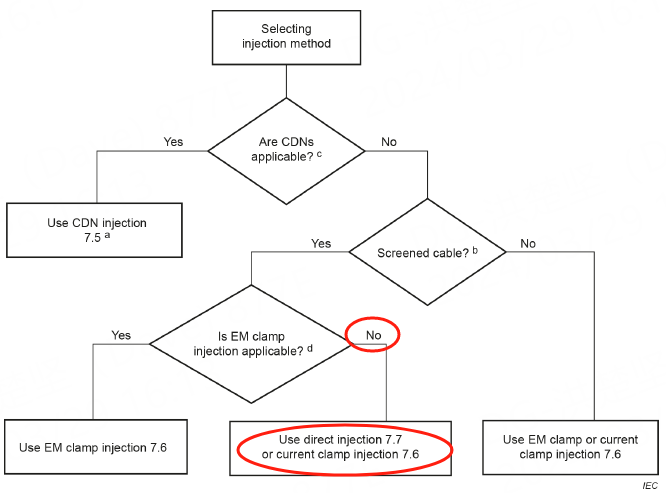
From the above two images, it can be seen that in the absence of a suitable CDN selection, there will be the following differences:
——For shielded wires, when EM clamp testing is not suitable, direct injection method or current injection method can be chosen, which has more options than the old version for current injection method;
——For shielded wires, when suitable for EM clamp testing, the new version can use EM clamp testing, while the old version needs to check whether the AE end meets the 150 Ω system impedance, and then decide on the specific testing method for using EM clamp or Current clamp;
——For unshielded wires, the new version chooses to use electromagnetic clamps or current clamps; The old version requires checking whether the AE end meets the 150 Ω system impedance, and then deciding on the specific testing method for using the EM clamp or Current clamp.
b. Updated amplifier saturation check method
In conducting anti-interference tests, the amplifier needs to be tested in an unsaturated state. The 2023 version of the standard has updated the method for confirming saturation, as follows:
1) Determine, across all used coupling devices, the highest forward power P formax required during the level-setting process at each frequency step.
2) For each frequency, repeat the following steps:
i) Set the output level of the power amplifier to P formax;
ii) Increase the control level of the RF signal generator by 5.1 dB;
iii) Record the new forward power P formax, inc
iv) if the difference P formax,inc-P formax is between 3,1 dB and 7,1 dB for all frequency steps, then the amplifier is in tolerance and the test system is sufficient for testing at the selected test level. If the difference is less than 3,1 dB or more than 7,1 dB then the amplifier is non-linear and is not suitable for testing.
Alternatively, the saturation verification program mentioned above can be directly included in the level setting process of each CDN.
c. Attachment H has been changed to: Multi signal testing
The addition of multi signal testing applications is aimed at shortening testing time for products that require testing with multiple signals.
But!! But!! But!! If multiple signal instruments test and the test result fails, the final result of a single signal test shall prevail.
Have you gained some understanding of the 2023 version update after reading the above information?
BTL has now completed the study of the new standard BS EN IEC 61000-4-6 2023 and has the ability to test it. If you want to learn more inquiries, you can contact us ! ! !
Relevant information

EU Releases Exemption Guidelines on Removability and Replaceability of Portable and LMT Batteries — Multiple Product Categories Relief Granted
On July 14, 2026, the European Commission published the "Commission Guidelines to Facilitate the Harmonised Application of Provisions on the Removability and Replaceability of Portable and Light Means of Transport (LMT) Batteries" (Commission Notice C(2026) 5032 final). These guidelines aim to provide a uniform interpretative framework for the implementation of Article 11 of the EU Battery Regulat

6G Developments: Past, Present and Future
The formulation of 6G standards has entered a more concrete phase. At the 3GPP RAN Plenary Meeting held in Singapore in June 2026, the industry made progress in multiple key research areas and finalized the timeline for Release 21, which is regarded as the first standard version expected to formally define 6G.

Overview of EN IEC 61000-4-29:2026
The key focus of the 2026 edition is to address new DC power distribution environments, especially higher-voltage DC systems. It also clarifies test generator capability, duration tolerance, current limitation during short interruptions, inrush current verification, result evaluation, and test report requirements. For products using 24 Vdc, 48 Vdc, 380 Vdc, 400 Vdc, 800 Vdc, or other DC input pow