

Safety Information: How does USB (Type-C) PD3.1 output exceeding LPS/PS2 comply with IEC 62368-1 requirements?
The USB Type-C interface has been widely adopted across various electronic devices, including smartphones, tablets, computers, and monitors. The Type-C interface delivers excellent performance in data transfer, display output, and fast charging. In terms of fast charging, with the continuous updates to USB PD, the new USB PD3.1 fast charging standard supports a maximum voltage output of 48V, with charging power increasing to 240W.
When USB PD protocol transitioned from version 3.0 to USB PD 3.1, shifting from SPR (100W) @ 20V max to EPR (240W) @ 48V max, the safety requirements for USB output also changed. Previously, USB outputs were required to comply with LPS/PS2 power limits (<100W). However, in EPR mode, the power supply can normally exceed 100W. As a result, starting from USB PD 3.1, USB can no longer be regarded as a guaranteed "limited power source." This means that powered devices (PD) connected downstream must be designed with fire-resistant enclosures (unless they are limited to operating in SPR mode). This change is due to the fact that the power-supplying equipment (PSE) in EPR mode operates as a dynamically varying voltage source, no longer constrained to below 100W.
This technological evolution introduces certain contradictions and challenges to fire safety requirements. To address these issues, the IECEE Safety Technical Committee (IEC/TC 108) issued a new resolution, 108/832/INF, aimed at providing rapid solutions to mitigate the risk of fire in EPR mode. Industry experts conducted an analysis of the USB PD protocol against a functional safety communication standard (IEC 61784-3). This evaluation included the following eight common communication errors / failure modes:
1. Message corruption
2. Unintended repetition of a message
3. Incorrect message sequence
4. Message loss
5. Unacceptable delay of message
6. Message insertion
7. Message masquerade
8. Incorrect address
This primarily focuses on evaluating the communication protocol complying with a functional safety and validation test, ensures the provision of EPR power and the handling of EPR receivers when operating in EPR mode, while also implementing adequate protective measures to prevent faults and mitigate fire risks. Furthermore, it ensures that in non-EPR mode, the power transmission between the power supply and receiver is maintained below 100W.
Power Source vs Powered Device and need for Powered Device fire enclosure:
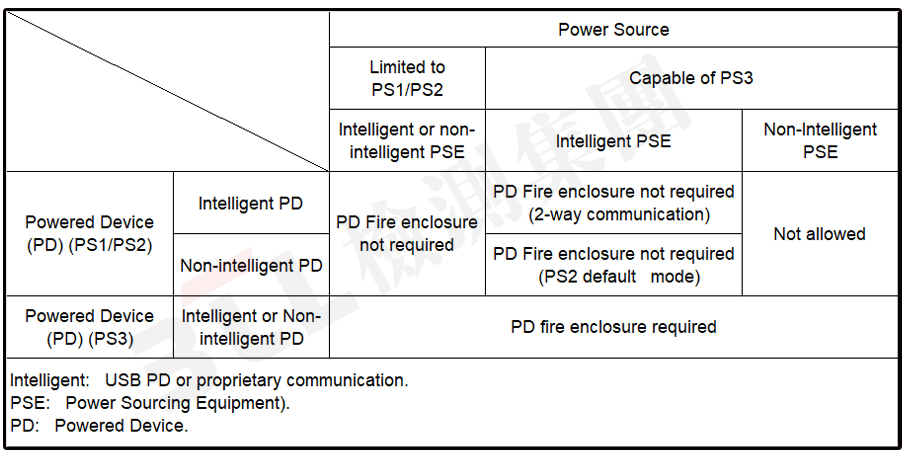
Regarding the recent popular requirements related to USB Type-C, this article mentions the IECEE (TC 108/832/INF) Functional Safety and the upcoming EU Common Charger Directive, which will be mandatory.
BTL currently utilizes the latest USB-IF Association-approved testing equipment (GRL-USB-PD-C2-EPR). This enables BTL to provide comprehensive testing services to a wide range of manufacturers and issue recognized certification reports, offering customers a faster, and one-stop solution platform.
Relevant information

EU Releases Exemption Guidelines on Removability and Replaceability of Portable and LMT Batteries — Multiple Product Categories Relief Granted
On July 14, 2026, the European Commission published the "Commission Guidelines to Facilitate the Harmonised Application of Provisions on the Removability and Replaceability of Portable and Light Means of Transport (LMT) Batteries" (Commission Notice C(2026) 5032 final). These guidelines aim to provide a uniform interpretative framework for the implementation of Article 11 of the EU Battery Regulat

6G Developments: Past, Present and Future
The formulation of 6G standards has entered a more concrete phase. At the 3GPP RAN Plenary Meeting held in Singapore in June 2026, the industry made progress in multiple key research areas and finalized the timeline for Release 21, which is regarded as the first standard version expected to formally define 6G.

Overview of EN IEC 61000-4-29:2026
The key focus of the 2026 edition is to address new DC power distribution environments, especially higher-voltage DC systems. It also clarifies test generator capability, duration tolerance, current limitation during short interruptions, inrush current verification, result evaluation, and test report requirements. For products using 24 Vdc, 48 Vdc, 380 Vdc, 400 Vdc, 800 Vdc, or other DC input pow