

Announcement: Taiwan BSMI to Revise Inspection Regulations for Products Such as "Power Banks and Lithium Batteries"
Recently, the Bureau of Standards, Metrology and Inspection (BSMI), Ministry of Economic Affairs, Taiwan held an explanatory meeting on amending the relevant inspection regulations for 13 items including "secondary lithium power banks" and 1 item of information products, as well as incorporating "secondary lithium battery packs for non-power use in road vehicles" into the scope of mandatory inspection. At the same time, it released the implementation draft for relevant products (including lithium-based battery cells/battery packs, power banks, energy storage batteries, battery chargers, secondary lithium battery packs for non-power use in road vehicles, and charging-related equipment, etc.).
The main changes for secondary lithium battery cells / battery packs, power banks, and battery chargers are as follows:
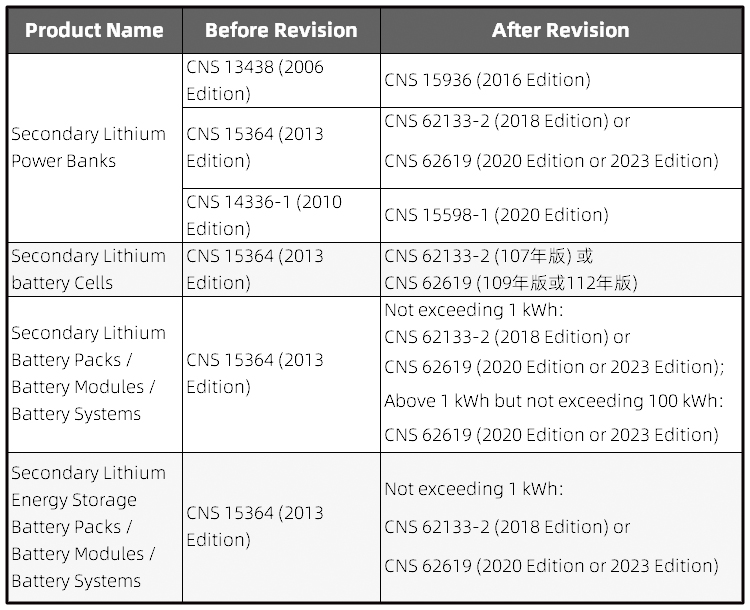
I. Changes in Inspection Standards
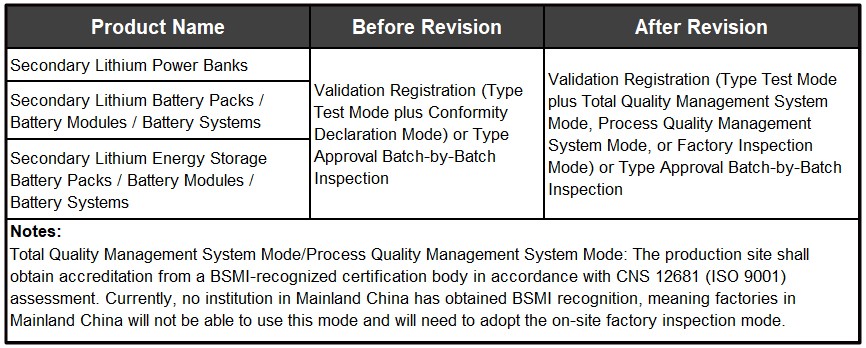
II. Changes in Inspection Methods
III. Other Changes
1. For secondary lithium batteries adopting CNS 62133-2, test reports on transportation safety requirements (CNS 16080 (2019 Edition) or UN 38.3) from ILAC-MRA accredited laboratories, IAF-MLA accredited laboratories, or IECEE accredited test organizations will be accepted. This relaxes the previous requirement of only accepting UN 38.3 test reports from TAF accredited laboratories.
2. Battery chargers will no longer be limited to 3C battery chargers converting AC to DC; DC input or AC output chargers may be included in mandatory inspection control.
3. It is expected that the previous (old) standards before revision will cease to apply on July 1, 2027. That is, from July 1, 2027, applications can only be made in accordance with the revised (new) inspection standards.
4. After the official announcement, applications can be submitted in accordance with the revised inspection standards. For certificates applied for before July 1, 2027, their validity period will be three years from July 1, 2027. Certificates obtained in accordance with the old standards before June 30, 2026, can be used until the end of their valid period.
5. For those who have obtained CNS 15364 type test reports, the original testing laboratory shall supplement the difference testing and then reissue them as new standard type test reports.
As a designated testing laboratory for BSMI mandatory inspection products, with rich product certification experience, providing customers with a professional and efficient one-stop service platform.
Relevant information

EU Releases Exemption Guidelines on Removability and Replaceability of Portable and LMT Batteries — Multiple Product Categories Relief Granted
On July 14, 2026, the European Commission published the "Commission Guidelines to Facilitate the Harmonised Application of Provisions on the Removability and Replaceability of Portable and Light Means of Transport (LMT) Batteries" (Commission Notice C(2026) 5032 final). These guidelines aim to provide a uniform interpretative framework for the implementation of Article 11 of the EU Battery Regulat

6G Developments: Past, Present and Future
The formulation of 6G standards has entered a more concrete phase. At the 3GPP RAN Plenary Meeting held in Singapore in June 2026, the industry made progress in multiple key research areas and finalized the timeline for Release 21, which is regarded as the first standard version expected to formally define 6G.

Overview of EN IEC 61000-4-29:2026
The key focus of the 2026 edition is to address new DC power distribution environments, especially higher-voltage DC systems. It also clarifies test generator capability, duration tolerance, current limitation during short interruptions, inrush current verification, result evaluation, and test report requirements. For products using 24 Vdc, 48 Vdc, 380 Vdc, 400 Vdc, 800 Vdc, or other DC input pow