

EU ERP Regulation – Complete upgrade of Ecodesign Requirements for External Power Supplies
On 24 November 2025, the European Commission issued the new regulation [ Commission Regulation (EU) 2025/2052 ], establishing unified ecodesign requirements for products such as External Power Supplies (EPS), wireless chargers/wireless charger pads, battery chargers for portable batteries of general use, and USB Type-C cables. The regulation will officially enter into force on 14 December 2028, replacing the old regulation (EU) 2019/1782 and becoming the new market access benchmark for relevant products in the European Union.
I. Scope of Application
The regulation covers the following products across multiple sectors including consumer electronics, office equipment, and smart homes:
1. External Power Supplies (EPS): Including AC-DC and AC-AC power conversion devices for household and office equipment with an output voltage not exceeding 60Vdc or 42.4Vac.
2. Wireless chargers: Devices integrating a power module with a wireless transmission power ≤ 50W.
3. Wireless charger pads: Devices requiring an external power supply (excluding integrated power) with a wireless transmission power ≤ 50W.
4. Battery chargers for portable batteries of general use: EPS products used for charging batteries of general-purpose portable devices.
5. USB Type-C cables: Cables with Type-C connectors at both ends, rated power of 60W or 240W, and compliant with USB-IF Specification Version 2.4.
In addition, the regulation explicitly exempts products for specific scenarios, including Uninterruptible Power Supplies (UPS), power supplies dedicated to medical devices, vehicle-mounted power supplies, and lighting control/driver units, to avoid excessive regulation impacting specific industries.
II. Key Technical Requirements: Comprehensive Upgrade from Energy Efficiency to Interoperability
1. Further Improvement of Energy Efficiency Limits
The regulation sets differentiated energy efficiency standards for products of different types and power levels, with core requirements as follows:
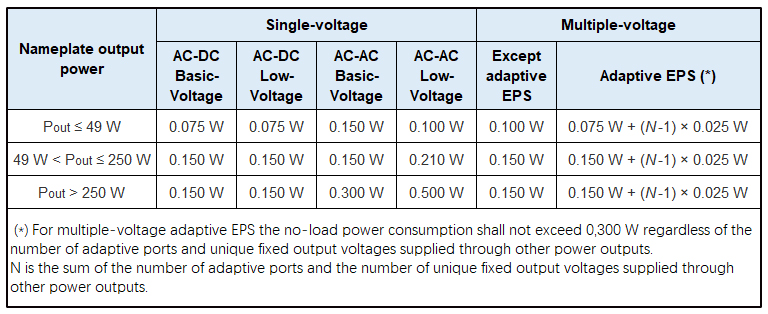
• No-load power consumption limit values for EPS:
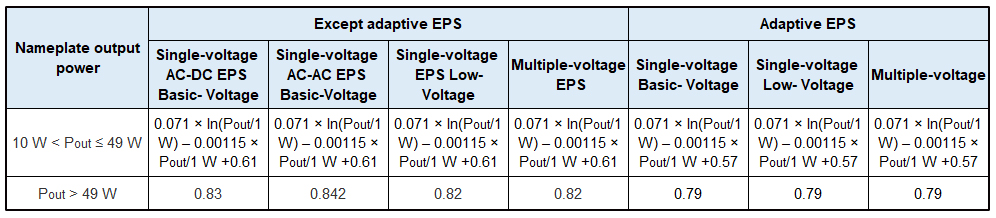
• Low load efficiency limit values for EPS (@10% Load):
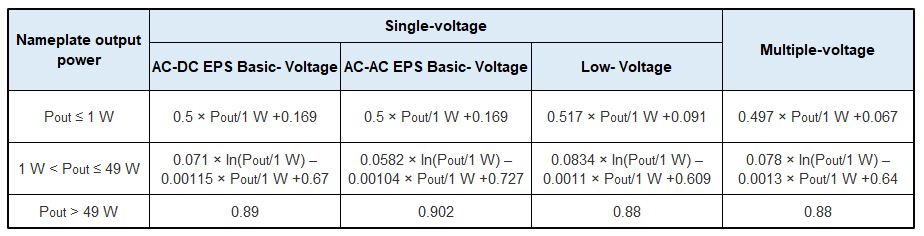
• The average active efficiency limit values for EPS (@ 25%-100% Load):
• Standby Power Consumption of Wireless Chargers:
AC input standby power consumption of wireless chargers ≤ 0.8W;
DC input standby power consumption of wireless charger pads (without EPS) ≤ 0.5W.
2. EPS Output Performance Requirements
• For power output ports other than USB Type-C or USB-PD, the output voltage shall not be lower than 90% of the rated voltage indicated on the nameplate under specified load conditions (10% - 100%). • For USB Type-C or USB-PD power output ports, the output voltage shall not be lower than 95% of the rated voltage indicated on the nameplate under specified load conditions (10% - 100%).
• Interoperable EPS shall have surge resistance, and the output shall still meet the above requirements after surge testing.3. Mandatory Interoperability Requirements for EPS
To promote the popularization of "Common Charger" and reduce electronic waste, eligible external power supplies must meet interoperability requirements:
• Mandatorily equipped with USB Type-C or USB-PD ports, and the maximum output power of the port must be consistent with the product's nominal power;
• Fixed cables for USB Type-C or USB-PD ports are prohibited to avoid premature power supply scrapping due to cable damage;
• Must be marked with the "Common Charger" logo and clearly indicate the maximum supported power of the port to facilitate consumers in identifying compatible devices;
• Exemption conditions for interoperability include:
Power supplies with output power > 100W, voltage > 48V or ≤ 4.5V, PoE injectors, charging docks, and devices dedicated to humid environments.
4. Standardization of Information Labeling and Technical Documentation
• EPS nameplates must indicate key parameters such as output power, voltage, and total maximum output power; dynamic power supplies must specify "continuous output power".
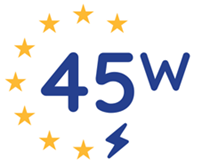
• Common chargers must display the Common Charger logo on their nameplates or housings, packaging, and instructions (the figure below is only an example for 45W). The height of the logo on the nameplate or housing shall not be less than 5mm, and the height of the logo in other positions shall not be less than 7mm.
• USB Type-C cables must be marked with the applicable rated power ("60W" or "240W") on the plug, with a font height of not less than 1.2mm (for numbers) and 0.6mm (for letters).
• Manufacturers shall disclose product information for 10 years in the product manual or on a freely accessible website, including manufacturer information, model, energy efficiency parameters, and testing methods.
III. Implementation Timeline and Transition Arrangements
• Official Implementation: 14 December 2028, replacing the old regulation (EU) 2019/1782.
• USB-PD power supplies with output power > 100W may continue to comply with the energy efficiency standards of the old regulation until 14 December 2030.
• Power supplies for spare parts may continue to follow the requirements of the old regulation until 14 December 2033.
• From 14 December 2025 to 14 December 2028, products complying with the new regulation shall be deemed automatically compliant with the old regulation.
IV. Industry Impact and Compliance Recommendations
The implementation of this regulation will have a profound impact on the power supply and charging equipment industry: Enterprises need to accelerate product design iterations, make early arrangements, prioritize the adoption of USB-C/PD interface solutions, optimize power supply topologies to improve energy efficiency, and improve technical documentation and labeling systems.
As a laboratory with years of experience in the industry, BTL holds testing and certification qualifications including ERP, DOE, CEC, NRCan, and MEPS, providing customers with a one-stop service platform.
Relevant information

EU Releases Exemption Guidelines on Removability and Replaceability of Portable and LMT Batteries — Multiple Product Categories Relief Granted
On July 14, 2026, the European Commission published the "Commission Guidelines to Facilitate the Harmonised Application of Provisions on the Removability and Replaceability of Portable and Light Means of Transport (LMT) Batteries" (Commission Notice C(2026) 5032 final). These guidelines aim to provide a uniform interpretative framework for the implementation of Article 11 of the EU Battery Regulat

6G Developments: Past, Present and Future
The formulation of 6G standards has entered a more concrete phase. At the 3GPP RAN Plenary Meeting held in Singapore in June 2026, the industry made progress in multiple key research areas and finalized the timeline for Release 21, which is regarded as the first standard version expected to formally define 6G.

Overview of EN IEC 61000-4-29:2026
The key focus of the 2026 edition is to address new DC power distribution environments, especially higher-voltage DC systems. It also clarifies test generator capability, duration tolerance, current limitation during short interruptions, inrush current verification, result evaluation, and test report requirements. For products using 24 Vdc, 48 Vdc, 380 Vdc, 400 Vdc, 800 Vdc, or other DC input pow