

Since the release of EN 301 908-13 V13.1.1 in 209/11, there are still two items in the current ETSI work item schedule that are yet to be completed, which are respectively delivered to the European Community and the time quoted by the OJ to be determined. Refer to the website
https://portal.etsi.org/webapp/workProgram/Report_Schedule.asp?WKI_ID=50585
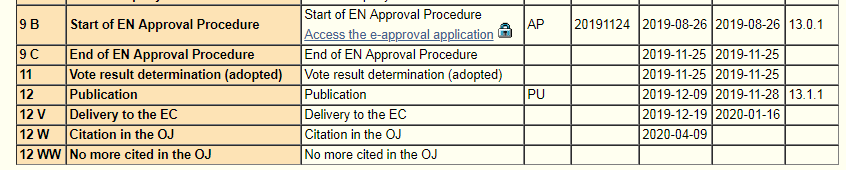
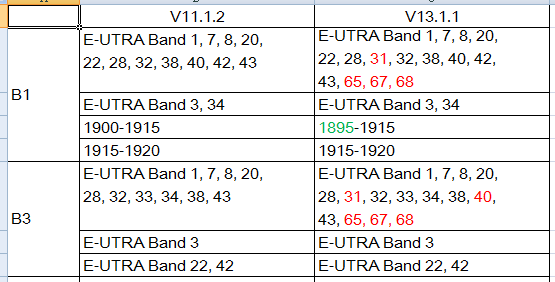
We Shared the changes of draft version of EN 301 908-13 in the early stage. Although the progress of V13.1.1 has not been completed by OJ, our mobile communication department shares the differences between the two versions of V11.1.2 & V13.1.1 on E-UTRA in the spirit of diligent and inquisitive study
Single Carrier
1. added B31(452.5~457.5MHz), B65(1920-2010MHz), B68(698-728MHz) for all TX Characteristics test items.
2. Changed B28 from UL: 703~748 MHz to UL: 703~736 MHz
3. added/Changed Spurious emission Co-existence DL band ,for example B1,B3
Carrier Aggregation (CA)
1. added intra-band contiguous CA_8B for all test items.
2. added Inter-band CA bands (two bands)
CA_1-46 , CA_3-46 ,CA_7-46 ,CA_42-46 ,CA_20-67 for Receiver test items.
3. added uplink inter-band CA (two bands) for all TX Characteristics test items.
CA_1A-3A , CA_1A-5A , CA_1A-7A , CA_1A-8A , CA_1A-28A , CA_1A-42A ,
CA_3A-5A , CA_3A-7A , CA_3A-8A , CA_3A-20A ,
CA_7A-20A , CA_7A-28A
4. Spectrum emission mask
4.1 added RB allocation (50RB+75RB )
4.2 Changed and detailed ΔfOOB range , added test limit
Receiver Characteristics
1. Receiver Blocking Characteristics
1.1 Added Carrier Aggregation in DL-only bands added B46 (DL)
1.2 Added Out-of-band blocking for inter-band carrier aggregation with band 46
CA_1A-46A, CA_2A-46A, CA_3A-46A, CA_4A-46A,
CA_7A-46A, CA_41A-46A, CA_42A-46A
2. Receiver Intermodulation & Receiver Spurious Emissions in DL-only bands
Added Carrier Aggregation in DL-only bands added B46 (DL)
3. Receiver Reference Sensitivity Level
3.1 Added Single Carrier b31 & b65
3.2 Added Inter-band Carrier Aggregation in DL-only bands
CA_1A-46A,CA_3A-46A,CA_7A-46A,CA_20A-32A,CA_42A-46A
Relevant information

CRA Implementation Enters a Critical Phase
In August 2026, preparations for the implementation of the EU Cyber Resilience Act (CRA) entered a critical stage. With the reporting obligations set to take effect on September 11, 2026, drawing near, the European Commission and the European Union Agency for Cybersecurity (ENISA) have been intensively issuing implementation guidance and materials related to the single reporting platform.
Canada's ISED Officially Releases RSS-310 Issue 6: Major Updates to Radio Frequency Equipment Requirements
Innovation, Science and Economic Development Canada (ISED) has formally issued RSS-310, Issue 6, “Licence-Exempt Radio Apparatus: Category II Equipment,” replacing Issue 5, which has been in effect since 2020