

Technical Requirements Update of MIC WLAN in Japan
On July 11, 2019, Japanese MIC issued a decree updating the technology of WLAN.
There are three main points:
1. Expanding Operating Range of W56
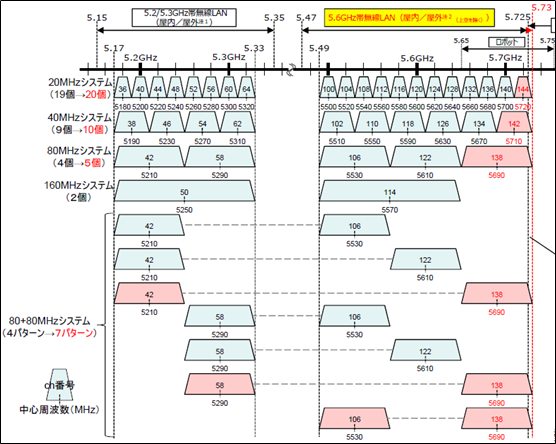
In order to alleviate the congestion of W56 channel and improve the utilization of high-speed WLAN, the operation range of W56 is expanded from 5725 MHz to 5730 MHz.
After the range is expanded, the available channel increases:
CH144 (20MHz system), CH142 (40MHz system), CH138 (80MHz system). The combination of 80 + 80MHz systems has also increased, and the number of channels for high-speed communication (80/160/80 + 80MHz system) has increased to 1.5 times the previous number.
2. Importing the IEEE 802.11ax
In order to improve the transmission speed of WLAN system, the IEEE 802.11ax is imported. Compared with 11ac, 11ax can increase throughput at least four times.
When 11ax was imported, the technical requirements were revised. The main change was OBW:
2.4G band OBW Limit is revised as follows:
For 20MHz system, there is no change, Limit is still 26MHz.
For 40MHz system, Limit is revised from 38MHz to 40MHz.
5G band OBW Limit is revised as follows:
19.7MHz → 20MHz (20MHz system)
38MHz → 40MHz (40MHz system)
78MHz → 80MHz (80MHz system)
158MHz → 160MHz (160MHz system)
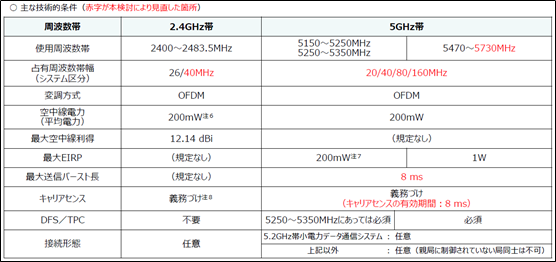
Other amendments:
a. Transmission Burst Length of 5GHz band is modified to 8ms (original Limit is 4ms).
b. Carrier Sense Capability in 5GHz band adds Limit to 8ms.
3. W53 DFS Testing Requirements Increased
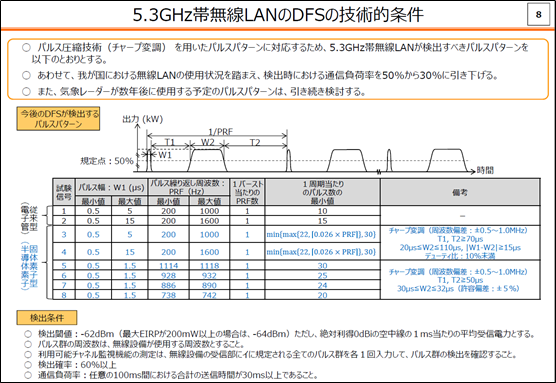
In order to share the frequency with meteorological radar in 5.3 GHz band WLAN and adapt to the changing trend of meteorological radar technology, a new W53 DFS test requirement is added.
The main changes are as follows:
a. The throughput decreased from 50% to 30%.
b. Radar type has been increased from 2 to 8. Radar parameters are detailed in the following figure.
c. The detection probability is consistent with the previous requirements, which should be more than 60%.
The transition period between the new version and the old version is one year, from July 11, 2019 to July 10, 2020 to July 10, 2020. On July 10, 2020, the new version will be enforced.
Relevant information

EU Releases Exemption Guidelines on Removability and Replaceability of Portable and LMT Batteries — Multiple Product Categories Relief Granted
On July 14, 2026, the European Commission published the "Commission Guidelines to Facilitate the Harmonised Application of Provisions on the Removability and Replaceability of Portable and Light Means of Transport (LMT) Batteries" (Commission Notice C(2026) 5032 final). These guidelines aim to provide a uniform interpretative framework for the implementation of Article 11 of the EU Battery Regulat

6G Developments: Past, Present and Future
The formulation of 6G standards has entered a more concrete phase. At the 3GPP RAN Plenary Meeting held in Singapore in June 2026, the industry made progress in multiple key research areas and finalized the timeline for Release 21, which is regarded as the first standard version expected to formally define 6G.

Overview of EN IEC 61000-4-29:2026
The key focus of the 2026 edition is to address new DC power distribution environments, especially higher-voltage DC systems. It also clarifies test generator capability, duration tolerance, current limitation during short interruptions, inrush current verification, result evaluation, and test report requirements. For products using 24 Vdc, 48 Vdc, 380 Vdc, 400 Vdc, 800 Vdc, or other DC input pow