

Interpretation|The new version of the IEC standard for electrostatic testing has stricter requirements for electrostatic gun calibration
The IEC electrostatic standard has not been updated for more than ten years, and there are still some changes in the overall layout compared to the previous version. Follow me to learn about the changes that need to be focused on:
Table 2 - General ESD generator parameters
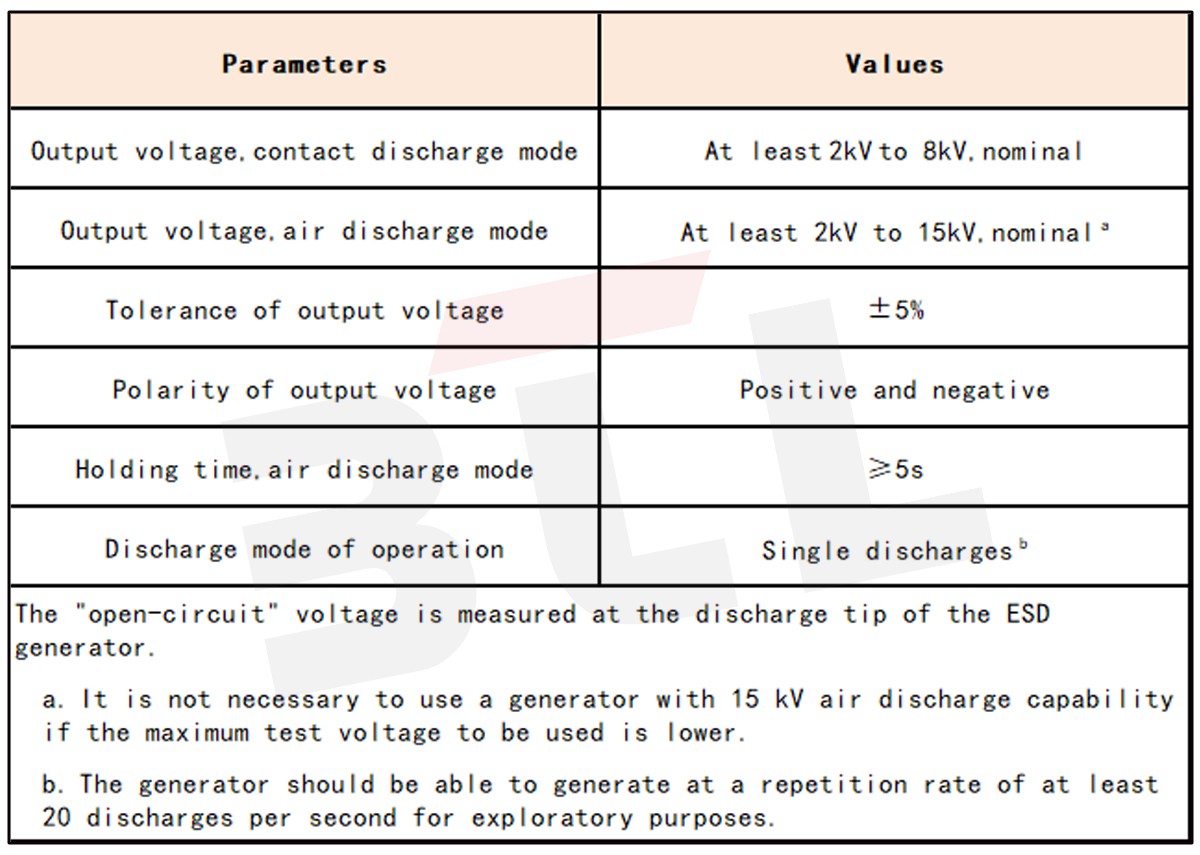
Table 3 Discharge current waveform parameters
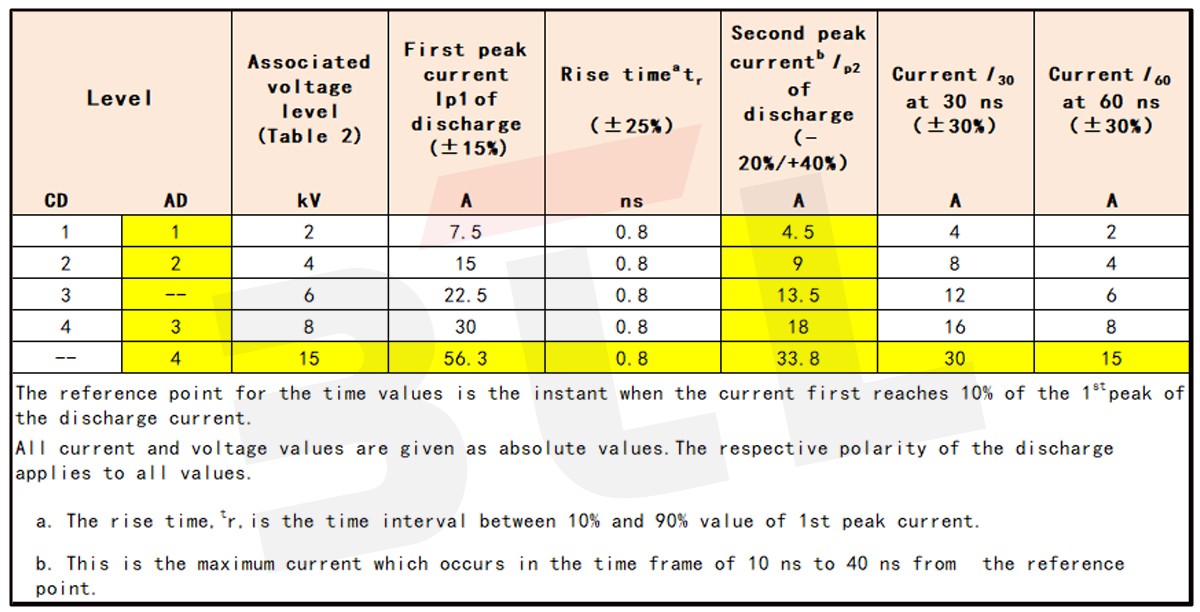
Observant you should have already noticed:
The contact discharge in Table 2 has been updated from 1 kV to 2 KV at least initially;
The yellow section in Table 3 has added calibration requirements for ESD generators with air discharge tips;
It can also be seen from Table 3 that for electrostatic guns supporting up to 15 kV, 15 kV waveform calibration is required.
Take a look at the waveform diagram of the 4 kV calibration current for electrostatic contact discharge in the new standard:
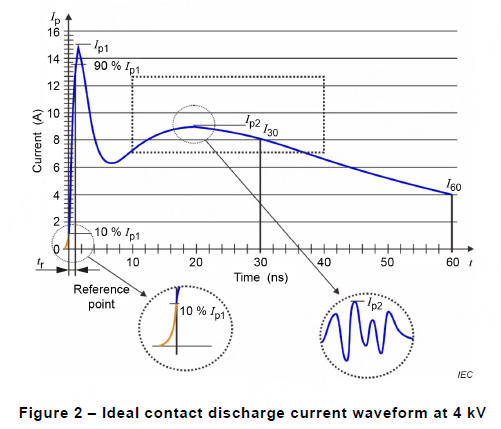
At the same time, some updates have been made to the current calibration program;
Of course, for the open circuit output voltage, it is necessary to measure the open circuit output voltage of the ESD generator when the discharge switch is closed and meet the requirements of Table 2.
Measurement steps for current waveform parameters of ESD generator:
1. Record the waveform of five discharges (five positive and five negative polarity).
2. Measure the following parameters (see Figure 2 and Table 3) and ensure that each value is within the allowable range:
Ip1: First peak current (A)
Ip2: Second peak current (A)
I30: Current at 30 ns after discharge (A)
I60: Current at 60 ns after discharge (A)
TR: Current rise time (ns)
3. At least one waveform of 8 kV positive polarity contact discharge should be included in the calibration report.
The measurement of Ip2 points has been added to the calibration program, and the 2025 standard emphasizes that at least one waveform of 8 kV positive polarity contact discharge should be included in the report.
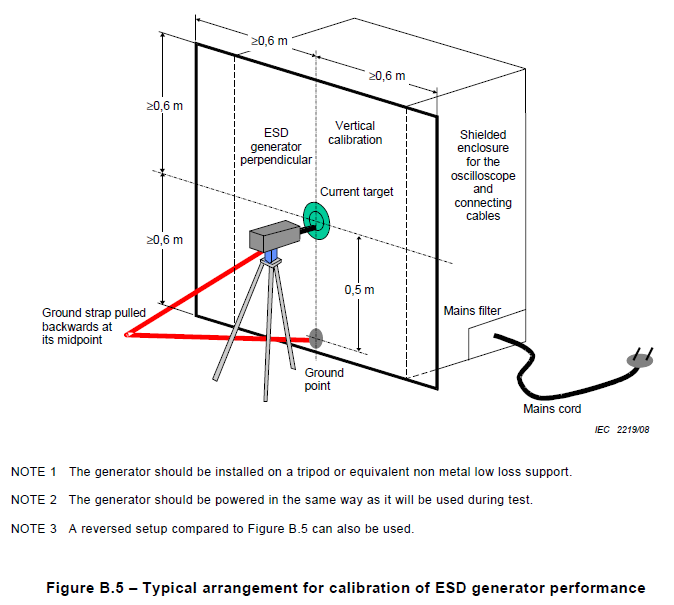
Let's compare some changes in the calibration target board configuration between the 2025 and 2008 versions:
IEC 61000-4-2:2025
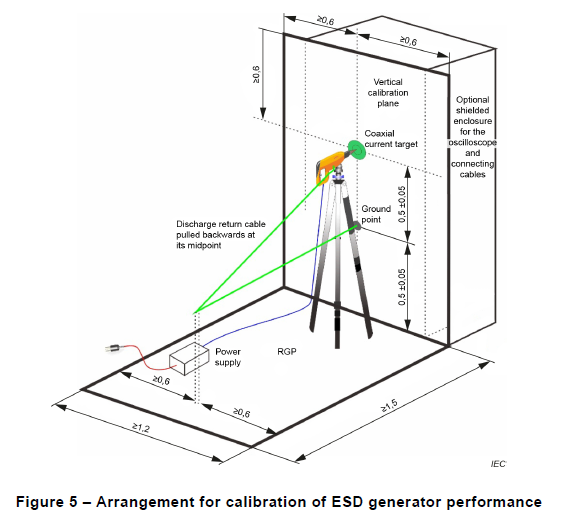
IEC 61000-4-2:2008
The new version has added normative attachments for specific equipment testing devices
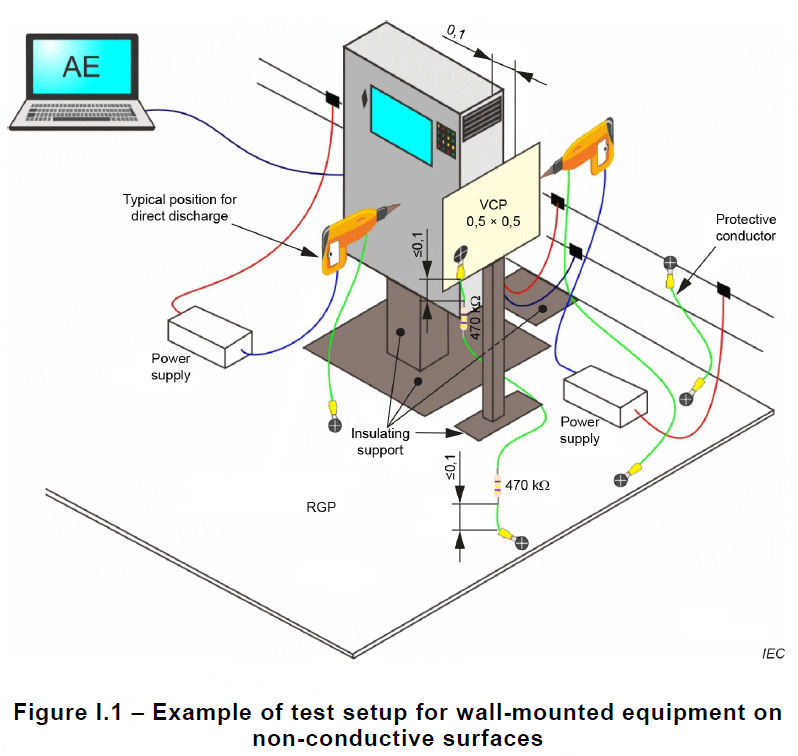
Small wall mounted EUTs; When EUT<(0.5*0.5) m, the center of VCP should be located at the center of both sides of EUT.
Wall mounted equipment should be installed on walls without conductive structures or embedded in walls, and should be set up according to the example shown in Figure I.1;
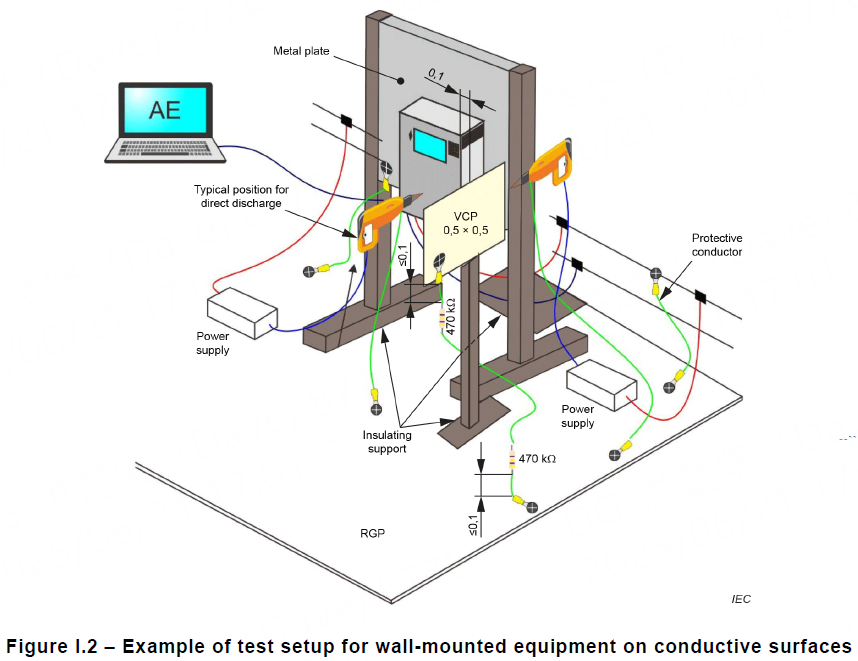
NOTE A Similar insulation brackets can be used, but without metal plates, as shown in Figure I.2.
If the EUT is intended to be installed on a conductive surface, the test setup is shown in Figure I.2,the size of the metal in Figure I.2 should exceed the EUT by at least 0.5 m in all directions.
Other differences between IEC 61000-4-2 2025 and the previous version:
Added an informative annex on how to select test points and give guidance on how to specify the number of pulses for direct contact discharges (see Annex E);
Moved Clause 9 into a new informative annex (see Annex K);
Improved measurement uncertainty considerations with examples of uncertainty budgets;
Moved post-installation tests into a new informative Annex G since they cannot be performed in a controlled environment.
The editor will tell you a secret:
The electrostatic guns at the two BTL static testing sites in southern China can support a testing strength of 30kV, which is sufficient to meet most standard testing requirements; BTL has been deeply involved in the testing industry for many years and has rich experience. In the South China region, it has a well-defined EMC engineering team with dedicated installation personnel, project evaluation management personnel, and on-site testing personnel, achieving greater professionalism, meticulousness, and efficiency; And the venue resources are abundant, with multiple complete sets of EMC equipment.
If you want to learn more about EMC related issues, you can call us for consultation. We are enthusiastic to answer your questions and welcome your call
Relevant information

EU Releases Exemption Guidelines on Removability and Replaceability of Portable and LMT Batteries — Multiple Product Categories Relief Granted
On July 14, 2026, the European Commission published the "Commission Guidelines to Facilitate the Harmonised Application of Provisions on the Removability and Replaceability of Portable and Light Means of Transport (LMT) Batteries" (Commission Notice C(2026) 5032 final). These guidelines aim to provide a uniform interpretative framework for the implementation of Article 11 of the EU Battery Regulat

6G Developments: Past, Present and Future
The formulation of 6G standards has entered a more concrete phase. At the 3GPP RAN Plenary Meeting held in Singapore in June 2026, the industry made progress in multiple key research areas and finalized the timeline for Release 21, which is regarded as the first standard version expected to formally define 6G.

Overview of EN IEC 61000-4-29:2026
The key focus of the 2026 edition is to address new DC power distribution environments, especially higher-voltage DC systems. It also clarifies test generator capability, duration tolerance, current limitation during short interruptions, inrush current verification, result evaluation, and test report requirements. For products using 24 Vdc, 48 Vdc, 380 Vdc, 400 Vdc, 800 Vdc, or other DC input pow