

Summary of Major Changes in the new Version(9.0) ENERGY STAR Product Specification for Computers
In early 2025, the U.S. Environmental Protection Agency (EPA) officially released the ENERGY STAR Computer Specification Ver 9.0. The transition period has recently ended; starting from October 27, 2025, all computers must undergo ENERGY STAR certification in accordance with the Ver 9.0 Specification. Certificates of the previous version (Ver 8.0) can no longer be used for ENERGY STAR certification, and only products complying with the Ver 9.0 Specification will be included in EPA's certified product list.
I. Updates to Product Definitions
1. Addition of the Ruggedized Notebook category
Ruggedized Notebook category: Must meet the military environmental standards MIL-STD 810H or IEC 60529 IP66 (for dust and water resistance) and include multiple expansion slots.
2. Enhanced ISV Certification for Workstations
• The number of Independent Software Vendor (ISV) certifications required has increased from 2 to 4, covering professional workflow scenarios such as architectural design, engineering technology, computer-aided design (CAD), product development, financial applications, and scientific applications. The completion timeframe has been extended from 3 months to 6 months.
• Explicitly requires hardware support for an "error correction mechanism," covering the CPU, interconnections, and system memory.
3. Adjustment to Tablet Screen Threshold
The minimum diagonal size of the screen has been increased from ">6.5 inches" to ">7.0 inches," focusing on portable products with larger screens.
4. Removal of the "Full Network Proxy" Definition
The "Full Network Proxy" definition has been removed and will no longer impact the mode weight selection for any product type in the new version.
II. Optimization of Energy Efficiency and Energy Consumption Calculation Rules
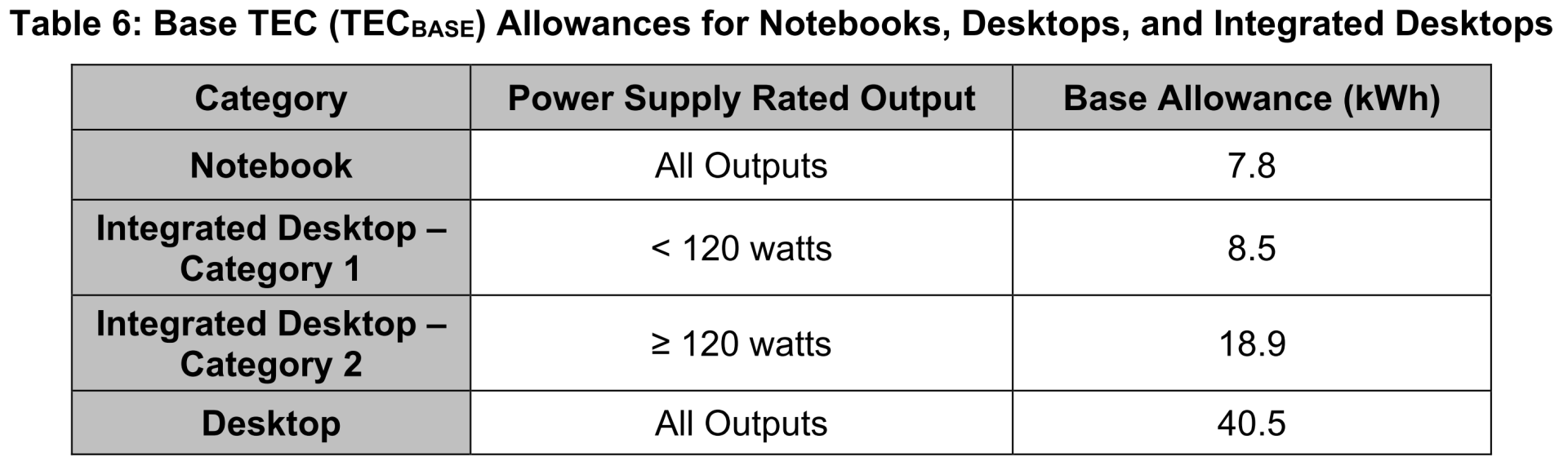
1. Base Allowance (TECBASE) in the table 6
The basic classification for notebooks, all-in-one computers, and desktop computers has been simplified. The complex Performance Score (P-Value) grading system has been eliminated, and baseline values are now set directly based on device type.
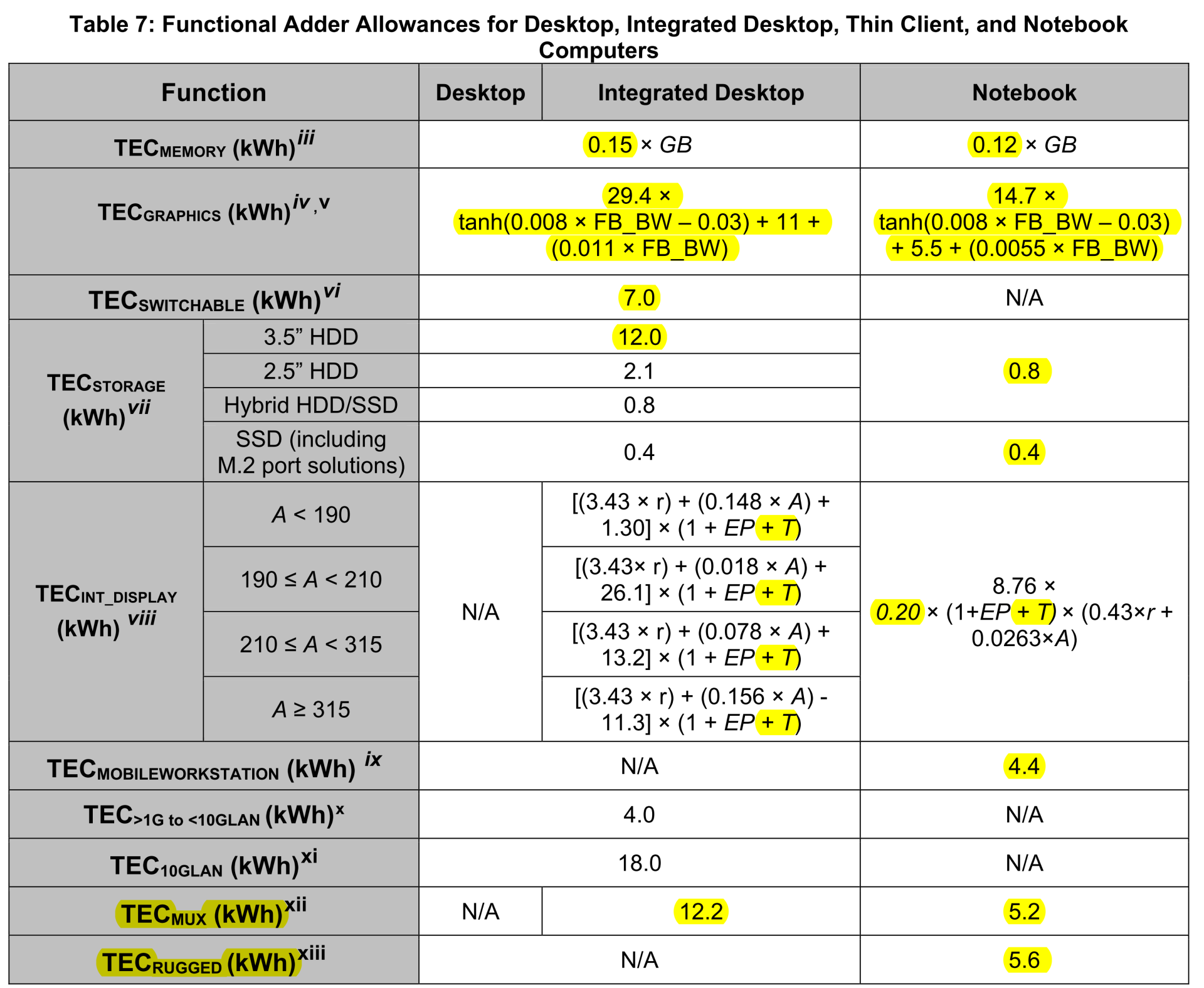
2.Tightening of Function Adders (Adder) in the table 7
• Updated Adders: Memory Energy Adder (TECMEMORY), Discrete Graphics Energy Adder (TECGRAPHICS), Switchable Graphics Adder (TECSWITCHABLE), Storage Energy Adder (TECSTORAGE), Integrated Display Energy Adder (TECINT_DISPLAY), and Mobile Workstation Energy Adder (TECMOBILEWORKSTATION).
• Newly Added Adders: MUX Hybrid Graphics Adder (TECMUX) and Ruggedized Notebook Adder (TECRUGGED).
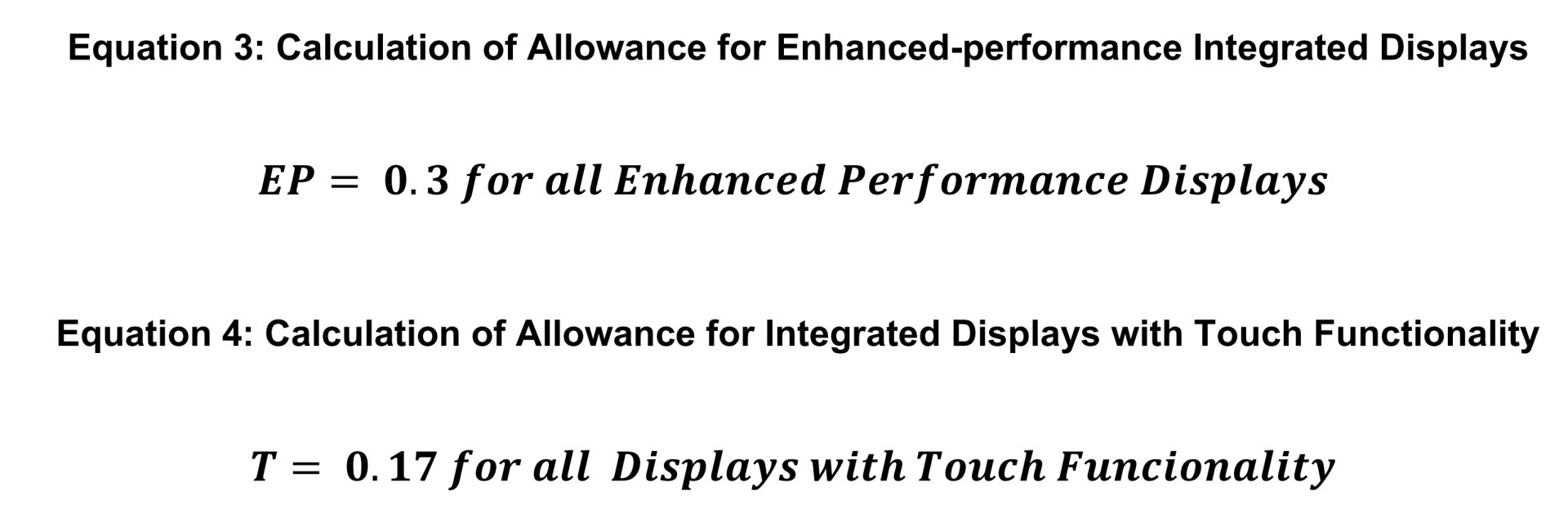
3.Updated the Adder Items of the Integrated Desktop and Notebook
the Enhanced Performance Display allowance calculated per Equation 3 (EP) has been updated, and Added the touch functionality calculated per Equation 4 (T).
4.Full Network Connectivity Weight
The previous "Full Network Proxy" Adder (ALLOWANCEPROXY) has been removed. Full network connectivity is now treated as a basic function by default and no longer affects mode weights.
III. Upgrade of Test Standards
• The referenced test specification for Internal Power Supplies (IPS) has been upgraded to Generalized Internal Power Supply Efficiency Test Protocol Rev. 6.7.2.
• The referenced standard for whole-machine test methods has been upgraded to IEC 62623 Ed. 2.0, 2022-04.
As an EPA-recognized laboratory (ID: 1114519), BTL’s qualifications cover electronic and office equipment such as computers, monitors, televisions, servers, imaging equipment, and telephones. Additionally, we hold North American energy efficiency certification qualifications including those from DOE (U.S. Department of Energy), CEC (California Energy Commission), and NRCan (Natural Resources Canada).
Relevant information

EU Releases Exemption Guidelines on Removability and Replaceability of Portable and LMT Batteries — Multiple Product Categories Relief Granted
On July 14, 2026, the European Commission published the "Commission Guidelines to Facilitate the Harmonised Application of Provisions on the Removability and Replaceability of Portable and Light Means of Transport (LMT) Batteries" (Commission Notice C(2026) 5032 final). These guidelines aim to provide a uniform interpretative framework for the implementation of Article 11 of the EU Battery Regulat

6G Developments: Past, Present and Future
The formulation of 6G standards has entered a more concrete phase. At the 3GPP RAN Plenary Meeting held in Singapore in June 2026, the industry made progress in multiple key research areas and finalized the timeline for Release 21, which is regarded as the first standard version expected to formally define 6G.

Overview of EN IEC 61000-4-29:2026
The key focus of the 2026 edition is to address new DC power distribution environments, especially higher-voltage DC systems. It also clarifies test generator capability, duration tolerance, current limitation during short interruptions, inrush current verification, result evaluation, and test report requirements. For products using 24 Vdc, 48 Vdc, 380 Vdc, 400 Vdc, 800 Vdc, or other DC input pow