

The ITU-T K.21 Recommendation specifies the electrical resistance requirements and testing procedures for telecommunications equipment connected to or installed in customer premises.
The compliance with this suggestion is voluntary. However, the proposal may contain certain mandatory clauses (such as to ensure interoperability or applicability), and when all these mandatory clauses are met, it is considered to meet the requirements of the proposal.
Test items of ITU-T K.21 2022: Lightning voltage, Lightning current, power line induction and/or ground potential rise, Neutral potential rise, Power line contact, Electrostatic discharge test
1. It is necessary to confirm which test numbers in the proposal need to be executed for the product to be tested. Follow the editor to further clarify:
ITU-T K.21 2022 divides test ports into External ports and Internal ports.
1)External port types are defined as common: Symmetric port、Coaxial port、Dedicated feeding port、 Main power port.
Test items applicable to external ports:
Symmetric ports: Lightning voltage、 Lightning current、Power induction and earth potential rise、Mains power contact;
Coaxial port: Llightning voltage and Lightning current;
Dedicated power supply port: Lightning voltage、Lightning current、Power induction and earth potential rise、Mains power contact;
Main power port: Lightning voltage and Neutral potential rise.
By using Table 1, we can help you quickly locate the test numbers that need to be executed for the relevant external ports;
▼ Table 1. Test table applicable to external ports
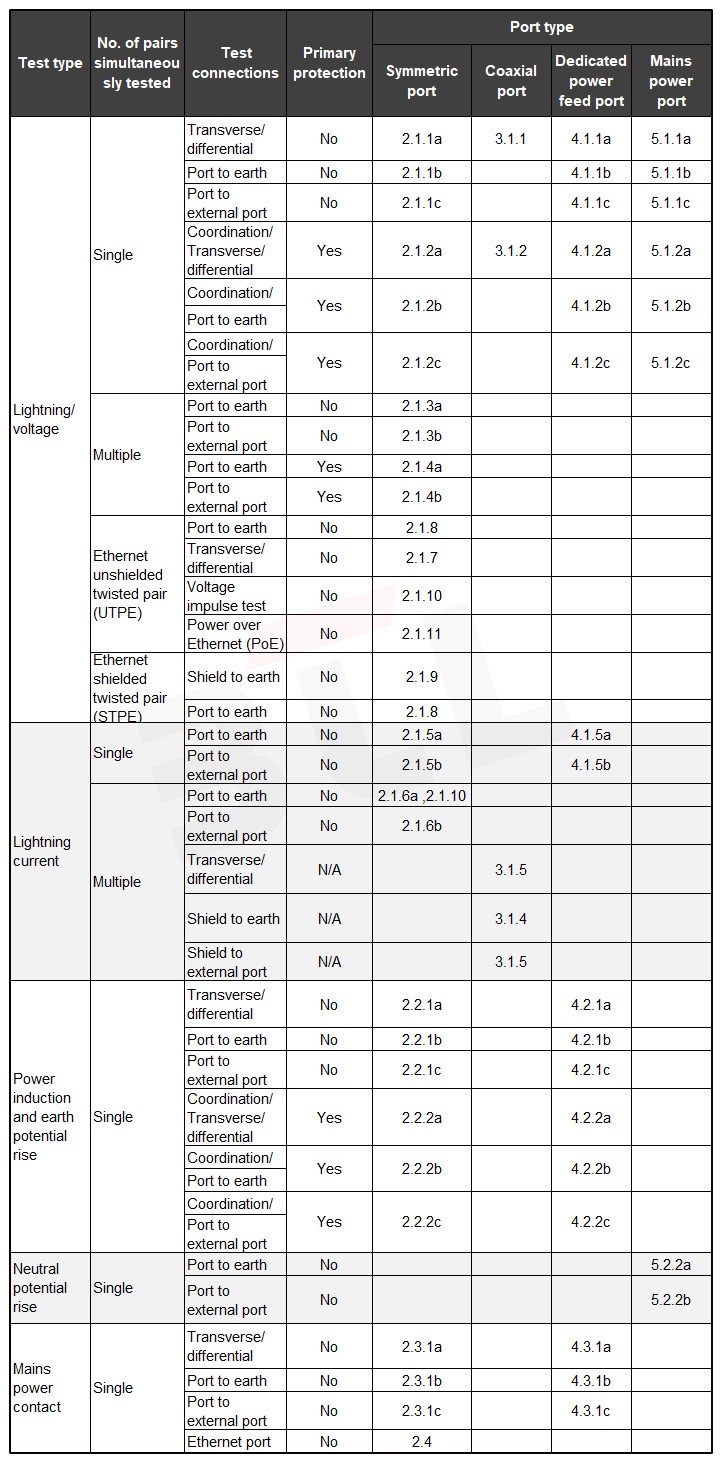
2)Internal port types: Unshielded cable、Shielded cable、PoE feed、DC powered equipment、DC power source;
Internal port applicable test item: Lightning voltage.
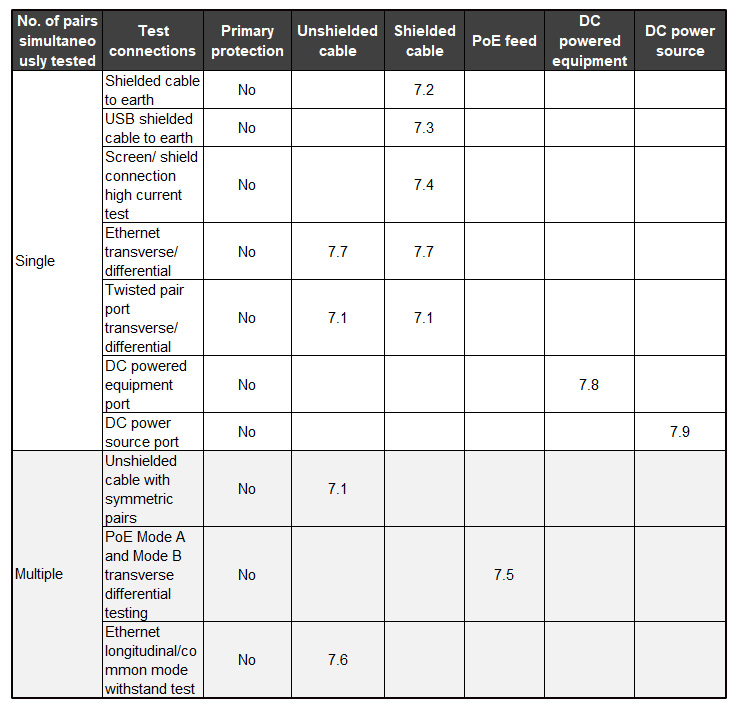
By using Table 2, we can help you quickly locate the test numbers that need to be executed for the relevant internal ports;
▼ Table 2. Lightning Strike Test Conditions for Ports Connected to Internal Cables
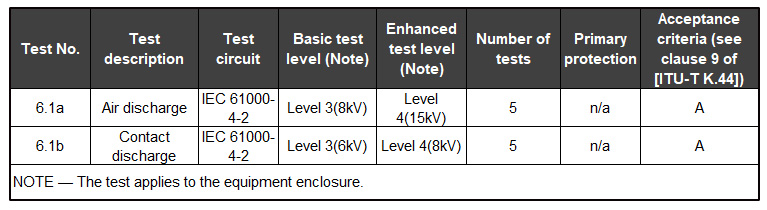
3)Of course, for the overall sample, the electrostatic test in Table 3 is an essential test item in ITU-T K.21 2022:
▼ Table 3. Conditions for conducting electrostatic discharge tests on the casing
2. Then find the corresponding test requirements for the test number in ITU-T K.21 2022. Taking the power port of the sample as an example:
1)Firstly, locate the port type as: main power port. According to Table 1 above,
• Lightning voltage: applicable to 5.1.1a/5.1.1b/5.1.1c/5.1.2a/5.1.2b/5.1.2c;
• Neutral potential rise: 5.2.2a/5.2.2b are applicable.
2)Then find the corresponding test requirement for the test number in ITU-T K.21 2022, as demonstrated in the figure below for the 5.1.1a test number.
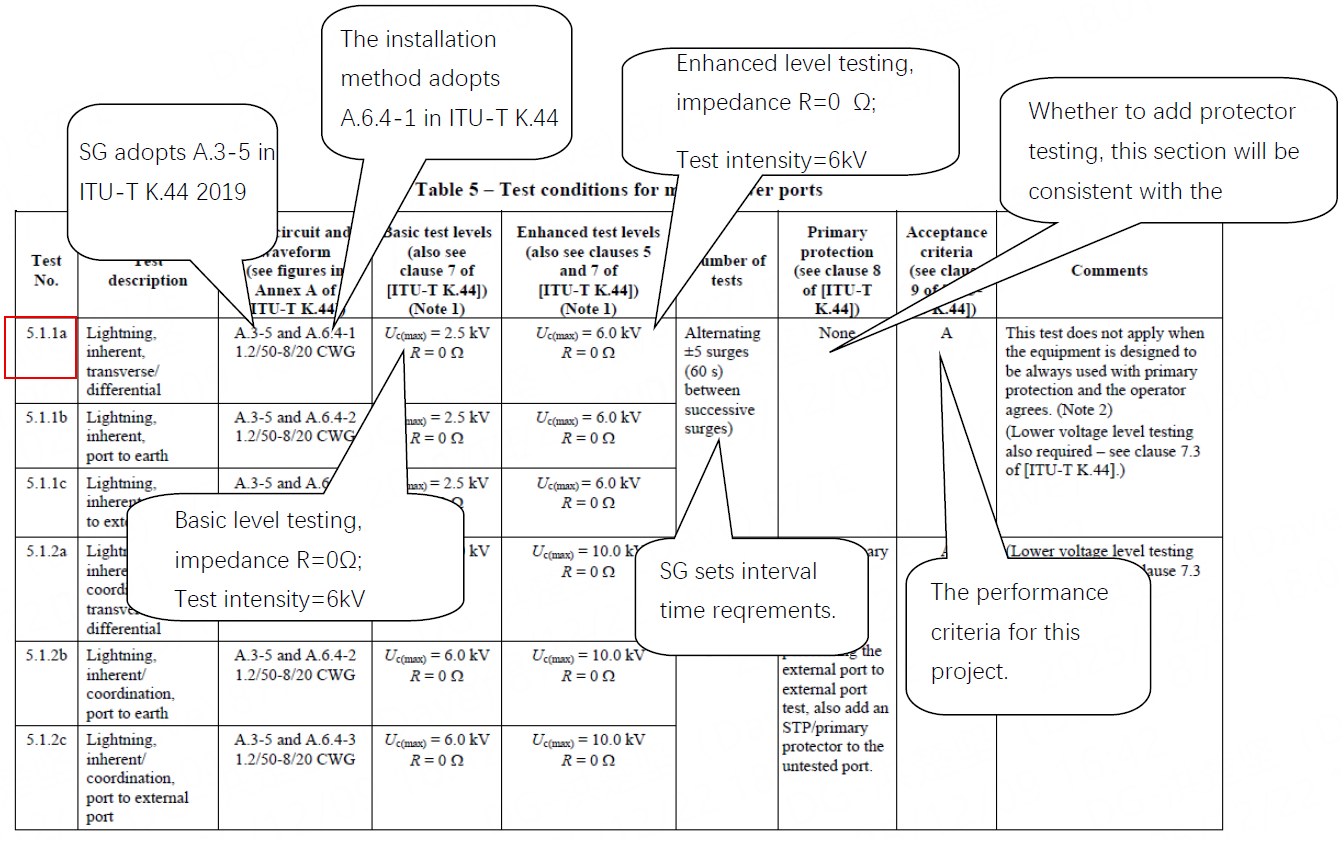
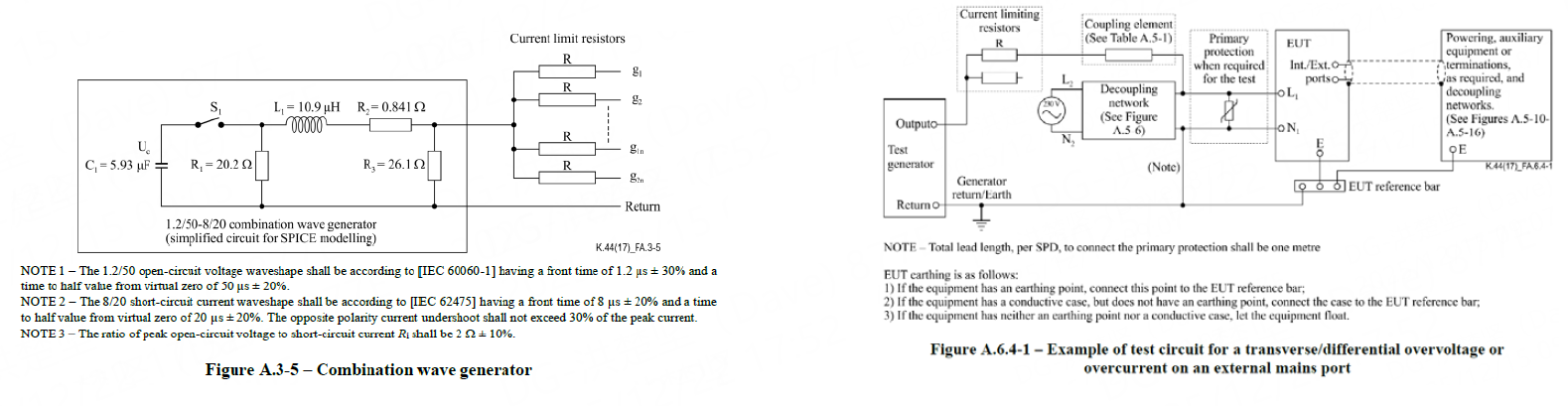
3) Finally, based on the information obtained in 5.1.1a above, it is necessary to confirm Figure A.3-5 and Figure A.6.4-1 in ITU-T K.44 2019, as shown below:
3. Acceptance criteria:
These two acceptance criteria are widely recognized:
Acceptance criteria A:
The equipment shall withstand the test without damage and shall operate within the manufacturer's specified performance limits after the test without an operator or user having to repower the equipment, perform a software or hardware reset or remove printed circuit cards.
The test shall not affect the continuous operation of other hardware and software parts of the equipment, but a temporary degradation of performance is allowed. However, users may need to reinitiate a service, e.g., remake a call or restart a download.
It should be ensured that all components of the equipment (e.g., ports, processor unit, display, wireless local area network (WLAN)) will continue to operate without any constraints after the surge.
The operation of overcurrent protection may temporarily disable the operation of some ports. The service may not become immediately available straight after the protection resets, for example, retraining may need to occur. It is expected that all ports should recover to normal functionality within a reasonable amount of time, from the cessation of the test, and documented by the equipment manufacturer.
If the power contact test is performed without the equipment being powered, it must not affect the test result. After the test, the system shall operate within the specified performance limits.
Acceptance criteria B:
The equipment may be damaged, but tests must not result in a safety hazard; in particular:
If a flame occurs, it shall not propagate beyond the equipment; and
The equipment shall not emit hot materials, e.g., molten metals.
A cheesecloth indicator may be used. In this case, the test shall not damage the structural integrity of the cheesecloth by ignition, charring, forceful ejection of fragments or melted materials into it.
After the above example, I believe you already know that the execution of ITU-T K.21 testing often relies on ITU-T K.44, so these two standards are combined to confirm.
BTL South China has ITU-T K.21 testing capabilities, CNAS and A2LA qualifications, and rich testing experience. In addition, the team has dedicated installation personnel, project evaluation management personnel, on-site testing personnel, and reporting personnel, forming a full process professional service system. There are multiple sets of EMI and EMS venues that can efficiently handle issues and quickly obtain evidence.
To learn more about ITU-T K.21 testing, please feel free to call us for consultation. We are happy to answer your questions and welcome your call!!!
Relevant information

EU Releases Exemption Guidelines on Removability and Replaceability of Portable and LMT Batteries — Multiple Product Categories Relief Granted
On July 14, 2026, the European Commission published the "Commission Guidelines to Facilitate the Harmonised Application of Provisions on the Removability and Replaceability of Portable and Light Means of Transport (LMT) Batteries" (Commission Notice C(2026) 5032 final). These guidelines aim to provide a uniform interpretative framework for the implementation of Article 11 of the EU Battery Regulat

6G Developments: Past, Present and Future
The formulation of 6G standards has entered a more concrete phase. At the 3GPP RAN Plenary Meeting held in Singapore in June 2026, the industry made progress in multiple key research areas and finalized the timeline for Release 21, which is regarded as the first standard version expected to formally define 6G.

Overview of EN IEC 61000-4-29:2026
The key focus of the 2026 edition is to address new DC power distribution environments, especially higher-voltage DC systems. It also clarifies test generator capability, duration tolerance, current limitation during short interruptions, inrush current verification, result evaluation, and test report requirements. For products using 24 Vdc, 48 Vdc, 380 Vdc, 400 Vdc, 800 Vdc, or other DC input pow